Due to the hot weather, some council services may need to change, but the majority of our services are operating as normal. Read our news story for more information.
Introduction
Within Brighton & Hove there is a significant need for affordable housing and the council is committed to maximising provision wherever possible.
This Affordable Housing PAN sets out the council’s preferred approach to securing affordable housing through Section 106 planning agreements. It is based on recently updated evidence about housing needs in the city and changes to national policy.
This Affordable Housing PAN replaces the Council’s previous Affordable Housing Brief (2021).
The Affordable Housing PAN is primarily aimed at planning applicants and Registered Providers, their designers, architects, consultants, and local authority planning officers. It provides guidance on how to implement policy requirements relating to affordable housing.
This PAN has been subject to a focused consultation with local housing providers, developers and agents and will be treated as a material planning consideration in determining planning applications.
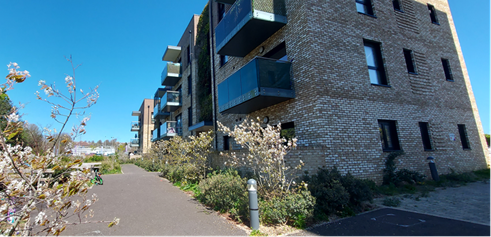
The above image shows an Affordable Housing Scheme with a planted ‘living’ wall. The scheme benefits from a ground source heat pump system to provide heating and hot water, highly insulated homes, solar panels providing electricity for lighting in communal areas of the flats and for external lighting.
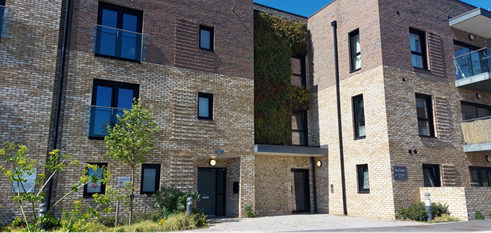
The above image shows the Affordable Housing Scheme’s communal garden of fruit trees and a wildflower lawn area for use by the residents. Other features include bat boxes and bee bricks to encourage biodiversity.
Relevant national and local policies, documents and requirements
National Planning Policy Framework (NPPF) includes definitions of Affordable Housing. Homes that do not meet the NPPF definition of affordable housing cannot be considered as affordable housing for planning purposes.
Brighton & Hove City Council Plan 2023 to 2027 refreshed in 2025, includes the objective ‘Homes for Everyone’ which sets the goal to deliver accessible, affordable and high quality homes for all residents of Brighton & Hove.
City Plan Part One includes strategic housing policies for housing delivery in the city to 2030. Key Policy requirements are set out in CP20 Affordable Housing and CP19 Housing Mix. See other relevant policies set out in Appendix 2.
City Plan Part Two includes policies which support the implementation and delivery of City Plan Part One. Policy DM6 is a key policy for Build to Rent Housing; see other relevant policies set out in Appendix 2
Strategic Housing Market Assessment (SHMA) 2023 The NPPF requires this assessment to be carried out by local planning authorities to help determine future housing needs and inform planning policies.
Interim Planning Guidance Note on Co-Living Accommodation 2023 sets out the council’s affordable housing requirements for Co-living developments
Affordable Housing Statement a validation requirement for applicants to demonstrate a thorough assessment of their submitted scheme against Affordable Housing policy criteria
Affordable Housing proforma a validation requirement for applicants to calculate the required amount of affordable housing contribution, where relevant
Viability Assessment checklist required for all applications where the proposal does not meet policy compliant requirements or developer contributions, and this is being justified on viability grounds.
Developer contributions technical guidance guidance for developer contributions in Brighton & Hove
Housing allocations policy and guidance 2025 sets out the council’s Housing Allocation Scheme and criteria for qualifying for social housing in the city.
Housing and disabled people: a toolkit for local authorities in England - planning accessible housing relevant in affordable housing design.
Housing need, key planning policy and validation
Our Council Plan 2023-27 priority ‘Homes for Everyone’ sets a goal to deliver accessible, affordable, and high-quality homes for all residents of Brighton & Hove
Housing need
The Strategic Housing Market Assessment (SHMA) 2023 looked at demographic trends and housing needs in the city over the period 2022-2041. The assessment suggests:
- future growth in the city will primarily be through the number and proportion of older age groups (aged over 65)
- limited growth in the working age population (aged 16-64)
- a potential fall in the number of children/young people (aged under 15).
This will give rise to a significant projected demand for specialised older persons housing and homes designed for people with mobility issues
The SHMA analysed income levels, house prices and private rents across the city. The analysis indicates that two-thirds of households in the city cannot afford to buy a home, of which one third are also unable to afford private rents.
Key Planning policy and validation requirement
Application of Policy CP20 Affordable Housing
Policy CP20 applies to all residential developments, including conversions and changes of use, that provide 5 or more dwellings (net) that contribute towards the city’s housing target. It states that requirement for affordable housing provision is:
- a) 40% onsite affordable housing provision on sites of 15 or more (net) dwellings;
- b) 30% onsite affordable housing provision on sites of between 10 and 14 (net) dwellings or as an equivalent financial contribution;
- c) 20% affordable housing as an equivalent financial contribution on sites of between 5 and 9 (net) dwellings.
The application of the policy is not necessarily restricted to development within Use Class C3, for example it also applies to purpose built shared accommodation (known as ‘Co-living’). The policy allows for some flexibility in applying these requirements subject to several specified factors, including financial viability. Financial contributions will be sought where the nature of the development proposed would not meet the council’s specifications for affordable housing units in the city, for example Co-living. The affordable housing requirements for Co-living developments are set out in the council’s Interim Guidance on Co-Living .
Application of Policy DM6 (Build to Rent)
Policy DM6 sets out specific requirements which apply to the provision of affordable housing within Build to Rent developments in the form of Affordable Private Rent units (also known as Discounted Market Rent units). The council will agree eligibility criteria for the occupants to be included in the Section 106 agreement.
Community led Housing
Community led Housing schemes, including co-operative housing, cohousing, community land trusts, and custom and self-build schemes, are not of themselves affordable housing and will also need to meet the council’s requirements for affordable housing and applicants should consider how the development will meet CP20 requirements.
Validation Requirements
Affordable Housing Statement / Affordable Housing proforma :All planning applications for 10 or more residential units that provide policy compliant levels of onsite affordable housing should be supported by an Affordable Housing Statement setting out details of the proposed affordable housing offer. This should include information on the individual affordable units, including floor area (sqm); tenure; housing type; number of storeys; bedrooms; bedspaces etc. For schemes of between 5 and 14 residential units where an in lieu financial contribution (commuted payment) is to be provided, a separate Affordable Housing Proforma should be completed and submitted with the application.
Applications for development which do not comply with Policy CP20 affordable housing requirements for reasons of financial viability and will not provide the appropriate percentage of affordable housing overall must be supported by a detailed viability assessment submitted alongside the planning application. The submitted viability assessment will be made publicly available in the same manner as the other documents that form part of the planning application submission.
Affordable housing tenure
Affordable Housing to Rent
The SHMA concludes there is likely to be a future need for 1,165 social/affordable rented homes per year (802 per year excluding households already living in unsuitable affordable housing). This level of need indicates that the Council needs to maximise the delivery of both social and affordable rented housing.
Although the SHMA found there is a need for both social and affordable rent, it sets out that social rents are more affordable for a wider range of households and therefore could be prioritised subject to viability considerations.
The council will seek to ensure that affordable housing delivered in the city addresses identified local housing needs as far as possible and recognises that there are households seeking a range of different types and tenures of affordable housing in the city. The evidence in the SHMA 2023 clearly indicates that the greatest need in the city is for affordable housing to rent, especially homes let at social rent levels, and this tenure will be treated as the council’s priority when bringing the affordable housing forward, subject to viability considerations.
In response to this evidence, the council will normally seek 100% affordable housing to rent (comprising social or affordable rent).
If this is not possible we expect rents on these homes to be the lower of either
- no more than 80% market rent; or
- the Local Housing Allowance for that property size (including any service charge where applicable).
Affordable homes for rent will be subject to a Nominations Agreement and Local Lettings Plan Housing allocations policy and guidance
Affordable Private Rent/Discounted Market Rent (within Build to Rent developments)
Build to rent housing is also expected to contribute towards meeting the city’s identified need for affordable housing under Policy DM6..
The council will apply the following local eligibility criteria for Affordable Private Rent (Discounted Market Rent tenancies) provided as part of Build to Rent developments:
- Household salary levels will be capped and will be regularly reviewed in Brighton & Hove unless moving to the city for an eligible job role; or an active member of the Armed Forces, divorced/separated spouses or civil partners of current members of the Armed Forces, spouse or civil partners of a deceased member of the armed forces (if their death was wholly or partly caused by their services) and veterans within 5 years of leaving the armed forces.
- People with a disability and/or who are economically active in the city with a maximum household income as stated above. Eligible job roles/groups to be provided by Strategic Housing & Development Team further to discussions with those organisations on roles that are currently hard to recruit and retain.
Affordable Housing to Buy
Affordable home ownership can play a role in helping to address local housing need. However, affordable home ownership products are generally provided at costs which are out of reach for most households in need.
Low-cost home ownership models will not normally be sought by the council as part of affordable housing secured by Section 106 agreements under Policy CP20. However, the council will support and encourage the delivery of such homes by Registered Providers as ‘additional’ affordable units delivered with the help of affordable housing grant or other sources of funding.
If Low-cost home ownership is delivered through a Section 106 agreement, a local eligibility criteria will apply during the first three months of marketing and subsequent resales. In these cases prospective buyers should have a local connection to Brighton & Hove and have either lived in the city in line with the latest adopted Housing Allocations Policy residency requirement or are fulfilling a caring role.
Note: In fulfilment of the Armed Forces Covenant, local connection criteria will not be required for all active members of the Armed Forces, divorced/separated spouses or civil partners of current members of the Armed Forces, spouse or civil partners of a deceased member of the armed forces (if their death was wholly or partly caused by their services) and veterans within 5 years of leaving the armed forces.
Table showing Housing unit size mix
| 1 bedroom | 2 bedrooms | 3 bedrooms | 4 bedrooms | |
|---|---|---|---|---|
| Overall (Policy CP20) | 30% | 45% | 25% over 3-4 bedroom | |
| Affordable rent (SHMA) | 30 to 35% | 35 to 40% | 20 to 25% | 5 to 10% |
| Affordable home ownership (SHMA) | 30 to 35% | 40 to 45% | 15 to 20% | 5 to 10% |
The figures in the above table suggest a unit size mix with an increased proportion of three and four bedroom units and a proportionate reduction in the number of two bedroom units provided for affordable rent.
To reflect evidence set out in the SHMA the council will seek 30-35% of affordable rented units as 3 or 4 bedroom units.
This will assist the council in addressing the extremely long waiting time on the housing register for family-size accommodation and enable families to remain in the city rather than move out to more affordable towns nearby. Applicants should have regard to the updated assessment of the need for different unit sizes when bringing forward development schemes in accordance with Policy CP20 as it specifically notes that up to date assessments of local need will be a consideration.
Where the affordable housing is provided by a Registered Provider the council will nominate people from the Housing Register for 100% of all affordable rented homes on initial lets and 75% on subsequent lets, in accordance with the council’s Housing allocations policy and guidance. This covers occupancy levels in affordable rented homes.
Affordable Housing Design
All developments should have high standards of design, layout and landscaping
which reflect the character of the area and local distinctiveness.
Affordable housing should be visually indistinguishable from the market housing on
the site in terms of
- build quality
- materials
- details
- levels of amenity space
- privacy
Registered Providers may have specific design requirements such as requiring affordable housing tenancies to be situated in separate blocks of flats or houses for financial and management reasons. For this reason, engagement with affordable housing providers on design issues is recommended at the earliest opportunity.
The council requires all housing to meet the technical standards set out in City Plan Policy DM1, including:
- meeting the nationally described space standard
- as a minimum be accessible and adaptable in accordance with Building Regulation M4(2)
- provision of usable private outdoor amenity space appropriate to the scale and character of the development.
For proposals providing 10 or more dwellings, 10% of the affordable residential units and 5% of all the residential units should be suitable for occupation by a wheelchair user in accordance with Building Regulation M4(3). Where this is not practicable onsite an equivalent financial contribution should be provided.
The National Planning Policy Framework (NPPF) includes definitions of people with disabilities. The household member with the disability may be:
- the head of household
- a cared-for child within a family
- an adult dependent
They may have visiting or live-in carers, or they may be extremely independent once their accommodation needs have been addressed.
The council will seek a range of unit sizes to meet these varying needs and may request bespoke accommodation for identified households with specific needs.
Wheelchair accessible and alternative specialist housing
Wheelchair accessible housing
The council’s preferred tenure for wheelchair accessible housing meeting M4(3) standards is affordable housing for rent where viable and practicable rather than low-cost home ownership. However this does not preclude provision of this accommodation in the market element of a development.
The council will require the affordable wheelchair accommodation to be accessible at the point of completion (i.e. ready for occupation) and will nominate suitable occupants for the wheelchair housing. Applicants are strongly recommended to engage with the BHCC Housing Strategy and Development team who can advise on design requirements and the suitability of the site for wheelchair users or people withmobility issues at an early stage in the design process.
Where provision of wheelchair adapted housing is not practicable on a site, for reasons such as site topography or constraints affecting building access:
- an equivalent financial contribution should be provided to enable alternative provision elsewhere more suitable in the city, or
- alternative specialist housing for people with other disabilities to be provided on site as requested by the Strategic Housing & Development Team.
Alternative specialist housing
This might include:
- units with enhanced soundproofing for residents with learning difficulties or autism
- ground floor accommodation with access to secure private garden space for residents with service or companion dogs
- accommodation in location close to medical facilities for older people;
- ground floor dwellings with direct access
or other such design considerations that will meet the housing needs of an identified group of residents.
Securing Affordable Housing Delivery
The council will negotiate with developers to secure the delivery of affordable
housing in accordance with Policy CP20 and DM6. The council will determine:
- the appropriate percentage of affordable housing overall;
- the type (tenure, size mix) of affordable housing sought; and
- whether provided onsite, offsite or as a commuted sum payment.
The council particularly welcomes 100% affordable housing schemes delivered by Registered Providers.
Financial viability
Relevant applications which do not comply with Policy CP20 or DM6 due to financial viability should submit a detailed viability assessment (see validation page of this document). The council will commission an independent review of the viability assessment provided and consider whether the approach adopted, and the inputs applied are appropriate and adequately justified by evidence.
Specialist advice will be sought from the Valuation Office Agency (VOA), or other external consultants, who will apply standard valuation procedures from the Royal Institute of Chartered Surveyors (RICS) 'Red Book' and the applicant will be required to pay the costs of this process.
It should be noted that any affordable housing provided in excess of viable numbers according to the viability assessment or CP20 on a site will be supported by the council and may also be eligible for Homes England grant funding. This is referred to as additionality.
Review/claw back mechanism
A review mechanism, or a re-appraisal of scheme viability, will be incorporated into the Section 106 agreement to ensure that any future uplift in development value is shared with the council. This will be as an improved affordable housing contribution up to a policy compliant level.
The Section 106 agreement will specify the details of the review mechanism, setting out clear and simple triggers for any viability review. These may include:
- where there is a significant delay in starting on site
- commencement of phases for large sites
- on submission of reserved matters application(s)
- at a specified point prior to the completion of the development
A review will also be required if an applicant or developer seeks to reduce the provision of affordable housing on the basis of updated viability information after the grant of planning permission. In such cases, it will be necessary to amend the Section 106 agreement to reflect any review findings. A review/claw back mechanism will not be required for 100% affordable housing sites developed by Registered Providers.
Means of Affordable Housing delivery
Onsite provision of affordable housing remains the council’s top priority.
Other than requirements for smaller sites (5-14 units) as set out in Policy CP20, offsite provision of affordable housing on an alternative site or by way of a financial payment in lieu (or commuted sum) will only be sought after full investigation of all onsite options.
For sites of 15 or more units good planning or housing reasons are needed to accept offsite provision or a commuted payment in lieu. Such justification will need to be clearly evidenced, as the general presumption will remain for onsite provision.
This is a matter for the developer to demonstrate and for the council to consider and agree. Neither offsite provision nor commuted payments will be a less expensive option than onsite provision. All these options will be equitable.
Affordable housing to rent should be delivered through a Registered Provider who may be for profit or not-for-profit, or through acquisition by the council. A list of partner Registered Providers is attached in Appendix 3, but this list is not exclusive. A clearing service for S106 sites is now available through Homes England to assist developers to identify Registered Provider partners. The Section 106 Affordable Housing Clearing Service.
Developers should engage with affordable housing providers prior to submitting a planning application. The expectation is that an affordable housing provider has been confirmed by the time planning permission is granted. The affordable housing value used in viability assessment should reflect offers from, or discussions with a Registered Provider. Where this has not been possible at application stage, the review mechanism will address actual values.
Financial viability does not determine whether provision will be on or offsite, but the following factors may justify offsite provision or payment in lieu:
- Where Registered Provider partners determine it is not practical from a management perspective to provide and manage a small number of onsite affordable housing units
- Where there are high housing costs for occupiers associated with the development. For example, in expensive flatted developments such as conversions of listed buildings leading to high service/ maintenance charges and where this cannot be satisfactorily overcome or avoided by alternative design, massing or separate new build for the affordable housing.
- Where mixed community objectives/housing priorities could be better met in an alternative location. For example, where family sized (3+ bedroom, outdoor space) housing cannot easily be provided on the development site itself or where there is already a concentration of social housing in an area, it may be preferable to seek offsite provision or a commuted sum to fund affordable housing elsewhere.
Where the provision of onsite affordable housing delivery is proven not to be viable or deliverable as set out above, the council will consider the following options in the order shown below:
- Council purchase of the affordable homes for rent, subject to assessment and viability.
- Provision of a financial payment in lieu (commuted sum) for all or part of the affordable housing element as laid out in the council’s Developer Contributions Technical Guidance and Current valuations for commuted sums. This will be used to fund affordable housing for rent in the city in the following ways:
- To contribute to the costs of building new affordable housing
- To contribute to the costs of area regeneration in connection with council owned land that will provide new affordable housing
- To contribute to the costs of purchasing land or properties for use as affordable housing
- Provision on an alternative development site e.g., where a private developer can ‘pair’ up development sites. Provision of affordable housing on an alternative development site will be in addition to any requirement arising from the development of the alternative site itself. Where an alternative site is insufficient in area to accommodate all the affordable housing requirement then financial contributions to remedy the shortfall will be sought.
Appendix 1: National Definitions
NPPF Definitions of Affordable Housing, Build to Rent, Self-build and custom-build housing
The National Planning Policy Framework defines affordable housing as housing for sale or rent, for those whose needs are not met by the market (including housing that provides a subsidised route to home ownership and/or is for essential local workers); and which complies with one or more of the definitions:
- Social Rent: meets all of the following conditions: (a) the rent is set in accordance with the Government’s rent policy for Social Rent; (b) the landlord is a registered provider; and (c) it includes provisions to remain at an affordable price for future eligible households, or for the subsidy to be recycled for alternative affordable housing provision.
- Other affordable housing for rent: meets all of the following conditions:
- (a) the rent is set in accordance with the Government’s rent policy for Affordable Rent, or is at least 20% below local market rents (including service charges where applicable);
- (b) the landlord is a registered provider, except where it is included as part of a Build to Rent scheme (in which case the landlord need not be a registered provider); and
- (c) it includes provisions to remain at an affordable price for future eligible households, or for the subsidy to be recycled for alternative affordable housing provision. For Build to Rent schemes affordable housing for rent is expected to be the normal form of affordable housing provision (and, in this context, is known as Affordable Private Rent).
- Discounted market sales housing is that sold at a discount of at least 20% below local market value. Eligibility is determined with regard to local incomes and local house prices. Provisions should be in place to ensure housing remains at a discount for future eligible households.
- Other affordable routes to home ownership includes housing provided for sale that provides a route to ownership for those who could not achieve home ownership through the market. It includes shared ownership, relevant equity loans, other lowcost homes for sale (at price equivalent to at least 20% below local market value) and rent to buy (which includes a period of intermediate rent). Where public grant funding is provided, there should be provisions for the homes to remain at an affordable price for future eligible households, or for any receipts to be recycled for alternative affordable housing provision or refunded to Government or the relevant authority specified in the funding agreement.
Build to Rent
Build to Rent is defined as ‘Purpose built housing that is typically 100% rented out. It can form part of a wider multi-tenure development comprising either flats or houses but should be on the same site and/or contiguous with the main development. Schemes will usually offer longer tenancy agreements of three years or more, and will typically be professionally managed stock in single ownership and management Control’.
Self-build and custom-build housing
Self-build and custom-build housing is defined as ‘Housing built by an individual, a group of individuals, or persons working with or for them, to be occupied by that individual. Such housing can be either market or affordable housing. A legal definition, for the purpose of applying the Self-build and Custom Housebuilding Act 2015 (as amended), is contained in section 1(A1) and (A2) of that Act.
Appendix 2: Relevant City Plan Policies
The Brighton & Hove City Plan Part 1 (CPP1) was adopted in March 2016 and sets out strategic council planning policies. The main, non-site specific policies for affordable housing are:
Policy CP20 - Affordable Housing
Policy CP20 Affordable Housing requires the provision of affordable housing on all sites of 5 or more of all types of residential development and sets out the following housing targets:
- a) 40% onsite affordable housing provision on sites of 15 or more (net) dwellings;
- b) 30% onsite affordable housing provision on sites of between 10 and 14 (net) dwellings or as an equivalent financial contribution;
- c) 20% affordable housing as an equivalent financial contribution on sites of between 5 and 9 (net) dwellings.
Policy CP7 Infrastructure and Developer Contributions
Policy CP7 requires appropriate provision of social, environmental and physical infrastructure. Sets out the use of s106 Planning Obligations via a legal agreement alongside the statutory tests.
Policy SA6 Sustainable Neighbourhoods requires the delivery of balanced communities through the requirement for an appropriate amount of affordable housing, mix of dwelling sizes and tenure types throughout the city.
Policy CP19 Housing Mix requires proposals to have regard to housing mix considerations and informed by local assessments of housing demand and need.
BHCC City Plan Part 2, Development Planning Policies relevant to affordable housing delivery
The Brighton & Hove City Plan Part 2 (CPP2) was adopted in October 2022 and supports the implementation and delivery of the City Plan Part 1 by setting out a detailed policy framework to assist in the determination of planning applications through 58 policies which provide detailed development management guidance. The relevant policies within CPP2 for affordable housing delivery are:
Policy DM1 – Housing Quality, Choice and Mix
Policy DM1 Housing Quality, Choice and Mix requires that proposals for new residential development a) incorporate a range of dwelling types, tenures and sizes that reflect and respond to the city’s identified housing needs; and b) make provision for a range and mix of housing /accommodation formats subject to the character, location and context of the site.
The policy also requires new residential development (including residential extensions and residential accommodation falling outside Use Class C3) to comply with residential space and accessibility standards and provide private outdoor amenity space appropriate to the scale and character of the development.
Policy DM44 – Energy Efficiency and Renewables
Policy DM44 requires stringent standards to meet the council’s objective of carbon neutrality by 2030 and extending eco-friendly standards to all development
Policy DM4 – Housing and Accommodation for Older Persons
Policy DM4 sets out the council’s approach to the provision of accommodation designed to meet the needs of the older population in the city as outlined in the Older People Housing Needs (Nov 2019.pdf)
The council will seek to ensure there is a sufficient supply and range of housing and accommodation suitable for older people and, in accordance with City Plan Part One Policy CP20 Affordable Housing, the council will seek an element of affordable housing provision for older persons as part of appropriate market-led developments for older people.
Policy DM5 - Supported Accommodation (Specialist and Vulnerable Needs)
Policy DM5 aims to provide a policy framework to support the delivery of good quality, suitably designed supported accommodation that meets the needs of the city’s residents and also to protect against the loss of good quality supported accommodation where it still meets local needs.
The need for different types of supported accommodation is assessed and monitored on an ongoing basis through the Joint Strategic Needs Assessments 2022 (JSNA) which is prepared by the Council in liaison with the Clinical Commissioning Group (CCG) and other health and care providers in the city.
Policy DM6 – Build to Rent Housing
Policy DM6 in CPP2 sets out the council’s approach to the provision of affordable housing within build to rent developments. The policy draws on evidence from the Council’s Build to Rent Study Aug 2019 which assessed the viability of build to rent development in the city and its potential to deliver affordable housing that meets identified local needs.
The policy outlines how developers of build to rent schemes will be required to provide private affordable rented (discounted market rent) units on site integrated within the development. As set out in the policy, the council will negotiate with the build to rent developer to:
- seek provision of up to 20% affordable housing at genuinely affordable rents to be agreed with the council, taking account of the overall viability of the proposed development and subject to consideration of criteria i. to v. in Policy CP20. Genuinely affordable rents are generally deemed to be those set no higher than the Local Housing Allowance (LHA) Housing Benefit limit (including service charges).
- agree eligibility criteria for the occupants of the affordable homes to be included in the Section 106 agreement
- agree the size mix of affordable housing units
- ensure that the affordable homes are secured in perpetuity through the inclusion within the Section 106 agreement of a ‘clawback’ arrangement in the event of affordable units being sold or taken out of the build to rent sector.
This could be achieved through the alternative provision of other affordable housing or a financial contribution equivalent to the value of the affordable housing lost as a result of the sale/conversion of the build to rent scheme.
As set out in the supporting text to Policy DM6, the council will require build to rent scheme operators to produce an annual statement confirming the approach to letting the units, rent charged, ongoing status and clearly identifying how the affordable housing provision specified in the planning permission is being met.
Planning Practice Guidance indicates that both the proportion of affordable private rent units, and the discount offered on them can be varied across a development, over time. Provision for this will be addressed through viability review mechanisms and will be set out in Section 106 agreements.
Policy DM6 also sets out other general policy requirements for build to rent schemes, including that the homes are held as build to rent under a covenant for at least 15 years; that the build to rent housing is under unified ownership and will be subject to common management; and that the development will offer tenancies of at least 3 years available to all tenants with defined in-tenancy rent reviews.
Appendix 3: Preferred partners
Preferred partners for the provision of new affordable housing
The council is not able to prescribe which Registered Provider (RP) [or provider of low-cost ownership homes] a developer chooses to work with but does have an established working relationship with a number of RPs through the Affordable Housing Delivery Partnership (AHDP) which includes RPs with a proven record of developing in the city.
These Registered Provider partners are committed to adhering to the requirements of the council’s Affordable Housing Planning Advice Note, meet the standards expected and actively contribute to the council’s strategic housing objectives. As such, the council would expect developers to consider these partners when seeking to meet their affordable housing obligation. The council is also a Provider and will look at affordable homes available through a S106 Agreement or otherwise.
In addition to these established RPs there are several more currently actively developing in the city. Details of AHDP members and current RP developers are shown below:
- Brighton & Hove City Council
- The Hyde Group
- Clarion Housing
- Southern Housing
- Guinness Housing Trust
Registered Providers currently actively working in the city including:
- Stonewater Housing
- Legal & General Housing Association
The council understands that other organisations may be interested in providing affordable housing in the city and may be brought forward by developers. Any such partner will be expected to meet the standards required by the council as well as any requirements outlined within planning agreements for affordable homes.
Affordable rented housing providers need to be registered with Homes England as a Registered Provider and provide details of local management arrangements. Registered Providers are subject to regulatory standards as contained in the Social Housing Regulation Act 2023 and are expected to adhere to these standards. The council will check the Regulator of Social Housing (RSH) register to ensure there are no concerns regarding any proposed partner.
First Homes will be marketed directly by the developer but if other low-cost ownership properties are proposed a formally established company and an established track record will be considered essential. The council will also consider the proposed costs to purchasers.
Whichever provider is chosen, it is advisable for the developer to involve them at the earliest opportunity, ideally before the design stage. Early consultation with an RP partner allows for the early incorporation of their standards and design brief in Affordable Housing designs.
Developers’ delivery partners, whether a RP or other provider/manager, and First Homes sales and resales will be similarly monitored in relation to specific sites through the obligations contained in legal agreements.