Introduction
This report summarises progress for the Brighton & Hove City Council Carbon Neutral Programme in 2023-24. The programme includes actions to reduce greenhouse gas emissions, enhance biodiversity, and adapt to climate change.
This annual report highlights select actions taken by the council under each of the three themes
The Decarbonisation Pathways Study and Climate Risk and Vulnerability Assessment commissioned in 2023 provide a new evidence base from which to identify and prioritise actions for the greatest impact on carbon reduction and climate resilience.
The council is working closely with our partners to update and replace the 2030 Carbon Neutral Programme with a refreshed plan.
Cutting greenhouse gases across the city
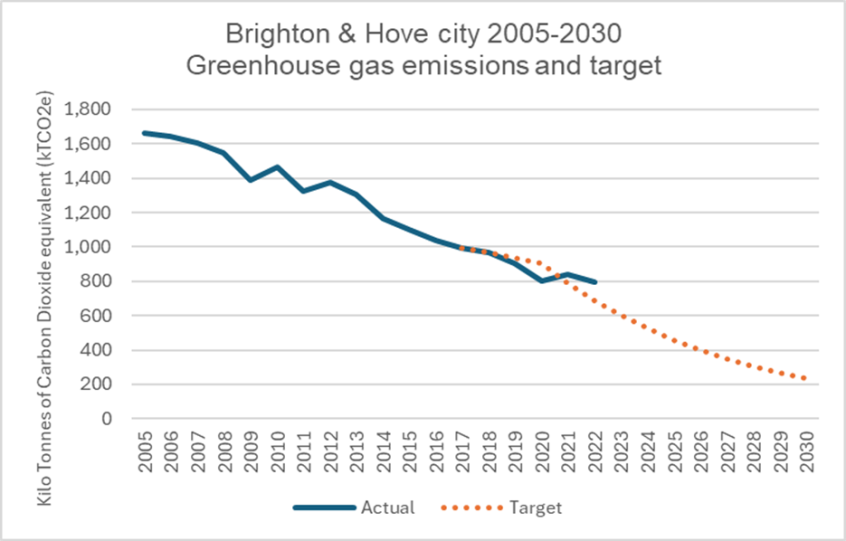
Across the city as a whole, greenhouse gases fell slightly from 2021 to 2022 (the most recent data available). A significant fall in emissions can be seen during the lockdown year of 2020, when economic and transport activity was restricted.
Figure 1: Brighton & Hove city greenhouse gas emissions and target 2005 to 2030
The solid line shows historic carbon emissions from the city falling by 52% from 2005 to 2022. The dotted line shows the council’s target towards being a carbon neutral city by 2030, reducing greenhouse gas emissions by 12.7% annually.
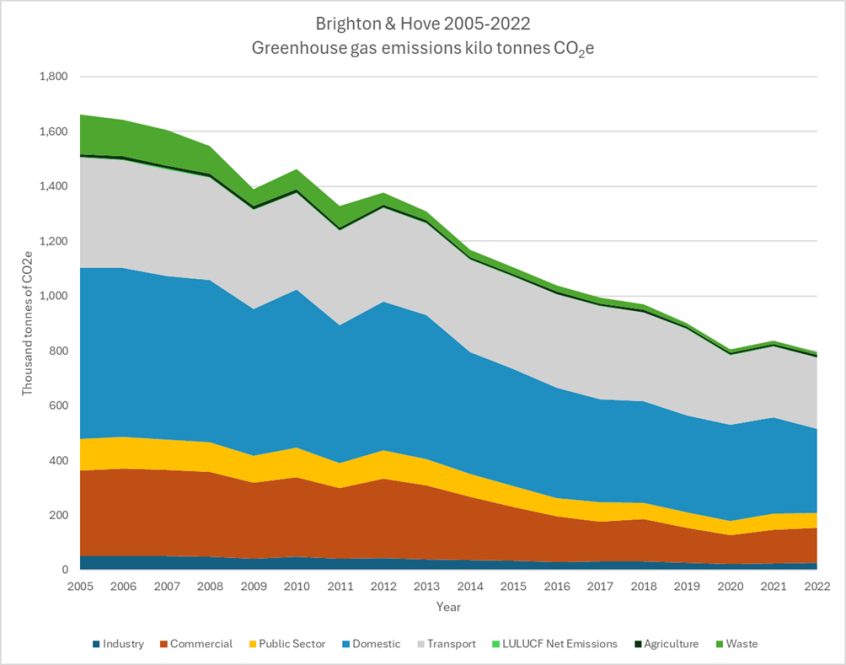
Figure 2 shows greenhouse gas emissions by sector. Greenhouse gases from domestic heating and electricity use have fallen the most since 2005. This is largely due to the decarbonisation of national electricity supply. While all sectors have reduced, transport has been the most resistant to change.
Figure 2: Brighton & Hove city greenhouse gas emissions 2005 to 2022 by sector
Cutting greenhouse gases in the council
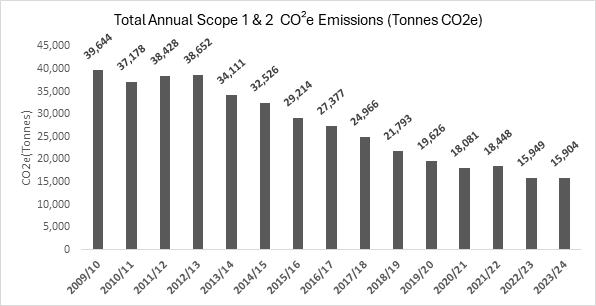
Since 2009, greenhouse gas emissions from the council’s estate have fallen by nearly 60% (see Figure 3). Emissions reductions in 2023/24 did not keep pace, despite significant improvements in fleet management (8% reduction in greenhouse gasses). This is partly due to an increased carbon intensity of the electricity grid, despite reductions in the council’s electricity use overall.
Although the council’s total electricity consumption fell by 5%, greenhouse gases rose 2% due to the increased carbon intensity of national electricity supply. National government initiatives, such as Great British Energy, aim to reduce these emissions in future years.
There were only marginal changes in total greenhouse gasses emitted from heating council buildings, despite improvements in individual buildings. This is due to increased fuel consumption in some council buildings. See highlights below and the full corporate report for more information.
Figure 3: Corporate council greenhouse gas emissions 2009 to 2024
Highlights in 2023 to 2024
City infrastructure
11% reduction in electricity consumption for street lighting, resulting in 4.5% reduction in emissions.
Council fleet
8% reduction in emissions from fleet fuel consumption due to electrification of fleet. This alone resulted in savings of 198 tonnes carbon dioxide equivalent (tCO2e), only slightly offset by an increase of 18 tCO2e from increased electricity consumption at the depot.
Corporate buildings
- 11% reduction in greenhouse gas emissions from corporate sites. Some of the main drivers were:
- 25% reduction at Bartholomew House (22 tCO2e)
- 18% reduction at Hollingdean Depot (19 tCO2e)
- 17% reduction at Hove Town Hall (15 tCO2e)
- Vacation of Moulsecoomb Hub (58 tCO2e)
- Vacation of Knoll House (16 tCO2e)
Council housing
7% increase in greenhouse gas emissions from housing sites, mostly due to increased consumption from blocks served by communal boilers. A key contributor to the increased consumption in these blocks was essential maintenance to pipework, which required multiple system drain-downs and additional gas demand to bring each system back up to operational temperatures. The council will monitor the gas demand at these sites going forwards and confirm that the increased consumption does not continue.
Climate action highlights 2023 to 2024: Strategy
A long list of existing strategies and plans continue to guide the council’s response to the climate and biodiversity emergency: The City Plan, Local Transport Plan, Downland Estate Plan, Fleet Strategy 2020 - 2030, Bus Service Improvement Plan, Local Cycling and Walking Improvement Plan, Air Quality Action Plan, New Build Housing Sustainability Policy, Local Flood Risk Management Strategy, the Surface Water Management Plan and Shoreline Management Plan.
The following strategic work was delivered in 2023/24.
Council Plan
A vision for a 'better Brighton & Hove for all' was agreed by the council in their new Council Plan for 2023 to 2027, approved by councillors at a meeting of Full Council on Thursday 20 July, 2023. The Council Plan is embedded into the council’s service planning and performance management. Key commitments include:
- working towards carbon net zero;
- reducing climate risk by adapting to climate change;
- protecting and enhancing the city’s natural environment; and
- ensuring that all decisions made by the council take into account the climate and biodiversity crises.
Decarbonisation Pathways Study
The council commissioned a study of energy systems in Brighton & Hove and ambitious yet realistic scenarios to reduce greenhouse gas emissions. The study provides an evidence base and identifies priority projects that should be considered as the basis for climate action going forward.
Fuel Poverty and Affordable Warmth Plan
The refreshed plan, delivered by members of the multiagency Fuel Poverty & Affordable Warmth (FPAW) Steering Group, targets improving the energy efficiency of homes and increasing access to cheaper, lower carbon energy.
Climate Risk and Vulnerability Assessment
Brighton & Hove City Council approved a Climate Risk and Vulnerability Assessment in February 2024. This assessment is the first comprehensive piece of work on climate adaptation since 2011. It identifies the key climate risks to the city, summarises the council’s latest work on climate adaptation, and provides recommendations for future programmes of work.
Economic Strategy
The council has developed a new Economic Strategy with key actions through to 2027, which is now being prepared for council approval. This includes the 10-year imperative to “Decarbonise and create a more regenerative economy”, with a short-term mission to “Ensure that decarbonisation is an acknowledged priority across our economy, creating a more circular and regenerative economy for the city.”
Procurement
An Environmentally Sustainable Procurement Policy and Social Value Policy is now in use across the council, giving additional weight to environmental and social value when assessing bids for council tenders.
Forthcoming strategies and plans include
- the Local Nature Recovery Strategy
- City Plan Part 1 Review
- 5th Local Transport Plan
- Electric Vehicle Strategy
- the Sustainable Drainage Strategy.
Theme 1: Carbon reduction
Transport
Electric vehicle charging – Brighton & Hove has one of the best electric vehicle charging networks in the country. 77% of households with no off-street parking in the city now live within five minutes’ walk from a charger. Electric vehicle ownership is going up and there is a steady increase in monthly usage for all charger types. There are 3,000 plug-in electric and hybrid vehicles registered in Brighton & Hove, an increase of around 1,000 since 2023.
The new chargers are being funded by central government grants from OZEV (Office for Zero Emission Vehicles) and the council’s EV charging operator.
With insights from Disabled Motoring UK, the council successfully bid for Innovate UK research funding to finance the development of three fully accessible electric vehicle charging point hubs with a prototype booking system.
Bus Service Improvement Plan
Brighton & Hove has one of the best local bus networks in the country and the highest bus use in the UK outside of London. However, bus journey times are increasing due to congestion, resulting in less reliable journey times and increasing bus operating costs.
The city’s Quality Bus Enhanced Partnership developed a Bus Service Improvement Plan which has been successful in securing around £28 million over 3 years. The Improvement plan is now in its second year and funding has been invested in additional bus priority measures to improve the reliability of bus journey times; new lower fares and simpler ticketing (focused on younger and older people); and enhancements to less frequent bus services which are financially supported by the council. A partnership between the council and Brighton & Hove Buses won £2.9 million from the Department for Transport’s ZEBRA 2 fund, which will support purchase of 16 electric buses and charging infrastructure.
Local Cycling and Walking Infrastructure Plan (LCWIP)
The LCWIP has been in place since 2022, and the securing of suitable funding and the delivery of priority schemes continues. LCWIP network schemes completed during 2023/24 include Happy Valley, Trafalgar St/Blackman St, Fox Way/Bush Farm Drive. Schemes substantially completed include Western Road.
The LCWIP has been integrated into processes to determine resource prioritisation across several wider City Transport projects, for example as part of the LTP capital programme, Cycle Hangars and Safer Better Streets. It is also being considered in the development of a Dropped Kerb Policy. A footway condition survey was commissioned across the city, when complete this will be used alongside the LCWIP to determine resource prioritisation.
School Streets
School Streets were implemented at 3 more schools, bringing the total to 16 schools. School Streets support the safe movement of children and families to and from school by enabling and encouraging more walking, wheeling, cycling and scooting. School Streets address issues on the roads around schools at drop off and pick up times, including congestion, unsafe parking and air quality issues immediately outside schools. This is achieved by restricting access to motor vehicles on the roads around schools for one hour at each end of the day, during drop off and pick up times.
E-cargo bikes
E-cargo bikes were leased by the council to an additional 12 small businesses, with funding from the council’s Carbon Neutral Fund. At May 2024, small businesses that had previously used petrol or diesel vans had travelled over 15,000km by e-cargo bike. The council also encourages local businesses to trial a local e-cargo delivery service, and to date 32 small and medium sized enterprises have switched.
Bikeshare Scheme
Beryl Bikes launched its new scheme in March 2023 and now provides city-wide coverage with a fleet of 780 bikes – 60% of which are electric pedal assist and 40% pedal only. 17 new hubs were added to the network, and there were a total of 104 hubs by Spring 2024. Users of the cycle hire scheme replaced nearly 34,000 private vehicle journeys over the year.
Secure cycle storage
The council provided 150 cycle hangars, with 900 spaces for residents to store bikes safely.
Council Fleet
The council aims to have a zero carbon fleet by 2030, including refuse vehicles and maintenance vans, and phasing out petrol and diesel vehicles. As of May 2024, 15% of the fleet was low carbon, with 63 electric vehicles and 8 electric HGVs. New HGVs include a top-loading truck for glass recycling collections, four refuse collection vehicles and three electric side-loading vehicle for communal bins.
The council has invested in EV charging infrastructure at the Hollingdean Depot and at Housing and Parks Department locations across the city, funded by the council’s Carbon Neutral Fund.
One electric refuse collection vehicle saves around £22,000 a year in fuel and has lower maintenance costs and downtime. Each vehicle is expected to save around 2.6 tonnes of carbon emissions per year.
Air quality improvement
A network of new air quality monitors that record air pollution are being rolled out across the city in 2024, providing more data to help inform decisions for targeted air quality improvements and helping the council to deliver its Air Quality Action Plan.
Increasing monitoring capacity will provide a more accurate indication of air quality in specific areas and help the council to put in place evidence-based actions to reduce pollution. Using data collected by the monitors, the council will target improvement measures to protect the health of all residents, particularly those more vulnerable to the effects of poor air quality.
Energy and Water
Solar panels on council housing 675 solar pv systems were installed on council houses and bungalows as of July 2024. A new programme of solar PV installations on council housing started with the aim of installing 800 more solar PV systems on council homes by 2026, as part of our action to help residents with the cost-of-living crisis and reduce carbon emissions. The priority for the programme is homes with an Energy Performance Certificate rating of D or lower, those with electric heating, and areas of the city with a higher likelihood of fuel poverty. There are also programmes to install more energy efficient heating and hot water systems, insulation, and new windows.
Solar panels on council corporate buildings
The council has installed Solar PV systems across 10 corporate sites, generating approximately 411,238 kWh of renewable electricity in 2023/24, and a reduction in carbon emissions of around 82 tCO2e in the same year. An additional tranche of Solar PV installs to 7 operational buildings is currently underway and due to be fully commissioned by the end of the 2024/25 financial year. This will increase the total generation capacity across the corporate estate to around 725,000 kWh per year and a total emissions reduction of 142 tCO2e in 2025/26.
Solar panels on schools
PV systems have been commissioned by the council, or self-installed by schools, at 9 school sites. These systems are expected to generate 147,365 kWh of renewable energy annually, and reduce bills by an estimated £28,000 in 2023/24. The total projected carbon emissions reduction from these systems is expected to be 148.5 tCO2e over the next 20 years. In addition, the council facilitated a Solar PV Framework between 2020 & 2024, which enabled 20 schools to acquire systems through local Community Energy providers Brighton Energy Co-operative (BEC), and Brighton & Hove Energy Services Co-operative (BHESCo).
Solar Together
Solar Together is a group-buying scheme that delivers cheaper installation of solar panels and battery storage systems for able-to-pay households including homeowners and landlords. The third round of the scheme saw a further 64 Solar PV systems and 62 batteries installed in Brighton & Hove.
The streetlight modernisation programme has been upgrading 18,000 streetlights across Brighton, Hove and Portslade, fitting them with new LED lights. Since 2017, more than 9 out of 10 of the city’s lanterns have been replaced and electricity use cut by 48.1% up to April 2024. Over the same period, carbon emissions have fallen to 1,011 tCO2e, a reduction of over 80%.
The traffic signal carbon reduction programme started in 2021 to replace traffic signal heads and their halogen bulbs with LEDs. Replacing the heads and the bulbs significantly reduces (87% less) the electricity used for the city’s traffic signals, as well as the number of signal faults. At July 2024, traffic signal heads had been replaced at 25 sites with 3 more sites planned for 2024/25.
Sports facilities lighting
The council has replaced luminaires with LEDs in two sports halls, floodlights at one astro turf facility, and floodlights at an outside tennis court, saving an estimated 93 tCO2e by 2030. These improvements also led to increased flexibility of activities and an improved customer experience.
Council corporate buildings lighting
LED retrofit pilots have been carried out in areas of Hove Town Hall, with the plan for this to be phased across the whole building. Lighting audits have been carried out across several school buildings with business cases for retrofitting works produced.
Heat decarbonisation in corporate & school buildings
Using grant funding received through two successful bids to the Low Carbon Skills Fund (LCSF), the council have put together high-level heat decarbonisation scoping documents, covering a significant portion of its corporate estate. This work focused on school and corporate assets with the highest level of emissions and presented a ‘fabric-first’ approach to improving energy efficiency and reducing dependence on fossil-fuel heating systems.
Work is due to commence in Summer 2025 to implement a low carbon heating system in a large primary school, which is due to be the first school in the council portfolio to be fully heated without gas or oil. Once commissioned this will contribute to the emissions savings delivered by the existing Ground or Air-source heat pumps installed at around 10 council operational buildings and schools.
In 2024, funding bids were submitted to the Phase 4 of the Public Sector Decarbonisation Scheme (PSDS), proposing a full replacement of existing gas boilers with a low-carbon alternative at some of the council-owned leisure sites.
Waste
Recycling options
Only 0.21% of the city’s waste is sent to landfill, but the overall volume of residual waste is increasing. Investment in infrastructure and clear regular communication on what can be recycled is a top priority being delivered by the council. A Waste Minimisation Officer has been appointed to work on reducing contamination and increasing recycling rates.
There has been an increase in recycling facilities across Brighton & Hove, with more recycling bins for food and drink cartons (such as Tetra Pak), waste electrical and electronic equipment, to help residents easily recycle items that might otherwise be disposed of as household waste. As of 01 October 2024, there are 21 electrical waste and 84 carton containers out across the city.
Third sector initiatives
Brighton & Hove Food Partnership runs several projects tackling food waste, including the Community Composting Scheme and the Surplus Food Network, an alliance of third sector organisations that intercepts and redistributes surplus food to community projects and food banks. Members include Sussex Fareshare, Real Junk Food Project, Sussex Homeless Support, Sussex Gleaning Network, and UKHarvest.
Digital giving and resale platforms like Freegle; community repair workshops and affordable resale initiatives such as Smarter Uniforms; and sharing initiatives such as Brighton Borrowers and Brighton Community Workshop Tool library all contribute to reducing non-territorial greenhouse gas emissions from consumption and waste (i.e. greenhouse gases emitting during the production and disposal of goods).
Built Environment
Council Housing – As of end of May 2024, BHCC owned and managed 12,122 domestic dwellings. BHCC is working towards its own target to improve energy efficiency, achieving an average SAP rating between 81 (EPC B) and 92 (EPC A) by 2030. As part of BHCC’s transition away from gas-fired boilers, we trialled the installation of 52 Air Source Heat Pumps (ASHP) in our housing, replacing inefficient, expensive electric heating and water heaters. In 2023-24 the heating and hot water services were decarbonised at two seniors housing schemes, Elwyn Jones Court and Charles Kingston Gardens, with the fitment of Hight Heat Retention Heaters, Sunamp Thermal Batteries and Infra-red heating for the common way entrance.
This investment is in addition to our annual capital investment through planned works programme such as new windows, external repairs including insulation improvements, new roofs and doors that all contribute positively to the energy efficiency of homes.
Corporate council estate
By 2024 around 75 energy efficiency audits had been carried out across the highest consuming corporate buildings, schools and leisure centres. These audits provided an overview of decarbonisation opportunities at each site. Subsequently, funding bids were made to the Low Carbon Skills Fund (LCSF), to request revenue funding to support detailed design work on Low Carbon Heating retrofits, and a successful bid to the Public Sector Decarbonisation Scheme (PSDS) to match fund the installation of heat pumps at a school site. Since 2021, carbon reduction projects related to the corporate estate have also received an investment of more than 4.9m from the council's Carbon Neutral Fund to accelerate delivery.
Planning policies
During 2022, the council enhanced planning policies on environmental themes, which now cover sustainable travel, green infrastructure and nature conservation, protecting the water environment, sustainable drainage, energy efficiency and renewables, community energy, heating and cooling infrastructure. In 2023/4 new guidance was introduced on retrofitting historic buildings for energy efficiency.
The council is now preparing an evidence base to support renewal of the main planning policies in the City Plan, which will include extensive new evidence on potential for renewable energy and circular economy approaches in new buildings.
New council homes
The council is undertaking Whole Life Carbon Assessments on seven newbuild council housing projects and several major projects to estimate and measure their impact on greenhouse gas emissions during construction and in use. One of the main outcomes will be homes with better insulation and low carbon heating systems. BHCC’s Design Guide and Employers Requirements for new build council housing provides targets for energy use, embodied carbon, and water use. It also requires a circular economy opportunities assessment to identify ways to reuse materials and avoid waste.
Victoria Road, Portslade
The Victoria Road, Portslade, development of 42 energy-efficient council homes in Brighton & Hove won development of the year from a local authority at the Unlock Net Zero Awards. The scheme has a ground source heat pump system to supply heating and hot water for the homes, which are highly insulated. Electricity generated from 168 solar panels provides lighting and power in communal areas and external lighting. The scheme has planted ‘living’ walls, bat boxes, and bird and bee bricks to encourage biodiversity, and a communal garden for residents which includes fruit trees and a wildflower area.
Theme 2: Biodiversity, nature and environment
City Downland Estate Plan
The Downs and parkland in and around Brighton & Hove are now protected and enhanced for future generations through a new plan, launched in September 2023 at Wilding Waterhall nature reserve. The City Downland Estate Plan covers around 13,000 acres of land owned by the council, including agricultural land and parkland used for leisure, sport and recreation. It sets out aims and actions for the Downland Estate over the next 100 years, to enhance biodiversity, protect the aquifer, accelerate progress to Net Zero, improve public access to nature and move farming towards a more sustainable model.
Nature recovery
Wilding Waterhall is a pioneering project to restore rare chalk grassland on a former golf course. The team is sensitively managing the landscape to restore rare downland habitats and the wildlife they support, for the enjoyment of all the city’s residents. At Waterhall, cows and sheep help maintain habitats by grazing on grassland and shrub. Friends of Waterhall volunteers contribute to conserving the site and the Waterhall rangers arrange visits, events and educational opportunities.
Other local chalk grassland regeneration projects include the maintenance of the 19 existing butterfly and bee banks across the city as well as the creation of new ones, as part of the Greening The Cities project
Black Rock vegetated shingle
The internationally rare habitat of vegetated shingle at Black Rock was created over 2 years by Brighton & Hove City Council and Kew’s Millenium Seed Bank, as part of the wider Black Rock Rejuvenation project transforming the Eastern seafront. A survey of invertebrates recorded 170 species including 60 species of beetle and a rare jumping spider among the planted shingle beds.
The Living Coast Biosphere
The Living Coast Biosphere has submitted an application to UNESCO, the United Nations Educational, Scientific and Cultural Organisation, to renew its designation in the World Network of Biospheres. Led by Brighton & Hove City Council, The Living Coast is a cross-sector partnership with businesses, conservation, education, voluntary, community, arts and culture, and local government organisations. It is the only urban biosphere in the UK, providing local, national, and international recognition to the region’s outstanding natural environments, encompassing the South Downs National Park, a unique chalk aquifer and the Marine Conservation Zone. The aims of The Living Coast are to protect wildlife and habitats; promote sustainable economy and communities; and encourage environmental education, training and research. A new report outlining the work that has been delivered locally over the past decade as well as the refreshed vision and goals for the next decade has been finalised in September 2024 and submitted to UNESCO. It is available here: thelivingcoast.org.uk/wp-content/uploads/2024/09/The-Living-Coast-UNESCO-Biosphere-10-Year-Progress-Report-Forward-looking-Sept24.pdf
Education and engagement
Our City Our World (OCOW), Brighton & Hove’s unique sustainability, climate change and environmental education programme, is the only whole school, whole city approach to climate change and sustainability in the country, and more than 90% of the city’s schools are involved. The programme has been recognised by the Department for Education, National Education Union and National Climate Education Action Plan.
Through the programme, schools have integrated environmental education into the curriculum and empower children and young people to become changemakers. This has included training secondary school students to be climate ambassadors, organising clothes swaps, refill shops, water saving activities and opportunities to question decision-makers. It has helped children and young people develop a close connection with nature through making wildlife areas for pollinators, creating ponds and rain gardens, and planting trees.
Schools have developed systems to reduce emissions through activities such as installing solar power, auditing water use, using sustainable transport for trips and reducing food waste.
While world leaders met at COP28, around 60 young people aged 12 to 16 hosted Brighton & Hove’s first Secondary Schools for a Sustainable Future Student Summit to help prioritise climate action in schools across the city.
Sustainable Development Goals videos for schools
A series of 17 videos featuring local sustainability champions was created to help schools across Brighton & Hove mark United Nations Day in October 2023. The Living Coast UNESCO Biosphere, Brighton & Hove City Council, and the Our City, Our World environmental education programme collaborated to produce a series of 17 videos to mark each of the United Nations’ Sustainable Development Goals.
The videos were shown during assemblies at schools across the city to explain how these global goals are being pursued and achieved locally while inspiring Brighton & Hove children to take action in their communities.
Educating and engaging council staff on climate action
At June 2024, 1133 members of staff had completed a climate e-learning module and 133 officers had completed intensive Carbon Literacy training, including 85 senior managers. In 2023 the council ran two Circular Economy trainings for senior managers and a Circular Economy specification-writing masterclass for council buyers and commissioners working in housing construction and maintenance and property to reduce the resource- and carbon-intensity of council services.
Theme 3: Adaptation to Climate Change
Climate Risk and Vulnerability Assessment (CRVA)
Brighton & Hove City Council approved a Climate Risk and Vulnerability Assessment in February 2024. This assessment summarises the council’s latest work on climate adaptation and recommends an Adaptation Action Plan.
Key risks identified in the CRVA for Brighton & Hove are:
- Heatwaves;
- Soil degradation, erosion and waterlogging; and
- Heavy rain events leading to increased flooding of some sections of the seafront, and coastal cliff erosion, affecting businesses, tourism, infrastructure, and water quality.
The recently updated Brighton Marina to River Adur Flood and Coastal Erosion Risk Management Scheme includes modelling of the potential impact of future coastal flooding, a survey of the flood and coastal erosion risk. It includes actions such as shingle management on the beach, plans to construct two rock armour revetments near Basin Road South, replacing existing flood walls and defences and installing new timber groynes at Hove.
Biodiversity is at risk from higher temperatures and sea level rise, and the City Downland Estate Plan provides a route map on enhancing wildlife and natural habitats.
Brighton & Hove’s urban heat islands were analysed to understand the variation in exposure to heat across the city, and the likelihood of ‘hotspots' of overheating. High temperatures are an emerging risk for Brighton & Hove’s infrastructure, particularly to transport infrastructure, buckling of rail lines, line sag and rail speed restrictions, damage to bridges, pavements and road surfaces.
Wetter winters currently pose an increased risk to the public highway. The frequent exposure to rain and the freeze-thaw cycle can exacerbate existing tarmac damage, leading to hazardous conditions and increasing the demand for road maintenance. The cost of drain maintenance is also expected to rise with heavier precipitation events.
Sustainable Urban Drainage Systems (SuDS)
Rainscapes, an important Sustainable Drainage System (or SuDS), are specially designed, engineered and landscaped solutions to manage surface water, reduce flood risk, improve water quality and promote biodiversity and community benefits. They work by holding onto and then slowly releasing surface water into the ground which in turn reduces the burden on the street drainage system.
As well as projects on council-owned land, major planning applications have to include a detailed drainage strategy.
A new rain garden in Norton Road tackles a history of flooding during severe wet weather. The rain garden is now working to absorb some of the water that would otherwise flow down the road. The new kerb line has small gaps, allowing surface water to flow into the garden. The rain garden was designed to improve visibility at the junction with Eaton Road and is planted with a variety of plants, including red campion, for biodiversity and pollinators.
SuDS in Schools creates rainscapes with play and educational opportunities as well as reducing flooding and increasing biodiversity with involvement from Highways, the Brighton & Hove City Council flood risk team, the Schools Climate Education Team (Our City, Our World), and The Aquifer Project, now hosted by The Living Coast UNESCO Biosphere, working in partnership with the South Downs National Park Authority, Southern Water and the Environment Agency.. Students are involved throughout the planning and creation of the rainscape scheme. The programme engages schools in climate resilience, groundwater protection, addressing flood risk and urban pollution. Schools in Brighton & Hove to have benefited are Carden and Moulsecoomb primaries.
The Wild Park Rainscape project is shortlisted for an award from South Downs National Park. In partnership with The Aquifer Project, National Highways and The Living Coast Biosphere, it will deliver a sustainable drainage system in the Wild Park Local Nature Reserve in the Moulsecoomb area, to prevent polluted highway run-off infiltrating directly into the underlying groundwater.
SuDS innovation and global promotion
The Living Coast UNESCO Biosphere was one of 15 UNESCO Biospheres in the world to be awarded funding by the Abrdn Foundation and UNESCO's Regional Bureau for Science and Culture in Europe to carry out research on the efficiency of nature-based solutions, such as SuDS, to improve water quality, especially from road water run-off pollution. The legacy of this project includes the future set up of baseline monitoring of the Wild Park Rainscape to inform future SuDS and surface water engineering and engagement opportunities.