1. Introduction
1.1
The Equality Act 2010 (Specific Duties and Public Authorities) Regulations 2017 requires all public and private sector employers with more than 250 employees to report their gender pay gap based on an annual ‘snapshot’ pay period. For the public sector this snapshot is the 31 March each year.
The reporting regulations require publication of the :
- mean and median gender pay gaps in hourly pay
- mean and median gender bonus gaps
- proportion of men and women who received bonuses
- proportions of men and women employees in each pay quartile
1.2
The reporting data includes all council employees who were employed on 31 March. Apprentices, seasonal, temporary or casual employees are included if they fall within the reference period created by the snapshot date. The data excludes schools based staff. Under the Regulations the Governing Body of maintained Local Authority schools is responsible for the reporting duty for the employees of their school, where the regulations apply.
1.3
We publish this information on the staff pay and conditions financial information section of its website and on the government’s website.
1.4
This report relates to the snapshot date of 31 March 2022.
2. Gender pay and equal pay
2.1
Gender pay is different to equal pay.
- Equal pay means that men and women in the same employment performing equal work must receive the same salary and have equal contractual terms, as set out in the Equality Act 2010.
- The gender pay gap is a measure of the difference between men’s and women’s average ordinary earnings (excluding overtime) across an organisation or the labour market. It is expressed as a percentage of men’s earnings. Both the mean (average) and median hourly rates are reported.
An employer can be equal pay compliant and still have a gender pay gap. The cause of a gender pay gap may not fall within the direct control of the employer, and is likely caused by the distribution of men and women in different job roles.
3. Gender pay gap reporting
3.1
Brighton & Hove City Council has a negative pay gap for both the mean and median gross hourly rates, meaning, on average females are paid more than males. This is not uncommon but goes against the overall national trend.
3.2.1
The mean (average) gender pay gap in hourly pay is -7.2%. This is a 0.7% negative decrease to the 2021 reported figure.
3.2.2
The median (middle) gender pay gap in hourly pay is -6.6%. This is a 1.5% negative decrease to the 2021 reported figure.
3.3
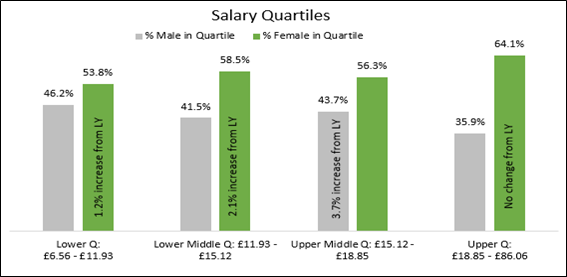
Salary quartile reporting is calculated by sorting employees by their hourly rate, from the lowest to the highest, then splitting them into four equal quartiles to show the proportions of male and female employees in each group. Definitions of the salary quartile information are shown in appendix A.
What the salary quartile graph means
The lower salary quartile includes the average earning hourly rates between £6.56 (apprentice pay rate) and £11.93.
The proportions of employees in the quartile is 46.2% male, 53.8% female. This is a 1.2% decrease in the number of male in the quartile compared to last year’s reporting.
The council is an accredited Real Living Wage employer with £9.50 set as the lowest pay rate as at March 2022.
The lower middle quartile includes hourly rates between £11.93 and £15.12. The quartile is 41.5% male, 58.5% female. This is a 2.1% decrease in males in the quartile compared to last year.
The upper middle quartile includes hourly rates between £15.12 and £18.85. The quartile is 43.7% male, 56.3% female. This is a 3.7% increase in males in the quartile compared to last year.
The upper quartile includes hourly rates between £18.85 and £86.06. The quartile is 35.9% male, 64.1% female. This is a the same as the previous year.
You can also view this data in a table.
|
Male |
Female |
Change to last year year's reporting |
|
|
Lower quartile: £6.56 to £11.93 |
46.2% |
53.8% |
1.2% female increase |
|
Lower middle quartile: £11.93 to £15.12 |
41.5% |
48.5% |
2.1% female increase |
|
Upper middle quartile: £15.12 to £18.85 |
43.7% |
65.3% |
3.7% male increase |
|
Upper quartile: £18.85 to £86.06 |
35.9% |
64.1% |
No change |
3.4
Bonus pay reporting. These figures are not applicable as we do not not pay bonuses.
4. Supporting narrative
4.1
Our overall workforce gender profile is 58% female and 42% male. This is unchanged from the previous year reporting period.
4.2
4,811 employees are included in the pay period comprising of 4,484 contracted employees and 327 casuals. As per reporting requirements employees on less than full pay have been excluded (88).
4.3
The mean hourly rate of pay for male employees was £16.09. The mean hourly rate for female employees was £17.24, this results in the reported -7.2% difference. This negative gap has decreased by 0.7% since last year because the male mean hourly rate has seen a greater increase, of 40 pence, compared to the female mean hourly rate, which saw a 32 pence increase.
4.4
The median hourly rate of pay for male employees was £14.63. The median hourly rate for female employees was £15.60, this results in the reported -6.6% difference. This negative gap has decreased by 1.5% since last year because the male median hourly rate has seen a greater increase, of 61 pence, compared to the female median hourly rate, which saw an increase of 44 pence.
4.5
Male employees work on average 33.4 hours a week, with 78% of all male employees working full time, 22% part time. Female employees work on average 28.7 hours a week, with 46% of all female employees working full time and 54% part time.
The table summarises data from sections 4.1 to 4.5
|
Male |
Female |
|
|---|---|---|
|
Workforce gender split |
42% |
58% |
|
Employee count |
2,012 |
2,799 |
|
Mean hourly rate |
£16.09 |
£17.24 |
|
Median hourly rate |
£14.63 |
£15.60 |
|
% of employees who work part time |
22% |
54% |
|
% of employees who work full time |
78% |
46% |
|
Average weekly hours for all employees |
33.4 |
28.7 |
|
Average weekly hours for part time employees |
21.6 |
22.3 |
4.6
Salary quartiles
The % of female employees in each quartile is higher than the % of men. This is in line with the overall workforce gender profile, however, the % gap between the number of men and women in each quarter significantly widens between the 2 lower quartiles and 2 higher quartiles. The lower quartile has 7.6% more women than men, the upper quartile has 28.3% more women than men. This shows that a greater proportion of women hold roles which have a higher mean hourly rate of pay than men.
There are various job roles within each quartile and the proportion of male and female employees in each role differs.
Below are some examples.
Lower quartile
|
Domestic Assistant |
70% female |
|
Library Officer |
62% female |
|
Customer Services Officer |
73% female |
|
Collection Operative |
95% male |
|
Housing Estates Assistant |
91% male |
Lower middle quartile
|
Early Years Educator |
100% female |
|
Community Family Worker |
92% female |
|
Home Care Support Worker Home Care |
87% female |
|
Maintenance Technician |
100% male |
|
Street Cleansing Driver |
96% male |
Upper middle quartile
|
Social Worker (PQ1) |
72% female |
|
Care Manager |
81% female |
|
Occupational Therapist |
77% female |
|
Collection Driver Supervisor |
95% male |
|
Performance Analyst |
55% male |
Upper quartile
|
Senior Social Worker |
82% female |
|
Team/Pod Manager |
80% female |
|
Assistant Director |
73% female |
|
Head of Service or Department |
56% female |
|
Accountant |
50% male |
4.7
Basic pay
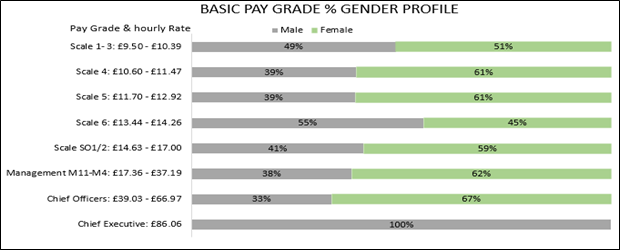
Reviewing the main basic pay grades for job roles shows a similar pattern, a larger proportion of female employees hold higher paid roles, particularly on management grades where 62% of roles are held by women. Similarly, 59% of all roles with basic hourly rates over £11.70 (£11.70 to £86.06) are held by women. In contrast 45% of all roles with lower basic hourly rates between £9.50 and £11.47, are held by men.
What the basic pay graph means
The graph shows the proportion of male and female employees on the main council pay grades.
Proportionately a higher % of female employees hold roles on the higher basic pay grades.
For example, 62% on the council’s management pay grades between M11 and M4 are female, with hourly rates between £17.36 and £37.19.
You can also view this data in a table.
Basic pay grade % gender profile
|
Pay grade and hourly rate |
Male |
Female |
|---|---|---|
|
Scale 1 to 3: £9.50 to £10.39 |
49% |
51% |
|
Scale 4: £10.60 to £11.47 |
39% |
61% |
|
Scale 5: £11.70 to £12.92 |
39% |
61% |
|
Scale 6: £13.44 to £14.26 |
55% |
45% |
|
Scale SO1/2: £14.63 to £17.00 |
41% |
59% |
|
Management M11 to M4: £17.36 to £37.19 |
38% |
62% |
|
Chief Officers: £39.03 to £66.97 |
33% |
67% |
|
Chief Executive: £86.06 |
100% |
0% |
4.8
Pay and grading
Our annual pay policy statement provides details of our pay and grading arrangements.
4.9
Allowances
28% of the workforce in the snapshot pay period received an allowance in addition to their basic pay, this is a 1% increase from 2021. Analysis by quartile of the mean and median hourly rates for employees in receipt of an allowance show that with the exception of the lower quartile, the mean and median hourly rates of female employees are consistently higher.
4.10
Working patterns
A further contributing factor to the pay gap is the working pattern of an employee. Roles where hours are worked at the weekend and night attract enhanced rates of pay, 21% of the workforce receive such enhancements. While proportionally more men receive working pattern allowances than women, the basic hourly rate of roles held by men are proportionally lower than the roles held by women. The higher basic hourly rated pay for roles held by women in addition to the enhanced rate of pay increases the mean and median hourly rates of pay for women.
|
Basic hourly rate range |
Proportion of gender in receipt of working pattern allowances by hourly rate %. Extract. |
|
|---|---|---|
|
|
Male % |
Female % |
|
£9.50 to £10.21 Pay Scale 1 to 2 and Scale 3 |
57% |
43% |
|
£10.41 to £16.71 Pay Scale 4 to S01/2 |
47% |
53% |
4.11
Market supplements
60% of employees in roles attracting a market supplement are women, 40% are men. This is a 10% increase for male employees compared to 2021. Market Supplements are subject to annual review.
4.12
Salary sacrifice
Salary sacrifice is where an employee gives up the right to receive part of their salary due under their contract of employment, in return for the employer’s agreement to provide an equivalent non-cash benefit, the value of which is exempt from tax and national insurance contributions (NICs).
Schemes include:
- Cycle to Work to help employees save on bikes purchased to commute to work
- Childcare vouchers - to help employees save on childcare costs.
- Additional Voluntary Contribution (AVC) Pension – enables Local Government Pension Scheme (LGPS) members to increase their retirement benefits by saving money alongside their pension pot.
7% of the qualifying workforce are signed up to a salary sacrifice scheme.
|
Male
|
Female
|
Variance to previous reported year 2022 to 2021 |
|
|---|---|---|---|
|
Number of employees in a salary sacrifice scheme |
124
|
205
|
The percentage of male employees in a salary sacrifice scheme increased by 4% and 6% for female employees. Overall a 5% increase |
|
Average monthly employee salary sacrifice amount |
£263 |
£286 |
The value of monthly salary sacrifice for female employees in a scheme increased by 31%, and decreased by 11% for male employees |
For the purposes of gender pay gap calculations these values must be deducted from relevant employees pay, thus reducing the overall reportable pay to include for averaging.
5. Conclusions and action plan
5.1
We're confident that our gender pay gap does not stem from an equal pay issue. In 2010 we introduced a new pay and grading system to ensure all roles are graded using a recognised job evaluation system to make sure individuals receive equal pay for equal work. In 2013 a new system of allowances and expenses was implemented to ensure consistency across the workforce.
5.2
Our gender pay gap shows that on average (by both measures) female employees are paid more than male employees and this is the opposite of the national gender pay gap. The Office of National Statistics (ONS) estimated a national median gender pay gap of 14.9% in 2022, a 0.5% decrease from 15.4% in 2021. The council’s mean and median pay gaps are both lower than the national average. This is because we have more female employees in higher graded posts.
5.3
We appreciate that a negative gender pay gap bucks the national trend and also that any pay gap represents inequality. Compared with last year, we have seen a narrowing of our negative gender pay gap by both measures. Our mean negative pay gap has decreased by 0.7%, and the median negative gap by 1.5%. We are committed to improving the diversity of our workforce to reflect our communities and gender is part of our wider diversity agenda. In addition, we are committed to understanding our data from an intersectional perspective to ensure we address any disproportionate outcomes as best we can.
5.4
The gender profile of the workforce remained roughly the same between reporting years with the majority of employees being female. In our latest Workforce Equalities Report 2021 to 2022, women continue to out-perform males in recruitment and selection processes across all pay grades and contract types. However, in 2021 to 2022 data showed that males (57.1%) were more successful in achieving promotions than females (42.9%), which is in contrast to the previous 3 year trend.
5.5
There are a number of factors that have contributed to our ability to recruit and retain female employees and enable them to develop careers within the organisation.
These include the following:
- We have a long-established suite of progressive policies such as:
- flexible working
- occupational, maternity and parental leave
- discretionary and carers leave
- childcare vouchers.
- Learning and development provided to staff and managers on equality, diversity and inclusion, including training provided to recruiting managers to ensure fair recruitment and selection processes.
5.6
We undertook a low pay review during 2022 and implemented significant retrospective pay increases in September 2022. This included the re-organisation of our lowest 4 pay scale and the removal of our bottom pay scale 1 to 2. These changes, along with the National Joint Council pay award from April 2022 will have a positive impact to help reduce our negative pay gap for the March 2023 gender pay gap reporting period.
5.7
As part of the Public Sector Equality Duty, we carry out regular equalities monitoring in respect of the following aspects of employment:
- workforce composition
- recruitment and retention
- employment casework
- access to learning and development opportunities
- employee satisfaction both in relation to current employees via the Annual Staff Survey and those who leave our employment.
5.8
Historically the insight provided by this data has also been used to develop actions to address any difference in outcomes identified for different staff groups through our ‘Fair and Inclusive Action Plan’ with areas of focus for action agreed annually to address these issues. This programme of work aims to deliver Our People Promise commitment to be a fair and inclusive place to work.
Continued activity for years 2023 to 2024 includes:
- review where there is an imbalance in the gender profile of staff in particular job roles and agree actions to attract and retain staff from under-represented groups.
- engagement with community groups and schools working alongside our Apprenticeship Programme Manager to raise the profile of the council as a potential employer, and showcase a range of roles challenging gender bias within sectors
- review potential barriers to recruitment and promotion to improve workforce diversity across the workforce as a whole, with a particular focus on roles graded M8 and above.
- continue to voluntarily publish annual ethnicity and disability pay gap reports in line with the gender pay gap reporting schedule. Reporting for March 2021 snapshot dates.
An update on the progress and impact of these actions will be reported in the Gender Pay Gap report for reporting period March 2023, to be published by March 30 2024.
Appendix A
Hourly Pay definition for the purposes of calculating the mean and median hourly rates
Pay will include:
- basic pay
- paid leave, including annual leave, sick leave, maternity, paternity, adoption or parental leave (except where an employee is paid less than usual because of being on any such leave)
- area and other allowances
- shift premium pay
- pay for piecework
- bonus pay
It will not include:
- overtime pay
- expenses
Full-pay relevant employee definition
“Full-pay relevant employee” means a relevant employee who is not, during the relevant pay period, being paid at a reduced rate or nil as a result of the employee being on leave. Employees who receive no pay at all during the relevant pay period, whether or not this is as a result of being on leave are excluded from the gender pay gap calculations. “Leave” includes:
- annual leave
- maternity, paternity, adoption, parental or shared parental leave
- sick leave
- special leave
Pay quartiles
This calculation requires an employer to show the proportions of male and female “full-pay relevant employees” in four quartile pay bands. This is done by dividing the workforce (so far as possible) into 4 equal sections to determine the lower, lower middle, upper middle and upper quartile pay bands. Where employees receiving the same hourly rate of pay fall within more than one quartile pay band, a relative proportion of male and female employees receiving that rate of pay was assigned to each of those pay quartiles.