Foreword
Foreword from Bella Sankey, Brighton & Hove City Council Leader
Sussex is at a once-in-a-generation turning point. The government has invited us to bring forward proposals for simpler and stronger local government, alongside new devolved powers for our region.
We welcome the opportunity and the challenge. This is our chance to design councils around how people actually live, to make everyday life easier, services better, and local democracy closer to home.
Change on this scale is unsettling. It's also necessary. Too often, our current boundaries cut through communities, decisions feel distant, and responsibility is unclear. Our vision is for councils that are big enough to be resilient and small enough to stay connected, places where local pride and local voice shape what happens next.
This is not just about lines on a map. It's about the experience of residents. It means services that are easy to reach and joined up. It means decisions informed by lived experience and made with our communities, not for them. It means neighbourhood-led partnerships with the NHS, schools, police and the voluntary sector so that support feels seamless when people need it most.
We see one authority bringing together Brighton & Hove with Peacehaven, Telscombe, East Saltdean and Falmer, reflecting the reality of a continuous urban corridor and shared daily journeys. But this vision is wider than that corridor alone. Across Sussex as a whole, we propose 5 councils, balanced in population size. Each would serve around 300,000 to 400,000 people, large enough to be financially resilient and small enough to remain rooted in local communities.
Together they form a family of councils with clear responsibility and strong accountability, able to stand as equal partners in a devolved Sussex.
This is not about one place growing at the expense of another. It's about the whole of Sussex being set up to succeed, with every community recognised and every council built on a scale that works.
We have written this proposal so that people and partners across Sussex can compare approaches and judge them on their merits.
Our commitment is to be constructive, open and ambitious, protecting local identity, simplifying daily life and giving Sussex the foundations to thrive for the next generation.
Councillor Bella Sankey
Leader of Brighton & Hove City Council
Executive summary
Purpose and submission of the proposal
Government is reshaping local government across England to:
- make responsibilities clear
- remove duplication
- make services easier to use
At the same time, new powers over transport, skills, growth and net zero are being devolved to directly elected Mayors and their Strategic Authorities.
In this context, we're invited to bring forward a proposal for unitary local government covering East Sussex and Brighton & Hove, with the option to consider wider boundaries where this would improve sustainability and support devolution.
Our Base Proposal is presented with whole districts as the building blocks to comply with the Local Government and Public Involvement in Health Act 2007.
The Base Proposal is submitted for legal compliance.
We ask Ministers to consider modifications to the Base Proposal that, in our judgement, better meet the public service, financial sustainability and local identity tests.
The Modified Proposal is, in our view, the option that best meets the invitation criteria. Our Modified Proposal is stronger than the Base Proposal as it:
- aligns boundaries to daily travel-to-work and study routes
- balances populations so no council is unusually large or small
- groups services in ways that support regeneration, health access and local accountability
This improves service coherence and financial sustainability while keeping communities whole.
A representative Sussex-wide model
Our Modified Proposal creates 5 councils, each serving between approximately 300,000 and 400,000 residents.
This balance:
- avoids extremes of scale
- gives every area a council that is large enough to deliver complex services
- keeps areas small enough to stay rooted in their communities
Together, they serve 1.72 million residents, providing a strong and resilient platform for devolution.
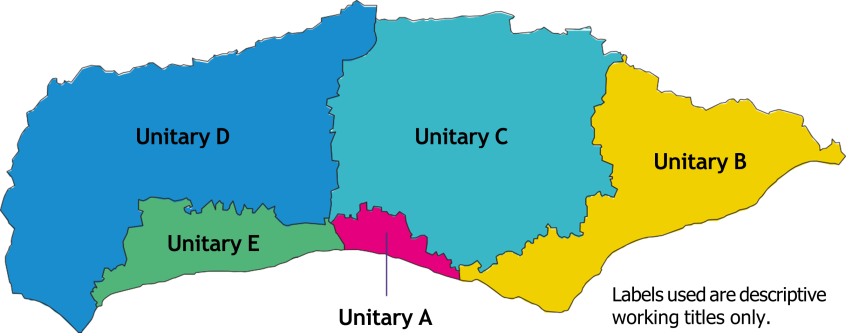
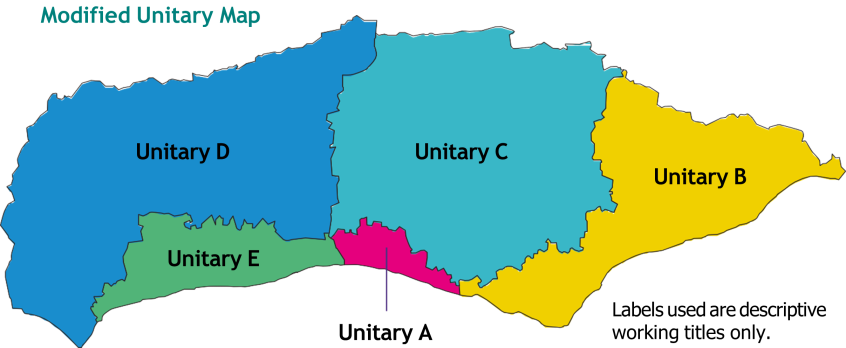
Modified Unitary Map

Unitary A
This includes:
- Brighton & Hove (all wards)
- the following wards from Lewes District Council:
- East Saltdean & Telscombe Cliffs
- Peacehaven West
- Peacehaven East
- Peacehaven North
- Falmer Parish (from Kingston ward)
Population: 301,130.
Why this council works
Brings together Brighton, Hove, Saltdean, Peacehaven, Telscombe and Falmer Parish as one continuous urban coastal area, aligning services with the way people already live, study and travel.
People
The youngest and most diverse part of Sussex, with only 13.5 per cent of residents aged 65 or over compared to more than 23 per cent in West Sussex and 26 per cent in East Sussex.
Strong student, commuter and family populations drive demand for housing, prevention and accessible services.
Place
Neighbourhoods along the seafront already function as a single city region.
Falmer links through universities, the Amex Stadium and health services. This helps align the Brighton Kemptown constituency boundary, which includes East Saltdean, Peacehaven and Telscombe.
Infrastructure and anchors
The A259 and Coastway rail bind the corridor.
Universities, hospitals, cultural venues and the visitor economy provide major anchors.
Criteria check
Within the expected population range, resilient, matches travel-to-work patterns, protects identity.
Unitary B
This includes:
- Eastbourne (all wards)
- Rother (all wards)
- Hastings (all wards)
- the following wards from Lewes District Council:
- Newhaven North
- Newhaven South
- Seaford Central
- Seaford East
- Seaford North
- Seaford South
- Seaford West
- the following wards from Wealden District Council:
- Pevensey Bay
- Lower Willingdon
- South Downs
- Herstmonceux & Pevensey Levels
- Polegate South & Willingdon Watermill
- Stone Cross
- Upper Willingdon
- Polegate North
- Polegate Central
Population: 359,868.
Why this council works
Brings together the eastern coastal towns of Sussex (Seaford, Newhaven, Eastbourne, Hastings and Rother) along with nearby Wealden communities. This creates one connected council for the eastern shoreline, where regeneration, health and transport can be planned as a single system.
People
Older age profiles and some of the starkest health inequalities in Sussex. In Hastings and Rother, over one in 5 adults reports a limiting long-term illness.
Wages are below the South East average.
Place
Eastbourne, Hastings, Rother, Seaford and Newhaven, with nearby Wealden communities such as Polegate and Willingdon that already rely on Eastbourne.
Infrastructure and anchors
The A259, East Coastway, and Seaford rail lines connect the shoreline.
Eastbourne District General and Conquest Hospitals provide health anchors.
Newhaven Port is an international gateway.
Criteria check
Representative population, aligns with service and travel patterns, supports regeneration, protects identity.
Unitary C
This includes:
- Mid Sussex District Council (all wards)
- the following wards from Wealden District Council:
- Arlington
- Buxted
- Maresfield
- Hartfield
- Forest Row
- Danehill & Fletching
- Horam & Punnetts Town
- Heathfield North
- Heathfield South
- Hellingly
- Withyham
- Hadlow Down & Rotherfield
- Mayfield & Five Ashes
- Chiddingly East Hoathly & Waldron
- Crowborough Central
- Crowborough North
- Crowborough South East
- Crowborough South West
- Crowborough St Johns
- Crowborough Jarvis Brook
- Frant & Wadhurst
- Uckfield Ridgewood & Little Horsted
- Uckfield North
- Uckfield East
- Uckfield New Town
- Hailsham Central
- Hailsham North
- Hailsham North West
- Hailsham South
- Hailsham West
- Hailsham East
- the following wards from Lewes District Council:
- Lewes Castle
- Kingston (without Falmer Parish)
- Plumpton
- Streat
- East Chiltington & St John
- Ouse Valley & Ringmer
- Lewes Bridge
- Lewes Priory
- Ditchling & Westmeston
- Newick
- Chailey
- Barcombe & Hamsey
- Wivelsfield
Why this council works
Creates one council for market towns, villages and rural communities that share daily commuting north to London and south to Brighton.
People
Employment is high (around 79%), but the population is ageing quickly, with strong growth forecast in the over-65 and over-85 age groups.
Families, commuters and older residents need reliable health and care services.
Place
Mid Sussex, with towns such as Uckfield and Crowborough and Lewes hinterland villages that look north for work and education.
Local character preserved through parish and town councils.
Infrastructure and anchors
The Brighton Main Line, Thameslink, Uckfield rail line and A23/A22 connect to London, Gatwick and Brighton.
Market towns, education hubs and health services act as anchors.
Criteria check
Representative population, supports growth and infrastructure, protects identity.
Unitary D
This includes:
- Chichester (all wards)
- Horsham (all wards)
- Crawley (all wards)
Population: 394,308.
Why this council works
Links Crawley, Horsham and Chichester, combining an international gateway with historic towns and rural communities.
People
Crawley has a younger and more diverse population, with median monthly wages around £2,576, but a claimant unemployment rate above 4%.
Horsham and Chichester bring older age profiles and extensive rural settlements.
Place
The economy of Gatwick and Manor Royal connects with historic towns and the South Downs. Parish and town councils safeguard accountability.
Infrastructure and anchors
Gatwick Airport, Manor Royal, Goodwood, the University of Chichester and the South Downs National Park.
The M23, A23 and A27 roads, and the Arun Valley and Horsham rail lines, provide connectivity.
Criteria check
Representative population, links key economic anchors with communities, supports devolution, protects identity.
Unitary E
This includes:
- Arun (all wards)
- Adur (all wards)
- Worthing (all wards)
Population: 343,098.
Why this council works
Brings together Arun, Adur, and Worthing as one coastal strip, reflecting the shared identity and daily life of seaside towns.
People
Among the oldest age profiles in Sussex, with a high demand for health and care services.
The coastal economy mixes tourism, marine industries, horticulture and a growing creative sector.
Place
Worthing, Littlehampton, Shoreham and Bognor Regis share housing markets, labour patterns and seafront challenges. Parish and town councils continue.
Infrastructure and anchors
The A259 and West Coastway rail connect the coast.
Worthing Hospital, Shoreham Port, Littlehampton Harbour and seafront economies act as anchors.
Criteria check
Representative population, coherent for coastal renewal and flood planning, strengthens health and care resilience, protects identity.
How this proposal meets the government’s criteria
Right size and scale
Each council serves between 301,000 and 394,000 residents. All fall within a tight band that gives resilience for adult and children’s services while staying close to communities.
Collectively, they form a county-wide population of 1.72 million, providing balance and strength for devolution.
High-quality and sustainable services
Single-tier councils:
- remove duplication between counties and districts
- place clear accountability in one unitary authority for each area
This makes services easier to use, decisions faster, and integration with health, education, police and voluntary sectors more effective.
Financial sustainability
The model reduces duplication, streamlines management and aligns contracts and estates.
Transition costs are real but will be paid back within a small number of years, after which recurring savings improve sustainability.
For all councils, social care, SEN and homelessness funding pressures remain, requiring national reform.
This model acknowledges the financial pressures that already exist within the Sussex system and provides the opportunity for genuinely local transformation and engagement to address them in the years to come.
It also provides a clearer framework of the need to engage the central government, the wider public sector partners and the Mayoral Authority in rebalancing those pressures.
Where individual councils face tighter financial margins, mitigations include:
- shared platforms and procurement
- phased policy convergence
- reserve guardrails
Local collaboration and consensus
This is a single coherent proposal for Sussex that allows clear comparison with East Sussex’s preferred option.
It has been developed with input from partners and over 2,000 residents, whose feedback has shaped protections for parishes, clarified accountability, and kept councils within a recognisable scale.
Support for devolution
The 5 representative councils provide equal and stable partners for a Sussex Mayor. Together, they create:
- one transport voice
- a visible investment pipeline
- a skills framework that can move from plan to delivery
Community engagement and neighbourhood empowerment
Councillor numbers and warding will follow LGBCE principles for fair representation and community identity.
As an interim, election-ready scheme, we propose using existing county electoral divisions as building blocks in 4 of the 5 councils, generally with 2 members per division, and a bespoke scheme where local circumstances require.
Parish and town councils retain their existing powers and precepts, supported by neighbourhood charters, and local access points to keep decisions close to communities.
Service delivery and lived experience
On day one, there will be continuity: bins collected, care provided, and front doors to services kept open.
Over time, services will become simpler and more responsive.
Each council will have one website, one account and one main phone number.
Policies will be harmonised fairly within each footprint, and council tax will be aligned over a transparent glidepath.
Decisions will be made with communities, not for them, so lived experience shapes priorities.
Financial case in outline
Change has costs and unlocks recurring savings. Estimated transition costs, savings and payback are set out in the financial case.
Savings are driven by removing duplication, streamlining management and aligning contracts and estates. Overall, the model delivers prudent payback in a small number of years, followed by sustained annual savings.
Top risks and mitigations
Reorganisation carries transition risks, particularly in ICT and finance, but these are recognised, openly managed and mitigated through phased delivery, dual running and independent assurance.
Transition disruption will be managed through phased cutover, dual running and strong programme controls.
ICT and data migration will be staged and supported by interoperable systems.
Funding reform and stranded liabilities will be addressed through early dialogue with the Government and prudent reserves.
Programme assumptions
Shadow arrangements from April 2027 and vesting from April 2028, subject to Government consultation and ministerial decision.
1. National and legal context
Why change is being proposed now
The government has set out a national programme to simplify two-tier areas where appropriate into single unitary councils and to devolve more powers for transport, skills, growth and net zero to directly elected Mayors and their Strategic Authorities.
The English Devolution White Paper (December 2024) and the English Devolution and Community Empowerment Bill provide the policy and legislative framework for local government reorganisation and devolution in Sussex.
In February 2025, MHCLG invited principal authorities in East Sussex and in Brighton & Hove, and principal authorities in West Sussex, to bring forward proposals for unitary local government for the invitation area.
The invitation allows exploration of wider boundaries where this would improve sustainability and support devolution, and asks councils to evidence how proposals meet the published criteria and enable easy comparison across Sussex.
The statutory route under the 2007 Act
Structural and boundary changes are made under the Local Government and Public Involvement in Health Act 2007.
Invitation and proposal
The Secretary of State invites proposals. Principal authorities submit a single, coherent proposal for the invitation area, supported by evidence.
Assessment and consultation
The government assesses proposals against its criteria and carries out statutory consultation before any decision is taken.
Decision and implementation
If satisfied, the Secretary of State may implement the change by making a Structural Changes Order.
The Order provides for transfer of functions, property, rights and liabilities, staffing and pensions, and may establish a shadow period or designate a continuing authority.
The government may also issue directions to protect financial stability during the transition.
Electoral arrangements
Interim electoral provisions are set out in the Order. The Local Government Boundary Commission for England then undertakes a review to settle longer-term electoral arrangements.
Proposals are normally framed using existing district boundaries as building blocks. Where boundary change is sought, this must be presented as a request for ministerial modification, supported by clear public service and financial sustainability justifications.
Our request for modifications is evidence-based and designed to improve service coherence, financial resilience, and community identity.
Interim plans submitted in Sussex
All Sussex partners provided interim plans in March 2025.
East Sussex councils set out a preference for a single unitary on the existing county boundary (“One East Sussex”), emphasising scale, continuity and collaboration.
West Sussex councils described options and dependencies and sought clarity on population steers, timelines and the interface with the Mayoral Strategic Authority, without selecting a single preferred model at the interim stage.
Brighton & Hove submitted an interim plan that described the unique character of the area, our early engagement feedback, and the options that would be explored
We indicated that, if feasible, a five-unitary Sussex-wide model would provide the most representative and sustainable structure.
Government feedback on interim plans
In June 2025, MHCLG published national feedback on interim plans. It did not approve or reject options. It asked areas to use common assumptions and datasets, to present evidence clearly against the 6 criteria, and to format proposals so that residents and partners can compare proposals side by side.
Officials invited further dialogue to refine cases ahead of final submissions.
The interim plan feedback requested that where a proposal contained a preferred option for a single tier of local government across the whole of the proposed Sussex and Brighton MSA area, such as an option for five unitary councils across Sussex, it's recommended that the impacts for both invitation areas are set out.
The interim plan feedback also clarified that existing district areas should be considered the building blocks for proposals, but that, where there's a strong justification, more complex boundary changes will be considered.
How this proposal meets the Government’s 6 criteria
This document is deliberately structured against the 6 criteria set out in the invitation to enable a clear and auditable assessment. A summary of this is included in the Executive Summary.
Indicative timelines and dependencies
The invitation set an indicative pathway from proposal development to consultation and, if Ministers decide to proceed, to the making of a Structural Changes Order.
The sequence and timing are for the Government to determine and may change. Our delivery plans, therefore:
- identify the decisions only the government can make
- set out the steps we will take once those decisions are confirmed
- build in safeguards from recent reorganisations, including:
- phased implementation
- external assurance
- clear financial directions
How this document responds
We present a five-unitary council base case with whole district councils as the building blocks and request a ministerial modification to adopt refined boundaries where this better meets the criteria.
We have aligned headings and assumptions so assessors, residents and peers can compare like-for-like with East Sussex and West Sussex interim work.
We have consistently indicated that, subject to feasibility, a five-unitary Sussex model could provide the most representative and sustainable structure if it could be made to work. This final proposal shows how that can now be delivered.
We set out the government’s 6 criteria next, followed by our options and shortlisting, our modified five-unitary authority model, and the base case it's built from.
Key documents and references
English Devolution White Paper (December 2024).
Sets the national direction: simplify two-tier areas into unitary councils and devolve powers to Mayors and Strategic Authorities.
English Devolution and Community Empowerment Bill (2024 to 2025).
Provides the legislative framework for unitarisation and neighbourhood governance.
MHCLG invitation letter (February 2025). Invited East Sussex, Brighton & Hove, and West Sussex councils to bring forward proposals, with scope to explore wider boundaries.
East Sussex interim plan (Mar 2025) Preferred option: “One East Sussex”, a single county-wide unitary, emphasising scale, continuity and collaboration.
West Sussex interim submission (March 2025).
Explored one or two unitaries, flagged dependencies on Brighton’s footprint and Crawley’s alignment, with no preferred option.
Brighton & Hove interim plan (March 2025). Tested a coastal unitary footprint and signalled that a five-unitary Sussex model could be the most balanced option.
MHCLG national feedback on interim plans (June 2025).
Did not approve or reject options. Called for common datasets, clear evidence against 6 criteria, and like-for-like comparability.
Sussex feedback pack (June 2025). Collated MHCLG feedback on East Sussex, West Sussex and Brighton & Hove interim plans.
2. The case for a new beginning
This section explains why change is needed across Sussex, the outcomes we want for residents and partners, and the principles that shape a stronger map for local government and devolution.
Why change is needed now
People in Sussex deal with a system every day that is too complicated, too slow, and increasingly fragile. Residents are passed between tiers, and families are sometimes unsure whether to call the district or the county. Boundaries cut across daily life.
Prevention and early help often stop at the council line, even though health, education and care pathways cross them every day.
Services are under strain. Adult social care, children’s SEND and homelessness are rising faster than budgets. Without reform, councils will struggle to cope with the challenges.
Duplication drives cost. Partners can find themselves repeating conversations across several councils before decisions are taken, delaying investment and reducing efficiency.
Doing nothing risks costing more and delivering less. Standing still risks weaker resilience in services and leaves residents with a system that is harder to use.
What people told us
Over 2,300 people took part in our second round of engagement. Responses were self-selecting and not statistically representative, but they gave clear insight.
As in other parts of the country, many were sceptical about structural reform. Within that, residents and partners consistently set out the safeguards they would want if change proceeds.
Concerns included:
- identity and representation
- trust and governance
- services and infrastructure
- finance
- vulnerable groups
- boundaries and process
We have treated these as design conditions. Our proposal reflects them through:
- indicative right-sized councils of around 300,000 to 400,000 residents (subject to statutory consultation)
- neighbourhood charters to support the parish and town voice
- a Day-1 continuity principle for services
- safeguards in principle on finance
- clearer accountability about who does what
Full details of engagement are set out in section 9.
Functional Sussex: councils designed around how people live
People in Sussex routinely cross council lines to use schools, hospitals, workplaces, libraries and leisure facilities.
Organising local delivery and accountability around lived geographies could support the following.
Devolution readiness
This would support the Mayor working with a small number of stable, expert councils anchored in functional geographies.
Design once, deliver locally
This would support prevention standards and service pathways set once per corridor, so people do not face different rules from town to town.
Clearer accountability
This would support residents having a defined local lead for the services they use most, and partners having fewer, more consistent relationships.
This approach is expected to:
- give people fairer access, clearer rules and faster action
- make services simpler and more consistent across the places they actually use
- enable Sussex to present a clearer national voice while keeping councils recognisable and close to communities
Illustrative corridors already cut across current boundaries.
South Coast Corridor
The A259 and the Coastway rail lines link communities from Hastings and Eastbourne through Seaford, Newhaven, Peacehaven, Saltdean and Brighton & Hove, continuing west towards Worthing and Chichester.
Aligning local delivery here could:
- bring consistency to services such as admissions, travel concessions and social care
- support joined-up regeneration
- provide the Mayor with clear partners on coastal priorities
North–south spines
The Brighton Main Line and Thameslink services connect Mid Sussex and Crawley directly to Gatwick and London. Horsham links in via the Arun Valley line.
Treating these routes as functional geographies could:
- support planning around stations
- integrate prevention with NHS providers and colleges
- give the Mayor clear partners for rail, skills and investment
Gateways: ports and the airport
Gatwick Airport, Newhaven and Shoreham ports are gateways of regional and national significance. Littlehampton harbour plays a more local role.
Aligning councils to these gateways could:
- ensure local impacts are managed coherently
- enable the Mayor to lead on trade corridors, freight strategy, decarbonisation and national investment
Rural Sussex: east and west
In the east, market towns such as Uckfield and Crowborough anchor the High Weald. In the west, Chichester and the South Downs sustain farming, visitor economies and green industries.
Recognising these rural systems could:
- bring services into a single local approach tailored to dispersed settlements
- ensure parish and town voices are designed-in
- give the Mayor rural counterparts on connectivity, investment and climate resilience
What good looks like for Sussex
The case for reform is not about structure for its own sake. It's about councils that are simpler to navigate, safer for services and closer to communities.
The government’s 6 tests are the guardrails that ensure any proposal delivers those outcomes.
Our interpretation for Sussex is to create councils that are local where it matters and scaled where it helps.
Local means:
- councils people recognise
- a single accountable route for services
- neighbourhood voice designed in
- visible local access
Scale means councils large enough to:
- deliver high-risk services safely
- withstand financial shocks
- sustain professional depth and act as credible partners to the NHS, education, police, government, investors and the Mayor
Meeting the 6 tests
- Establishing a single tier of local government. For residents, this means one accountable council for local services in each area, so people are clear who to turn to. The aim is to simplify responsibility and reduce duplication. The exact configuration will be tested further in the statutory process.
- Councils of the right size. Councils must be large enough to run complex services and resilient enough to absorb shocks, while still being recognisable. We believe that councils in the 300,000 to 400,000 range may best balance local identity with resilience, subject to statutory consultation and ministerial decision.
- High-quality and sustainable services. The priority is safe continuity. On day one, residents should continue to use services in the same way. In the longer term, aligning councils to lived geographies can make prevention more consistent and allow focus on local pressures such as coastal deprivation, growth around Gatwick or rural access.
- Engagement was sceptical about reform but surfaced clear conditions for support: recognisable councils, clear accountability, and neighbourhood voice. These conditions are embedded in the design. Only the statutory consultation can test all options across Sussex.
- Support for devolution. Sussex is preparing for a Mayoral Strategic Authority. Right-sized councils aligned to lived geographies could provide the Mayor with a small number of expert, democratically accountable partners, improving pace and clarity of decisions on transport, skills, housing growth and net zero.
- Stronger community engagement and neighbourhood empowerment. Parish and town councils will remain with their existing powers and precepts. It's anticipated that new authorities will consider mechanisms such as neighbourhood charters and locality arrangements. Local access could be maintained through existing hubs. Specific mechanisms would be determined locally through democratic processes.
3. Options considered and methodology
This section explains how options were appraised and how we reached our proposal. The government’s invitation made clear that whole principal authorities are the normal building blocks, but it also allowed for refined boundaries where there's a strong justification.
We therefore assessed both:
- a statutory base case using whole principal authorities (Districts and Boroughs) to meet the requirement under the 2007 Act
- alternative maps using wards (and one parish) which better reflect communities and lived experiences
Considering the whole of Sussex
Although the invitation formally covered East Sussex and Brighton & Hove, the government’s letter (February 2025) also made clear that proposals could explore wider boundaries where there was justification.
All of Sussex is moving towards a single Mayoral Strategic Authority (MSA), and the interim plan feedback invited further detail on how the proposed new structures would support arrangements for the proposed Sussex & Brighton MSA.
MHCLG feedback stated that ‘in this regard it would be helpful for proposals to have regard to the model of government that is proposed across the whole Sussex & Brighton area’.
For that reason, and because Brighton & Hove sits between East and West Sussex, we assessed options across the whole of Sussex.
This approach ensures coherence for devolution and continuity for residents.
Coherence for devolution
The Mayor will need a stable set of constituent councils covering the whole county. Considering Sussex as a whole means the final structure is balanced and credible at the Mayoral level.
Continuity for residents
Daily travel and service use crosses the East–West line: Coastway, Gatwick and the Downs–Weald corridors all cut across boundaries.
Our starting point
All councils in Sussex face financial pressures from adult social care, special educational needs and homelessness. Reorganisation does not remove those national pressures. Our gateway test was therefore resilience. No new council should be too small to survive or so large that it becomes remote.
We also assessed deliverability and cost of change. More complex options require services to be split and recombined, which increases programme cost and risk in the short term. This cannot be ignored. But we're clear, this is a once-in-a-generation opportunity to reshape local government for the next 30 to 40 years. That means short-term costs and complexity must be weighed against long-term benefits for residents and communities.
Feedback from engagement reinforced these principles. Residents consistently stressed the importance of councils they recognise, parish and neighbourhood voice, and clearer accountability for services. These conditions were built into our considerations.
Method and evidence
We built a Sussex-wide evidence base from published sources. The same assumptions were applied to every option.
Options were assessed against the 6 government criteria:
- A proposal should seek to achieve for the whole of the area concerned the establishment of a single tier of local government.
- Unitary local government must be the right size to achieve efficiencies, improve capacity and withstand financial shocks.
- Unitary structures must prioritise the delivery of high-quality and sustainable public services to citizens.
- Proposals should show how councils in the area have sought to work together in coming to a view that meets local needs and is informed by local views.
- New unitary structures must support devolution arrangements.
- New unitary structures should enable stronger community engagement and deliver genuine opportunities for neighbourhood empowerment.
Options considered
3 unitaries:
- uneven sizes, some large and remote, others small and fragile
- harder collaboration due to an imbalance, weaker pooling of risk
- fewer partners for the Mayor, but with an imbalance in size and weight
4 unitaries
- stronger short-term pooling, easier to deliver
- still unbalanced in size, with larger councils at risk of feeling remote
- a better match to NHS Sussex place-based partnership footprints in the short term, but identity and local connection are weaker
5 unitaries
- more costly transition in the short term
- creates representative councils within a 300,000 to 400,000 band
- better long-term match to how people live, avoids leaving outlier communities underserved
Whole-district maps either produced councils that were too large and remote or required costly and disruptive service separation.
Options compared against the Government’s tests
Shortlist
On the combined balance of the 6 government criteria, the five-unitary map with modifications is proposed. This meets the following criteria:
- resilience: all 5 councils fall within a stable 300,000 to 400,000 band
- deliverability: transition is more complex than 3 or 4, but manageable with a phased approach and worth it to secure the right long-term structure
- identity: parishes and towns remain intact, so councils remain recognisable
- devolution: 5 balanced partners for the Mayor, with no single authority dominant
A four-unitary map pools resources more easily in the short term and is easier to deliver. But over the decades, it risks councils that are too large and remote, and requires disruptive separation now.
Finance is one test among 6. On the combined balance, analysis indicates that 5 unitaries, though harder to deliver, offer the most sustainable long-term balance for Sussex.
Sensitivities and dependencies
National decisions on adult social care, SEND and homelessness funding remain decisive for every option. These pressures account for the majority of future deficits across all Sussex councils and cannot be resolved through reorganisation alone.
The forthcoming Fair Funding Review is particularly important. Its timing creates both risk and opportunity.
If the Review shifts resources away from areas with older populations or higher social care demand, all Sussex councils will face greater structural pressure.
Equally, the Review provides an opportunity to address current funding discrepancies across East and West Sussex, where costs of care, transport and housing are high but not always fully recognised in the national formula, and risk not being adequately understood and represented on the national stage by the current large upper-tier councils.
Our financial modelling is therefore cautious. It assumes that current funding arrangements continue and that any positive changes from Fair Funding or wider reform (for example, multi-year settlements or simplification of grants) will be treated as upside.
Other dependencies include:
- implementation timetable: sequencing of Orders and elections will affect costs, complexity and deliverability, especially where shadow arrangements are needed
- ICT and contract transition: scale and cost of data migration and contract transition vary with the number of councils created - more councils mean more harmonisation, but also greater resilience once established
- neighbourhood governance requirements: expected secondary legislation on neighbourhood charters and representation ratios will shape how local voice is built into each new council
We have tested sensitivities around population forecasts and inflation assumptions. In all cases, the relative balance between options remained the same: 4 performs best on short-term financial pooling, while 5 performs best on long-term balance, identity and prevention.
4. The Base Proposal using whole districts as building blocks
This Base Proposal is required under the 2007 Act and is presented here for compliance. It does not represent the proposal we're advancing.
Our substantive proposal (Modified Proposal), set out in section 5, seeks a ministerial modification to refine this baseline into a balanced five-unitary model for Sussex.
Compliance statement
This section constitutes our Base Proposal on whole district boundaries, prepared in accordance with Part 1 of the Local Government and Public Involvement in Health Act 2007 and the February 2025 invitation.
It's a statutory base proposal and is not the final proposal we're advancing.
Our substantive proposal, which requests ministerial modification, is set out in section 5.
Base Proposal configuration
The base case groups existing principal authorities into 5 unitary councils, without any changes to existing District or Borough council boundaries.
- Unitary A: Brighton & Hove City Council (all wards); Lewes District Council (all wards) - Type C proposal.
- Unitary B: Eastbourne Borough Council (all wards); Hastings Borough Council (all wards); Rother District Council (all wards); Wealden District Council (all wards) - Type B proposal.
- Unitary C: Mid Sussex District Council (all wards) - Type B proposal.
- Unitary D: Crawley Borough Council (all wards); Horsham District Council (all wards); Chichester District Council (all wards) - Type B proposal.
- Unitary E: Arun District Council (all wards); Adur District Council (all wards); Worthing Borough Council (all wards) - Type B proposal.
Assessment against the government's tests
- Single-tier of local government
Creates 5 unitary authorities using existing principal authorities as building blocks. Meets the invitation’s requirement to set out a base case on whole districts and removes two-tier arrangements within each area.
- Right size and financial resilience
Produces units of uneven population size (for example, a single-district unit is smaller than a unit comprising several districts). The range in size may have implications for resilience and perceived local connection.
The extent of risk would depend on the size of each unit and on the delivery model adopted.
- High-quality and sustainable services
Establishes single tiers per area, which removes duplication of tiers. The degree of service integration and consistency would depend on local access, locality arrangements, and phasing.
Uneven population sizes may make collaboration and standardisation more variable across the county.
- Local collaboration and responsiveness to views
Provides a legally coherent configuration based on administrative boundaries. It does not incorporate ward-level refinements or other adjustments arising from engagement.
Transition would require formal collaboration mechanisms between the new councils.
- Support for devolution
Creates a complete set of constituent councils across Sussex for a Mayoral Strategic Authority.
Variation in unit size could affect perceived balance at the Mayoral table and may require compensating partnership arrangements.
- Community engagement and neighbourhood empowerment
Interim electoral and governance arrangements would ordinarily be set in the Structural Changes Order.
A full electoral review by the Local Government Boundary Commission would typically follow vesting to secure appropriate representation and neighbourhood governance in each new unitary.
Dependencies
All decisions on consultation, Orders, electoral arrangements and financial directions rest with the government.
No changes take effect unless and until the government makes a Structural Changes Order following statutory consultation.
5. Our proposal for 5 representative councils for Sussex
This section sets out the modified proposal we're asking the government to consult on and consider. The proposal is a modification of our Base Proposal, which is based on whole districts in accordance with s2 of the Act, and laid out in section 4.
We show the precise areas involved, the rationale for change, and how each option performs against the government’s published tests.
Sussex-wide rationale for 5 representative councils
Our proposal creates 5 new unitary councils that together cover the whole of Sussex. They are designed as a single, coherent family of authorities: each rooted in its local communities, yet collectively strong enough to partner effectively with a Sussex Mayor.
Every council falls within a representative population band of 300,000 to 400,000 residents, avoiding extremes of scale that risk either fragility or remoteness.
Each footprint reflects daily travel-to-work patterns and economic corridors, ensuring that services, growth and infrastructure can be planned once and delivered more effectively.
By keeping parishes and towns intact, the model preserves local identity and accountability, while the potential for shared services and platforms across the 5 councils reduces cost and risk.
This arrangement balances what matters most: resilient councils that can run complex services, neighbourhoods that retain a clear voice, and a county-wide structure that provides a credible foundation for devolution.
Other models were tested, including 3 or 4 unitaries. These offered some short-term simplicity but created uneven scales, left some areas feeling remote from decision making, and risked concentrating too much power in one or two very large authorities.
5.1 Our proposed 5 unitaries
5 councils strike the right balance:
- resilient but connected - each council has 300,000 has 400,000 residents, large enough for adult and children’s services, small enough to remain rooted
- functional fit - boundaries align to daily travel patterns and economic corridors
- fair partnership - 5 councils of similar size avoid dominance by any one authority and give the Mayor a stable set of partners
- deliverable - the model allows phased transition and shared platforms to manage complexity
- recognisable - each footprint reflects places that residents already identify with and keeps parishes intact
The 5 proposed unitaries at a glance
Council (working title): Unitary A
Areas covered (summary): Brighton, Hove, Peacehaven, Telscombe, East Saltdean, Falmer
Population (approximately): 301,000
Indicative councillors: ~59
Council (working title): Unitary B
Areas covered (summary): Eastbourne, Hastings, Rother, Seaford, Newhaven, South Wealden communities
Population (approximately): 360,000
Indicative councillors: ~67
Council (working title): Unitary C
Areas covered (summary): Mid Sussex, Lewes hinterland, Uckfield, Crowborough, northern Wealden towns
Population (approximately): 323,000
Indicative councillors: ~55
Council (working title): Unitary D
Areas covered (summary): Crawley, Horsham, Chichester
Population (approximately): 394,000
Indicative councillors: ~62
Council (working title): Unitary E
Areas covered (summary): Worthing, Adur, Arun
Population (approximately): 343,000
Indicative councillors: ~54
5.2 Government criteria at a glance: 5 representative councils
Our proposal creates 5 representative councils across Sussex. Each falls within an indicative population band of 300,000 to 400,000 residents, avoiding extremes of scale that risk fragility or remoteness.
The configuration reflects daily travel and service corridors, keeps principal towns and parishes intact, and ensures councils are similar in size so that none dominates.
This creates a fair and stable set of partners for a Sussex Mayor, while ensuring services remain recognisable and the local voice is protected.
Unitary A (Brighton, Hove, Peacehaven, Telscombe, Falmer)
- Right size and scale
Approximately 301k residents. Within the 300 to 400k indicative band. Continuous coastal and urban corridor avoids extremes of size.
- High-quality and sustainable services
One authority for school admissions, SEND travel and care pathways along the A259/Coastway, reducing hand-offs.
Unites the eastern coast and Newhaven Port, so prevention, health and regeneration can be planned once.
- Financial resilience
Balanced tax base. Shared corporate platforms across 5 councils are anticipated to reduce overheads. Savings to be tracked and verified through implementation and audit.
- Local collaboration and responsiveness to views
Comparable in size to peers, avoiding dominance. Responds to engagement feedback about recognisable councils and clear accountability.
Well placed to collaborate with NHS trusts, universities and the voluntary sector across the city region.
- Support for devolution
Provides a clear coastal urban partner for the Mayor on transport, skills, growth and net zero.
- Community engagement and neighbourhood empowerment
Ward councillors continue under interim arrangements; full LGBCE review post-vesting. Parishes remain in Peacehaven, Telscombe and Falmer.
A neighbourhood charter is anticipated to set standards across urban neighbourhoods and eastern parishes.
Local access is maintained through hubs such as libraries and family centres, with further tools to be considered by the new authority.
Unitary B (Eastbourne, Hastings, Rother, Seaford, Newhaven, South Wealden)
- Right size and scale
Approximately 360k residents. Within the band. Brings the eastern shoreline into one authority without creating an over-large unit.
- High-quality and sustainable services
Unites the eastern coast and Newhaven Port, so prevention, health and regeneration can be planned once.
- Financial resilience
Larger coastal footprint supports consistent commissioning and shared systems, improving resilience over time.
- Local collaboration and responsiveness to views
Balances 3 coastal districts with inland communities. Keeps Seaford and Newhaven with Eastbourne, reflecting feedback. Supports joint work with East Sussex Healthcare NHS Trust, Newhaven Port, Further Education and Higher Education, and regeneration partnerships.
- Support for devolution
Provides a single eastern shoreline partner for regeneration, port and transport programmes.
- Community engagement and neighbourhood empowerment
Ward councillors continue; full LGBCE review post-vesting.
Parishes remain across the eastern coast, including Seaford and Newhaven.
A neighbourhood charter is anticipated to set standards for coastal and inland engagement. Local hubs provide visible access; outreach for vulnerable groups.
Unitary C (Mid Sussex, Lewes hinterland, northern Wealden towns)
- Right size and scale
Approximately 323k residents. Within the band. Keeps market towns and rural areas together at a sustainable scale
- High-quality and sustainable services
Aligns commuter flows to Gatwick and London; single local approach to rural prevention and family support.
- Financial resilience
A mix of growing towns and rural areas. Shared procurement and platform alignment are intended to support efficiencies.
- Local collaboration and responsiveness to views
A peer of comparable size to others. Keeps Lewes town and rural hinterland together, responding to engagement. Strong basis for joint work with health, Further Education and Higher Education, and rural networks.
- Support for devolution
Provides a coherent inland partner aligned to rail spines and rural networks.
- Community engagement and neighbourhood empowerment
Ward councillors continue; full LGBCE review post-vesting.
Parishes and market towns remain intact.
A rural-focused neighbourhood charter anticipated, with parish partnerships, digital outreach and locality budgets considered by the new authority.
Unitary D (Crawley, Horsham, Chichester)
- Right size and scale
Approximately 394k residents. Upper end of the band, but still within range. Combines airport communities, towns and the South Downs without dominance.
- High-quality and sustainable services
Links Gatwick Airport, Crawley, Horsham and Chichester with the surrounding South Downs, allowing coherent planning of services and infrastructure.
- Financial resilience
A diverse economy around Gatwick and historic towns. Shared back-office systems are intended to provide savings once the steady state is reached.
- Local collaboration and responsiveness to views
Larger but still within the band, acting as a peer among 5.
Combines Gatwick with market towns and the South Downs, supporting collaboration with airport bodies, employers, Further Education and Higher Education, and rural partnerships.
- Support for devolution
Provides a representative partner linking Gatwick with historic towns and rural areas to the west.
- Community engagement and neighbourhood empowerment
Ward councillors continue; full LGBCE review post-vesting.
Parishes remain in Horsham and Chichester; unparished Crawley is covered by tailored arrangements.
A charter anticipated to formalise standards across towns and villages, with mechanisms such as resident panels considered for issues linked to the airport, skills and transport.
Unitary E (Arun, Adur, Worthing)
- Right size and scale
Approximately 343k residents. Within the band. A coherent west-coast strip at a sustainable size.
- High-quality and sustainable services
Supports coastal renewal, flood management, and consistent community health and care along the West Coastway.
- Financial resilience
Shared coastal challenges are addressed jointly. Procurement alignment and platform sharing are expected to support recurring efficiencies.
Provides a west-coast partner for seafront renewal, flood schemes and skills for coastal sectors.
- Local collaboration and responsiveness to views
Provides a west-coast peer of comparable size. Keeps coastal towns together, reflecting identity. Supports joint approaches on flooding, coastal renewal and skills with local partners.
- Support for devolution
Provides a west-coast partner for seafront renewal, flood schemes, and skills for coastal sectors.
- Community engagement and neighbourhood empowerment
Ward councillors continue; full LGBCE review post-vesting.
Parishes remain in Arun; unparished Worthing and parts of Adur are covered by tailored neighbourhood arrangements.
A coastal charter is anticipated to set standards for engagement on seafront renewal, flood schemes, and the local environment.
5.3 Request for ministerial modification to the Base Proposal
We request that the Secretary of State modify the statutory Base Proposal described in Section 4 to adopt the boundary refinements set out below.
These refinements better satisfy the government criteria by improving:
- public service coherence
- financial sustainability
- local identity
- the balance of partners for devolution
What change is sought
- Unitary A - Coastal urban council centred on Brighton & Hove
Transfer from Lewes District: East Saltdean & Telscombe Cliffs ward; Peacehaven West, East and North wards; Falmer parish (from Kingston ward).
- Unitary B - Eastern coastal council (Eastbourne, Hastings, Rother, part-Wealden, part Lewes)
Transfer from Lewes District: Seaford South, West, North, Central and East wards; Newhaven North and South wards.
Transfer from Wealden District: Polegate North and Central wards; Polegate South & Willingdon Watermill ward; Upper and Lower Willingdon wards; Stone Cross ward; Pevensey Bay ward; Herstmonceux & Pevensey Levels ward; South Downs ward.
- Unitary C - Rural and market towns council (Mid Sussex, northern Wealden, Lewes hinterland)
Transfer from Lewes District: Lewes Castle, Bridge and Priory wards; Kingston ward (minus Falmer parish); Newick ward; Chailey, Barcombe & Hamsey ward; Plumpton, Streat, East Chiltington & St John ward; Ouse Valley & Ringmer ward; Ditchling & Westmeston ward; Wivelsfield ward.
Transfer from Wealden District: Uckfield Ridgewood & Little Horsted, North, East and New Town wards; Arlington ward; Buxted ward; Maresfield ward; Hartfield ward; Forest Row ward; Danehill & Fletching ward; Horam & Punnetts Town ward; Heathfield North and South wards; Hellingly ward; Withyham ward; Hadlow Down & Rotherfield ward; Mayfield & Five Ashes ward; Chiddingly, East Hoathly & Waldron ward; Crowborough Central, North, South East, South West, St Johns, Jarvis Brook wards; Frant & Wadhurst ward; Hailsham Central, North, North West, South, West, East wards.
- Unitary D - North Sussex council (Crawley, Horsham, Chichester) - no change
- Unitary E – West Sussex coast council (Arun, Adur, Worthing) - no change
Why this modification better satisfies the tests than the statutory baseline
Public services
The modification removes artificial splits created by whole-district boundaries.
Seaford and Newhaven are placed with Eastbourne, where residents already travel for schools, hospitals and jobs.
Lewes hinterland wards and northern Wealden towns join Mid Sussex, matching commuting and education flows north and south.
This alignment means councils can plan once for the services people actually use, instead of handing off across boundaries.
Financial sustainability
The refined map is more complex to deliver in the short term and will bring higher transition costs than whole-district mergers. However, it avoids leaving councils at extremes of size that would be financially fragile or too remote from residents.
By creating 5 authorities in a tighter band of around 300 to 400k residents, the model provides a stronger long-term balance. National pressures in social care, SEND, and homelessness remain, but this structure ensures no council is set up to fail.
Identity and accountability
The modification produces councils that people recognise. Parishes and towns are kept whole, with no principal settlement split.
Seaford is not separated from its coastal neighbours, Lewes town remains with its rural hinterland, and Peacehaven and Telscombe join the city corridor where they already look.
Town and parish councils remain, supported by neighbourhood charters. This ensures the local voice is visible and protected, while councils are big enough to carry complex services sustainably.
Comparison of the statutory Base Proposal (whole districts, no ward changes) and the requested Modified Proposal (refined boundaries)
Government test: 1. Single-tier of local government
Base Proposal (whole districts, no modifications)
Creates 5 unitary authorities using existing principal authorities as building blocks. Meets the invitation’s requirement to set out a base case on whole districts and removes two-tier arrangements within each area.
Modified Proposal (refined boundaries as set out in 5.25.3)
Also creates 5 unitary authorities and removes two-tier arrangements. Uses ward and parish refinements to adjust footprints where justified so that the single-tier pattern better follows how people use services.
Government test: 2. Right size and financial resilience
Base Proposal (whole districts, no modifications)
Produces units of uneven population size (for example, a single-district unit is smaller than a unit comprising several districts). The range in size may have implications for resilience and perceived local connection.
The extent of risk would depend on the size of each unit and on the delivery model adopted.
Modified Proposal (refined boundaries as set out in 5.25.3)
Places all 5 councils within an indicative band of about 300,000 to 400,000 residents. This is intended to avoid extremes of scale and to provide a more balanced platform for long-term resilience.
Financial performance would still depend on delivery choices, but the starting sizes are more even.
Government test: 3. High-quality and sustainable services
Base Proposal (whole districts, no modifications)
Establishes single tiers per area, which removes duplication of tiers. The degree of service integration and consistency would depend on local access, locality arrangements and phasing.
Uneven population sizes may make collaboration and standardisation more variable across the county.
Modified Proposal (refined boundaries as set out in 5.25.3)
Aligns footprints more closely with travel-to-work and service corridors, so fewer hand-offs should be needed, and prevention can be designed once and delivered locally. Any service changes would follow assessment, engagement and due process.
Government test: 4. Local collaboration and responsiveness to views
Base Proposal (whole districts, no modifications)
Provides a legally coherent configuration based on administrative boundaries. It does not incorporate ward-level refinements or other adjustments arising from engagement.
Transition would require formal collaboration mechanisms between the new councils.
Modified Proposal (refined boundaries as set out in 5.25.3)
Reflects engagement themes about recognisable councils, clearer accountability and neighbourhood voice by keeping principal settlements and parishes intact where possible.
Councils of similar size are intended to collaborate as peers, with less risk of dominance.
Government test: 5. Support for devolution
Base Proposal (whole districts, no modifications)
Creates a complete set of constituent councils across Sussex for a Mayoral Strategic Authority. Variation in unit size could affect perceived balance at the Mayoral table and may require compensating partnership arrangements.
Modified Proposal (refined boundaries as set out in 5.25.3)
Provides 5 partners of comparable size for the Mayor. This is intended to create a fair and stable platform for strategy, investment and performance without a single authority being dominant.
Government test: 6. Community engagement and neighbourhood empowerment
Base Proposal (whole districts, no modifications)
Interim electoral and governance arrangements would ordinarily be set in the Structural Changes Order.
A full electoral review by the Local Government Boundary Commission would typically follow vesting to secure appropriate representation and neighbourhood governance in each new unitary.
Modified Proposal (refined boundaries as set out in 5.25.3)
Parishes and towns remain intact where possible. Neighbourhood charters and proportionate locality arrangements are anticipated so that local voice is visible, with initial warding settled through the Order and a full LGBCE review post-vesting.
6. Proposed council profiles
Unitary A
Population: ~301,000.
Boundary and geography
This authority would bring together the existing Brighton & Hove City Council with East Saltdean & Telscombe Cliffs, Peacehaven (East, West, North) and Falmer Parish.
These areas already share schools, universities, hospitals and cultural anchors, with thousands of daily journeys along the A259, Coastway rail and Brighton Main Line.
Including Falmer resolves an administrative anomaly: it's functionally part of the city’s service and transport system, but currently sits outside the boundary.
Governance and representation
- indicative councillors: c.59, based on county divisions scaled to 2 to 3 members each, subject to full LGBCE review after vesting
- Leader and Cabinet governance model
- Peacehaven Town, Telscombe Town, and Falmer Parish Councils will be retained with their existing powers and precepts
- ward councillors continue, supported by a Neighbourhood Charter to guarantee consultation standards, response times, and escalation routes
- legal neutrality: all proposals are subject to ministerial decision and statutory process
Council tax and finance
- Band D harmonisation phased fairly; parish precepts remain local, the period and method for harmonisation are set in the Structural Changes Order - recent reorganisations have used multi-year glidepaths, we do not fix a number here, it would be confirmed in the Order
- resilience strengthened by pooling resources and cutting duplication across the coastal corridor
- potential to explore shared services across all 5 councils in internal audit, procurement, ICT, finance, HR/payroll, and customer contact to support steady-state savings
- shared platforms for cybersecurity and data, finance, HR/payroll and customer systems would be procured once and used by all 5 councils
- like all councils, this footprint will still face national pressures in adult social care, SEND and homelessness - the coherent footprint improves the ability to manage these pressures, it does not remove them
Services (council-led)
- children’s services rated Outstanding (Ofsted, 2024), with standards extended across the new footprint
- adult services are stable but under rising demand; a wider urban base improves resilience
Education, housing, public health/prevention and local regeneration could be planned once across the corridor, reducing costly hand-offs (council-led).
This authority will also take on county services currently delivered by East Sussex for the Peacehaven, Telscombe, East Saltdean and Falmer areas, ensuring one council is responsible for all local functions
Why this council works
Brighton, Hove, Peacehaven, Telscombe, East Saltdean and Falmer already operate as one urban coastal system.
Residents share the same schools and colleges, universities, hospitals, leisure and cultural facilities.
Aligning local government with this lived reality delivers:
- simpler services (council-led): one accountable authority instead of hand-offs across boundaries
- clearer local accountability: one website, one account and one main phone number
- identity protected: parish and town councils retained; neighbourhood plans for places that want them
- better strategic fit with the Mayor: a single coherent coastal council that can work with the Sussex Mayor on county-wide strategy for transport corridors, skills and investment - local housing and regeneration remain council functions, aligned to the Mayoral strategy where relevant
At ~301,000 residents, the footprint sits within the 300 to 400k, which we believe is large enough for professional depth and financial resilience, yet small enough to remain connected to communities.
Collectively, the 5 new councils provide a Sussex-wide scale without creating a single remote authority.
What this means for residents
- clarity: one council responsible for local services across the corridor, fewer points of confusion
- continuity: bins collected, care packages maintained, schools open, safeguarding in place
- identity protected: Peacehaven, Telscombe, and Falmer remain distinct places, with parish and town councils unchanged
- fair council tax: harmonisation phased gradually and explained clearly
- no change to addresses: residents still live in Peacehaven, Telscombe, Saltdean, Falmer, Brighton or Hove
Government tests at a glance
Criterion: 1. Single tier of local government
Assessment: Meets
Evidence: Creates a single unitary authority, removing 2 tiers along the corridor.
Criterion: 2. Right size and financial resilience
Assessment: Meets
Evidence: Approximately 301k residents within the 300 to 400k indicative band; balanced with the other 4 councils.
Criterion: 3. High-quality, sustainable services
Assessment: Meets
Evidence: A single council reduces hand-offs and duplication. Strong existing children’s services (Ofsted, 2024: Outstanding) and wider prevention can be planned once.
Criterion: 4. Local collaboration and responsiveness to views
Assessment: Meets
Evidence
Responds to engagement feedback on recognisable councils and accountability. Representative peer alongside 4 others, able to collaborate with NHS trusts, universities and the voluntary sector.
Criterion: 5. Support for devolution
Assessment: Meets
Evidence
Provides a coherent coastal partner for the Sussex Mayor on transport, skills and investment.
Criterion: 6. Community engagement and neighbourhood empowerment
Assessment: Meets
Evidence
Peacehaven, Telscombe and Falmer councils remain; the neighbourhood charter is anticipated to guarantee standards and visibility of local voice.
Unitary B
Population: ~360,000.
Boundary and geography
This council would unite Eastbourne, Hastings and Rother with Seaford and Newhaven, plus nearby Wealden communities that functionally tie into Eastbourne (for example, Polegate, Willingdon, Pevensey, Stone Cross). These places share daily travel and service use along the A259 and East Coastway rail corridor, with the Marshlink line extending east from Hastings to Ashford International.
Governance and representation
- indicative councillors: c.67, based on county divisions scaled to 2 to 3 members each, subject to SCO and full LGBCE review
- governance model: arrangements for the shadow period would be set in the Structural Changes Order - the enduring governance model will be confirmed by the new council in line with legislation at that time, current law allows either the Cabinet or a committee, but the Government’s English Devolution and Community Empowerment Bill proposes to abolish the committee system, so we assume the Cabinet as the enduring model
- town and parish councils (Seaford, Newhaven, Rye, Bexhill, Polegate, and rural parishes) would continue with their existing powers and precepts
- ward councillors would continue, tools to strengthen neighbourhood voice (for example, local standards or charters) could be considered by the new council.
- legal neutrality: all changes are subject to ministerial decision and statutory process
Council tax and finance
- Council Tax would be phased to a single schedule in line with the method and period set in the Structural Changes Order(SCO); parish precepts would remain local
- financial resilience is intended to be improved by pooling resources and reducing duplication across one coastal authority
- shared corporate platforms used across all 5 councils (finance, HR/payroll, customer, cyber/data) would support steady-state efficiencies, subject to each council’s decisions
- national pressures in adult social care, SEND, and homelessness will continue - a coherent coastal footprint improves the ability to manage these pressures; it does not remove them
Services
- health services are anchored by Eastbourne District General Hospital and Conquest Hospital (Hastings), which together can provide complementary acute and planned care for the corridor
- Newhaven Port is a strategic maritime asset with the ferry link to Dieppe and growing clean-energy activity
- education, housing, public health/prevention and local regeneration could be planned once for the shoreline, reducing hand-offs between authorities, and aligning delivery to lived geographies
Why this council works
The eastern shoreline already functions as a shared system:
- Eastbourne ↔ Polegate/Willingdon: daily commuting and service use
- Hastings ↔ Rother: integrated labour and housing markets with linked regeneration priorities
- Seaford & Newhaven: strong east–west ties along the A259 and rail, and a working harbour at Newhaven
Common challenges: older-than-average age profiles, well-documented health inequalities (particularly in Hastings), constrained housing supply and A259 transport bottlenecks. These are easier to address when planned once across the shoreline and delivered locally.
This council would:
- simplify local services: one accountable authority instead of multiple hand-offs
- clarify accountability: a single local decision-maker for the eastern coast; access routes could be simplified over time
- protect identity: towns and parishes remain; any further neighbourhood-voice arrangements would be for the new council to decide
- work better with the Mayor: provide a coherent coastal partner that can work with the Sussex Mayor on a county-wide strategy for transport corridors and skills
- local housing, public health and regeneration would remain council responsibilities, aligned to Mayoral strategy where relevant
Bringing county and district functions together into one authority will reduce hand-offs and provide clearer accountability for residents.
People and place
The area combines diverse coastal towns (Eastbourne, Hastings, Bexhill, Seaford, Newhaven), historic settlements (Rye, Battle) and growing commuter hubs (Polegate, Willingdon). It includes both affluent rural communities and some of the South East’s deprived coastal wards.
The coast supports strong visitor economies but is also exposed to flood and climate risks.
Nearby assets such as the South Downs and Seven Sisters draw visitors and require coordinated stewardship.
Infrastructure and anchors
- health: Eastbourne District General and Conquest Hospitals provide complementary acute and planned care for the corridor
- transport: the A259 and East Coastway rail connect Seaford, Newhaven, Eastbourne, Bexhill and Hastings; Polegate provides onward rail to London
- economy and culture: Newhaven Port; Eastbourne’s conference and cultural offer (e.g., Towner Eastbourne); Hastings’ heritage and creative economy; Bexhill’s DeLa Warr Pavilion
- natural environment: South Downs National Park, Seven Sisters cliffs and Rye Harbour nature reserve underpin tourism and resilience planning
What this means for residents
- clarity: one council responsible for local services across Eastbourne, Hastings, Rother, Seaford and Newhaven
- continuity: hospitals, schools and front-line services are intended to continue; safeguarding and local access points remain
- identity protected: Seaford, Newhaven, Bexhill, Rye and parishes remain with their names and civic institutions unchanged
- fair council tax: harmonisation phased in line with the SCO and explained clearly
- joined-up improvement: a single shoreline view for coastal renewal, flood planning, housing growth and public realm, delivered locally
Government tests at a glance
Criterion: 1. Single tier of local government
Assessment: Meets
Evidence: Creates one unitary across Eastbourne, Hastings, Rother, Seaford, Newhaven and part of Wealden; removes 2 tiers along the corridor.
Criterion: 2. Right size and financial resilience
Assessment: Meets
Evidence: ~360k residents within the 300 to 400k band; balanced with the other 4 councils; avoids extremes of scale.
Criterion: 3. High-quality, sustainable services
Assessment: Meets
Evidence: One authority for the shared coastal system anchored by Eastbourne DGH and Conquest Hospital reduces hand-offs and aligns services with lived geographies.
Criterion: 4. Local collaboration and responsiveness to views
Assessment: Meets
Evidence: Representative peer alongside 4 others. Keeps Seaford and Newhaven with Eastbourne, reflecting engagement feedback. Well placed to collaborate with East Sussex Healthcare NHS Trust, Newhaven Port, Further Education and Higher Education, and regeneration partnerships.
Criterion: 5. Support for devolution
Assessment: Meets
Evidence: Provides a coherent eastern coastal partner that can work with the Sussex Mayor on strategic transport, skills and investment.
Criterion: 6. Community engagement and neighbourhood empowerment
Assessment: Meets
Evidence: Indicative ~67 councillors, subject to LGBCE review post-vesting. Town and parish councils (Seaford, Newhaven, Rye, Bexhill, Polegate, rural parishes) remain.
Neighbourhood charters or other tools are anticipated to guarantee standards of engagement.
Unitary C
Population: ~323,000.
Boundary and geography
This authority would bring together Mid Sussex (Burgess Hill, Haywards Heath, East Grinstead and surrounding villages), the Lewes town and hinterland (for example Lewes, Ringmer, Chailey, Newick, Ditchling, Wivelsfield, Plumpton) and northern and central Wealden towns and parishes (for example Uckfield, Crowborough, Forest Row, Maresfield, Buxted, Danehill & Fletching, Heathfield, Hailsham).
These places already align along north–south rail and road corridors serving London, Gatwick and Brighton.
Governance and representation
- indicative councillors: c.55, based on county divisions scaled to 2 to 3 members each, subject to SCO and full LGBCE review after vesting
- governance model: arrangements for the shadow period would be set in the Structural Change Order - the enduring governance model will be confirmed by the new council in line with legislation at that time, current laws allow either the Cabinet or a committee, but the Government’s English Devolution and Community Empowerment Bill proposes to abolish the committee system, so we assume the Cabinet as the enduring model
- town and parish councils remain with their existing powers and precepts
- ward councillors would continue; additional neighbourhood-voice tools (for example, local standards or charters) could be considered by the new council
- legal neutrality: all changes are subject to ministerial decision and statutory process
Council tax and finance
- Council Tax would be phased to a single schedule in line with the method and period set in the Structural Changes Order; parish precepts remain local
- financial resilience is intended to be improved by pooling resources and reducing duplication within one inland authority
- shared corporate platforms across all 5 councils (finance, HR/payroll, customer, cyber/data) would support efficiencies, subject to each council’s decisions
- national pressures in adult social care, SEND, and homelessness will continue - a coherent north–south footprint improves the ability to manage these pressures; it does not remove them
Services (council-led)
- health: anchored by the Princess Royal Hospital (Haywards Heath) and the specialist Queen Victoria Hospital (East Grinstead), alongside strong primary/community networks
- education and skills: secondary and Further Education provision across Mid Sussex and the Lewes area; Plumpton College supports land-based and green skills
- local delivery: education, housing, prevention and regeneration could be planned once across the footprint, reducing hand-offs, and aligning to lived geographies
This authority will take on county services from both West Sussex (for Mid Sussex) and East Sussex (for Lewes and Wealden wards), creating a single authority across the north–south corridor.
Why this council works
Daily life in Unitary C is structured along north–south corridors.
Places
Lewes is the cultural centre for its hinterland; Uckfield, Crowborough, Hailsham and Heathfield look both north and south for work and learning; Burgess Hill and Haywards Heath are strategic growth and service hubs.
Rail
The Brighton Main Line/Thameslink through Burgess Hill and Haywards Heath connects to London and Gatwick; the East Grinstead and Uckfield lines serve commuters north, with interchange links to Brighton and the wider Sussex network.
Road
The A23/M23, A22 and A272 carry flows between towns, villages and employment hubs.
The footprint combines growing commuter towns with rural parishes and nationally significant landscapes (South Downs, High Weald, Ashdown Forest). Shared challenges like housing affordability, rural access, transport capacity and environmental stewardship are better addressed when planned once across the footprint and delivered locally.
This council would:
- simplify local services (council-led): one accountable authority instead of multiple hand-offs
- clarify accountability: a single local decision-maker for the area; access routes could be simplified over time
- protect identity: towns and parishes remain distinct; further neighbourhood voice arrangements would be for the newcouncil to decide
- work better with the Mayor: provide a coherent inland partner that can work with the Sussex Mayor on a county-wide strategy for transport corridors and skills
- local housing, public health and regeneration would remain council responsibilities, aligned with Mayoral strategy where relevant
Bringing county and district functions together into one authority will reduce hand-offs and provide clearer accountability for residents.
People and place
- communities: commuter families in Mid Sussex towns; older residents in villages and rural areas - need is often dispersed and less visible, making prevention and rural access central to planning
- access: residents rely on town-anchored hubs (Lewes, Uckfield, Crowborough, East Grinstead, Haywards Heath, Burgess Hill) for schools, GPs, shopping and leisure; priorities include reliable bus services, station access and digital connectivity
- economy: Burgess Hill and Haywards Heath support knowledge-intensive clusters; East Grinstead hosts specialist clinical services; Plumpton College anchors land-based and green skills; town-centre renewal opportunities across Lewes, Uckfield, Burgess Hill, East Grinstead, and Crowborough
- environment: the South Downs, High Weald and Ashdown Forest shape growth and transport decisions, and stewardship of these landscapes is part of the council’s place identity
Infrastructure and anchors
- health: Princess Royal Hospital (Haywards Heath); Queen Victoria Hospital (East Grinstead); strong community health networks
- transport: Brighton Main Line/Thameslink; East Grinstead and Uckfield lines to London; A23/M23; A22; A272
- education and skills: Plumpton College; Further Education and secondary networks across Mid Sussex, Lewes and northern Wealden
- economy: Burgess Hill Northern Arc and Science Park; Haywards Heath health/knowledge clusters; East Grinstead clinical specialism; Lewes town renewal
What this means for residents
- clarity: one council responsible for local services across Mid Sussex, Lewes town and villages, Uckfield, Crowborough, Hailsham, and surrounding parishes
- continuity: bins, schools, GP services and safeguarding continue
- identity protected: towns and parishes keep their names and civic bodies
- fair council tax: harmonisation set by the SCO, phased and explained clearly
- joined-up improvement: one view of north–south transport, rural access, housing and skills planned once and delivered locally
Government tests at a glance
Criterion: 1. Single tier oflocal government
Assessment: Meets
Evidence: Creates one unitary across Mid Sussex, Lewes town and hinterland, and northern/central Wealden; removes 2 tiers.
Criterion: 2. Right size and financial resilience
Assessment: Meets
Evidence: ~323k residents within the 300 to 400k band; balanced with the other 4 councils; avoids extremes of size.
Criterion: 3. High-quality, sustainable services
Assessment: Meets
Evidence: One inland unitary aligned to commuter flows and rural patterns; anchored by Princess Royal and Queen Victoria hospitals; intended to reduce hand-offs and align prevention with lived geographies.
Criterion: 4. Local collaboration and responsiveness to views
Assessment: Meets
Evidence: A peer of comparable size to others; it keeps Lewestown with its rural hinterland, reflecting engagement feedback. Supports collaboration with NHS trusts, Plumpton College, Further Education and Higher Education, and rural networks along north–south spines.
Criterion: 5. Support for devolution
Assessment: Meets
Evidence: Provides a coherent inland partner for the Sussex Mayor on north–south transport corridors, skills and rural sustainability.
Criterion: 6. Community engagement and neighbourhood empowerment
Assessment: Meets
Evidence: Indicative ~55 councillors, subject to LGBCE review post-vesting. Town and parish councils remain. A rural-focused neighbourhood charter is anticipated to formalise engagement standards; new authority could also consider tools such as locality budgets or resident panels.
Unitary D
Population: ~394,000.
Boundary and geography
This authority would bring together Crawley, Horsham and Chichester districts. The area runs from the international gateway around Gatwick and Three Bridges in Crawley, through the market town of Horsham, to the cathedral city of Chichester and its South Downs and coastal plain.
Daily life and services are tied together by the A23/M23 and A24 corridors, the A27 across Chichester, and rail links via Gatwick/Three Bridges, Horsham and Barnham.
Governance and representation
- indicative councillors: c.62, based on county divisions scaled to 2 to 3 members each, subject to the SCO and full LGBCE review after vesting
- governance model: arrangements for the shadow period would be set in the Structural Changes Order - the enduring governance model will be confirmed by the new council in line with legislation at that time, current law allows either the Cabinet or a committee, but the Government’s English Devolution and Community Empowerment Bill proposes to abolish the committee system, so we assume the Cabinet as the enduring model
- town and parish councils remain with their existing powers and precepts
- ward councillors continue, and additional neighbourhood-voice tools may be considered by the new council
- all changes are subject to ministerial decision and statutory process
Council tax and finance
- Council Tax would be phased to a single schedule in line with the method and period set in the Structural Changes Order; parish precepts remain local
- financial resilience is intended to be improved by pooling resources and reducing duplication across Crawley, Horsham and Chichester
- shared corporate platforms across all 5 Sussex councils (finance, HR/payroll, customer, cyber/data) would support efficiencies, subject to each council's decisions
- national pressures in adult social care, SEND, and homelessness will continue - a coherent North Sussex footprint improves the ability to manage these pressures; it does not remove them
Services
- health: acute services anchored by St Richard’s Hospital (Chichester); Crawley Hospital and Horsham Hospital provide urgent treatment and community care, with established referral routes to neighbouring acute providers
- education and skills: strong secondary/Further Education provision across Crawley, Horsham and Chichester; the University of Chichester anchors higher education and training
- local delivery: education, housing, prevention and regeneration could be planned once across the area, reducing hand-offs and aligning to lived geographies
Why this council works
Authority D combines:
- gateway strength: Gatwick Airport and Manor Royal in Crawley anchor jobs and national connectivity
- market town vitality: Horsham provides services and identity for a wide rural hinterland
- city heritage: Chichester blends cathedral, culture and a thriving visitor economy
- shared assets and challenges (from the A23/M23 Gatwick corridor, to growth pressure in Horsham, to managing the South Downs and Chichester Harbour AONB) benefit from one council planning process once
- bringing county and district functions together into one authority will reduce handoffs and provide clearer accountability for residents
This council would:
- simplify local services (council-led): one accountable authority instead of multiple hand-offs
- clarify accountability: one decision-maker for the area; access routes could be simplified over time
- protect identity: Crawley, Horsham, and Chichester retain their councils and names; parishes remain intact
- work better with the Mayor: provide a coherent inland-gateway partner that can work with the Sussex Mayor on a county-wide strategy for the Gatwick economy and A23/A27 corridors
- local housing, health prevention and regeneration would remain council responsibilities, aligned with the Mayoral strategy where relevant
People and place
- communities: a young and diverse workforce in Crawley; older populations in Horsham and Chichester towns and villages
- access: residents use town hubs for schools, GPs, retail and services; key interchanges include Gatwick, Three Bridges, Horsham and Chichester stations
- economy: aviation/logistics and advanced engineering (Crawley/Manor Royal); services and professional sectors(Horsham); cultural, education and visitor economy (Chichester, Goodwood, Chichester Festival Theatre).
- environment: the South Downs National Park and Chichester Harbour AONB frame growth, housing and transport decisions; stewardship of these landscapes is part of place identity
Infrastructure and anchors
- health: St Richard’s Hospital (Chichester); Crawley and Horsham hospitals for urgent/community care
- transport: A23/M23, A24, A27; rail via Gatwick/Three Bridges to London; Arun Valley line through Horsham to Barnham for Chichester access
- education and skills: University of Chichester; Further Education/secondary networks across Crawley, Horsham and Chichester
- economy: Gatwick Airport; Manor Royal business district; Goodwood; Chichester Festival Theatre; horticulture and viticulture on the coastal plain
What this means for residents
- clarity: one council responsible for local services across Crawley, Horsham, and Chichester
- continuity: bins, schools, GP/community health and safeguarding continue
- identity protected: towns, cities, and parishes retain their names and civic bodies
- fair council tax: harmonisation set by the SCO, phased and explained clearly
- joined-up improvement: one view for Gatwick/Manor Royal, the A23/A24/A27 corridors, housing and place-making - planned once, delivered locally
Government tests at a glance
Criterion: 1. Single tier of local government
Assessment: Meets
Evidence: Creates one authority covering Crawley, Horsham, and Chichester; removes 2 tiers in those areas.
Criterion: 2. Right size and financial resilience
Assessment: Meets
Evidence: ~394k residents, at the upper end of the 300 to 400k indicative band, balanced against the other 4 councils.
Criterion: 3. High-quality, sustainable services
Assessment: Meets
Evidence: One council linking gateway, towns and rural areas; anchored by St Richard’s, Crawley and Horsham hospitals; intended to reduce hand-offs and align services to lived geographies.
Criterion: 4. Local collaboration and responsiveness to views
Assessment: Meets
Evidence: Balanced peer alongside 4 others. Responds to engagement on recognisable councils. Well placed to collaborate with Gatwick Airport, NHS providers, University of Chichester, employers, and environmental partnerships (South Downs NP, Harbour AONB).
Criterion: 5. Support for devolution
Assessment: Meets
Evidence: Provides a coherent inland-gateway partner for the Sussex Mayor on Gatwick, skills, and transport corridors.
Criterion: 6. Community engagement and neighbourhood empowerment
Assessment: Meets
Evidence: Indicative ~62 councillors, subject to LGBCE review post-vesting. Parishes and towns remain.
Neighbourhood charters could formalise standards, with tailored engagement for unparished areas such as Crawley.
Unitary E
Population: ~343,000.
Boundary and geography
This authority would bring together the 3 coastal authorities of Arun, Adur, and Worthing. It runs from Bognor Regis and Littlehampton in Arun, through Worthing, to Shoreham-by-Sea, Lancing and Southwick in Adur.
The coastline is connected by the A259 and West Coastway rail, with the A27 providing the main east–west trunk route and interchanges north via the A24/A283.
Governance and representation
- indicative councillors: c.54, based on county divisions scaled to 2 to 3 members each, subject to the SCO and full LGBCE review after vesting
- governance model: arrangements for the shadow period would be set in the Structural Change Order - the enduring governance model will be confirmed by the new council in line with legislation at that time, current laws allow either the Cabinet or a committee, but the Government’s English Devolution and Community Empowerment Bill proposes to abolish the committee system, so we assume the Cabinet as the enduring model
- town and parish councils remain with their existing powers and precepts
- ward councillors continue; additional neighbourhood-voice tools could be considered by the new council
- all changes are subject to ministerial decision and statutory process
Council tax and finance
- Council Tax would be phased to a single schedule in line with the method and period set in the Structural Changes Order; parish precepts remain local
- financial resilience is intended to be improved by pooling resources and reducing duplication across one shoreline authority
- shared corporate platforms across all 5 councils (finance, HR/payroll, customer, cyber/data) would support efficiencies, subject to each council’s decisions
- national pressures in adult social care, SEND, and homelessness will continue - a coherent coastal footprint improves the ability to manage these pressures; it does not remove them
Services
- health: acute care anchored by Worthing Hospital (University Hospitals Sussex); community and planned care are delivered through Bognor Regis War Memorial Hospital and local primary/community hubs
- economy and regeneration: Shoreham Port(trust port) and Littlehampton Harbour are strategic maritime assets; Bognor Regis is a major visitor destination; Worthing and Shoreham town centres anchor retail, culture and services
- local delivery: education, housing, prevention and regeneration could be planned once for the coastal strip, reducing hand-offs between councils
Why this council works
This footprint reflects how the West Sussex shoreline already functions:
- a single seafront system: towns share shoreline infrastructure, sea defences and flood risk management needs
- connected places: the A259 and West Coastway rail link Bognor Regis–Littlehampton–Worthing–Lancing–Shoreham; the A27 provides the trunk route east–west
- shared economies: coastal tourism(Bognor Regis, Littlehampton, Worthing), marine and port activity (Shoreham Port, Littlehampton Harbour), horticulture on the coastal plain, and growing creative and digital sectors in Worthing and Shoreham
One shoreline council means:
- simpler local services (council-led): one accountable authority instead of multiple hand-offs
- clearer accountability: one local decisionmaker; access routes could be simplified over time
- identity protected: towns and parishes remain distinct; additional neighbourhood-voice tools would be for the new council to decide
- better strategic fit with the Mayor: a coherent shoreline partner that can work with the Sussex Mayor on county-wide strategy for the A27/A259 corridors, skills and coastal resilience
- local housing, prevention and regeneration remain council responsibilities, aligned with the Mayoral strategy where relevant
Bringing county and district functions together into one authority will reduce handoffs and provide clearer accountability for residents.
People and place
- communities: a mix of older-than-average populations in many neighbourhoods and younger families in growing coastal communities, needs can be concentrated (town centres, seafront) or dispersed (village hinterlands)
- access: residents rely on town hubs for schools, GPs, retail and leisure; priorities include reliable rail services, safer local roads and good station access (Shoreham-by-Sea, Lancing, Worthing, Littlehampton, Bognor Regis)
- economy: tourism and hospitality (Bognor Regis resort, Littlehampton seafront), creative and digital businesses (Worthing/Adur), marine and port industries (Shoreham Port, Littlehampton Harbour), and horticulture/food on the coastal plain
- environment: the coastline faces tidal flood and climate risks; the South Downs National Park meets the urban fringe at places such as Findon, Angmering, Arundel; stewardship and access management are central to balancing growth, homes and green space
Infrastructure and anchors
- health: Worthing Hospital (acute); Bognor Regis War Memorial Hospital (community/urgent care)
- transport: A27 and A259; West Coastway rail; Shoreham (Brighton City) Airport for general aviation
- economy and culture: Shoreham Port; Littlehampton Harbour; Butlin’s Bognor Regis; Arundel Castle (heritage); Worthing Museum and Theatres; Shoreham’s Creative Mile and seafront cultural assets
- environment: coastal-flood schemes (Adur tidal walls), shoreline management plans, and links to the South Downs National Park
What this means for residents
- clarity: one council responsible for local services across Arun, Adur, and Worthing
- continuity: on day one, bins, schools, GP/community health and safeguarding continue
- identity protected: towns and parishes keep their names and civic bodies
- fair council tax: harmonisation set by the SCO, phased and explained clearly
- joined-up improvement: one view for seafront renewal, flood management, housing growth and public realm - planned once, delivered locally
Government tests at a glance
Criterion: 1. Single tier of local government
Assessment: Meets
Evidence: Creates one shoreline authority covering Arun, Adur, and Worthing; removes 2 tiers in those areas.
Criterion: 2. Right size and financial resilience
Assessment: Meets
Evidence: ~343k residents within the 300 to 400k indicative band; balanced with the other 4 councils.
Criterion: 3. High-quality, sustainable services
Assessment: Meets
Evidence: One shoreline authority for health, housing and coastal resilience; anchored by Worthing Hospital and Bognor Regis War Memorial Hospital; intended to reduce hand-offs and align services.
Criterion: 4. Local collaboration and responsiveness to views
Assessment: Meets
Evidence: A peer of comparable size to the other 4 councils. Reflects engagement by keeping coastal towns together. Supports collaboration with University Hospitals Sussex, Shoreham Port, South Downs NP, visitor economy networks and Further Education/Higher Education providers.
Criterion: 5. Support for devolution
Assessment: Meets
Evidence: Provides a coherent shoreline partner for the Sussex Mayor on A27/A259 corridors, skills, housing growth and coastal resilience.
Criterion: 6. Community engagement and neighbourhood empowerment
Assessment: Meets
Evidence: Indicative ~54 councillors, subject to LGBCE review post-vesting. Town and parish councils remain where they exist across Arun.
Unparished areas like Worthing and parts of Adur could be covered by tailored arrangements.
A coastal neighbourhood charter is anticipated to set standards for engagement, subject to decisions of the new authority.
7. Comparison with other proposals for Sussex
The government asked each invitation area to put forward an evidence-led proposal that meets the 6 statutory tests. Refined boundaries may be included where justified. Ministers will then test proposals they assess as meeting the criteria side by side through statutory consultation before any decision.
East and West Sussex developed their cases to the same timetable as us. They could not fully appraise our refined five-council proposal at that stage.
This section places the approaches next to each other, using the government’s 6 tests. The purpose is to show how different interpretations of the tests have been brought forward for Ministers and residents to compare.
All 3 approaches, a single East Sussex authority, the single and two unitary models for West Sussex, and our proposal for 5 representative councils, are valid interpretations of the government’s 6 statutory tests.
Each has strengths and tradeoffs. The statutory Sussex-wide consultation is the proper stage for Ministers, residents, and partners to weigh those options side by side.
Why the footprints differ
East and West Sussex were asked to work within their invitation areas. Their cases, therefore, tested county-wide and two unitary models but did not cross county lines.
Our proposal takes a whole-Sussex view, as MHCLG’s invitation allowed. Our ask to the government is that these options are now consulted on side by side across the whole Sussex region, subject to the Secretary of State’s decision.
Transition and deliverability
We recognise that a 5 council model involves greater transition complexity than a single county unitary. East Sussex has emphasised the simplicity of a continuing authority model.
Our view is that this is a once-in-a-generation reform that is expected to shape local government for 30 to 40 years.
The short-term costs and programme risks of transition are recognised and have been modelled in our financial case. They can, in principle, be funded safely through reserves, capital receipts and, subject to government decision, time-limited capacity support.
Over the long term, we judge that the benefits of balanced structures where no council is fragile, no council is excessively large, and none dominates the Mayoral table, outweigh the short-term disruption of transition.
Residents' safeguards made real
Engagement across our footprint was sceptical about structural reform but clear on the safeguards people would want if change proceeds.
Residents asked for councils they can recognise, for parish and neighbourhood voice to be protected, and for clarity about who does what. These conditions are embedded in our proposal.
Every council is designed to sit within the 300,000 to 400,000 range so that it feels recognisable. Parishes would remain with their existing powers and precepts.
New authorities would be expected to consider neighbourhood charters, subject to local decision, to formalise engagement standards.
Each council would provide a single accountable route for local services, removing confusion between district and county responsibilities, while day-to-day services and safeguarding continue under the Structural Changes Order on vesting.
Short-term and long-term trade-offs
In the short term, East and West Sussex single-county models offer simplicity, stronger headline pooling and quicker payback, with lower transition risk.
In the long term, 5 representative councils:
- avoid extremes of size
- keep councils recognisable
- enable peer-to-peer collaboration
- create a Mayoral table where no single authority is dominant
How the approaches interpret the 6 government tests
MHCLG test/feature: Geography and constituent areas
- East Sussex: “One East Sussex” (single county unitary ~555,000)
One unitary covering the current East Sussex county area: Eastbourne, Hastings, Rother, Wealden and Lewes. Brighton & Hove remains a separate unitary.
- West Sussex: Option A - single county unitary (~891,000)
One unitary covering the current West Sussex county area: Adur, Arun, Chichester, Crawley, Horsham, Mid Sussex and Worthing.
- West Sussex: Options B1/B2 - 2 unitaries (~400 to 500,000 each)
B1: Arun, Chichester and Worthing in one council; Adur, Crawley, Horsham and Mid Sussex in another.
B2: Adur, Arun, Chichester and Worthing in one council; Crawley, Horsham and Mid Sussex in another.
- Sussex: 5 representative councils (~300 to 400,000 each)
A: Brighton & Hove with Peacehaven, Telscombe, East Saltdean and Falmer.
B: Eastbourne, Hastings and Rother with Seaford, Newhaven, and South Wealden communities (Polegate, Willingdon, Pevensey).
C: Mid Sussex with Lewes town and hinterland and northern/central Wealden towns (Uckfield, Crowborough, Hailsham, Heathfield).
D: Crawley, Horsham and Chichester.
E: Arun, Adur and Worthing.
MHCLG test/feature: Single-tier of local government
- East Sussex: “One East Sussex” (single county unitary ~555,000)
Creates one county-wide unitary system, removing the two-tier system. Minimal disaggregation inside East Sussex means a simpler transition.
- West Sussex: Option A - single county unitary (~891,000)
Creates one county-wide unitary system, removing the two-tier system. County services transfer intact with no disaggregation required.
- West Sussex: Options B1/B2 - 2 unitaries (~400 to 500,000 each)
Creates 2 authorities of about 400 to 500,000 residents. Delivery would involve disaggregation of county services and new interfaces between the two.
- Sussex: 5 representative councils (~300 to 400,000 each)
Creates 5 unitaries across Sussex, each replacing two-tier structures in their area. Boundaries refined to follow lived geographies, with transition phased to manage disaggregation safely.
MHCLG test/feature: Right size and financial resilience
- East Sussex: “One East Sussex” (single county unitary ~555,000)
Resilience through scale at about 555,000 residents. Their case argues that a single large authority reduces fragility and pools risk.
- West Sussex: Option A - single county unitary (~891,000)
Maximum pooling at about 891,000 residents. Their business case identifies the strongest savings and quickest payback, with a modelled net benefit of £48.8m per year and 2.3-year payback. Figures are based on West Sussex’s own methodology.
- West Sussex: Options B1/B2 – 2 unitaries (~400 to 500,000 each)
Two councils of about 400 to 500,000 residents. Their case shows lower savings, with a modelled net benefit of £18.8m per year and 6.4-year payback, but sizes are closer to the Government’s right-size guidance. Figures are based on West Sussex’s own methodology.
- Sussex: 5 representative councils (~300 to 400,000 each)
Five councils all within the 300,000 to 400,000 band, avoiding extremes of fragility or remoteness. Our modelling, using only publicly available RA data and Pixel forecasts, shows structural shortfalls comparable to 3 and 4-unitary comparators, and therefore viable.
Net recurring benefits rise to about £52m per year at steady state. These take longer to release than in larger models, but are sustainable with guardrails on reserves and capital receipts.
One-off costs are higher but affordable with phasing and, subject to government decision, time-limited capacity support. Full methodology is set out in section 9 (Finance and Resilience).
MHCLG test/feature: High-quality and sustainable services
- East Sussex: “One East Sussex” (single county unitary ~555,000)
Simplifies service delivery within county lines, reducing hand-offs. Their case notes reorganisation alone will not resolve national pressures in adult social care, SEND and homelessness.
- West Sussex: Option A - single county unitary (~891,000)
Simplest to deliver, as existing county services move intact. Fewest transition risks in the short term.
- West Sussex: Options B1/B2 – 2 unitaries (~400 to 500,000 each)
Service delivery would involve creating two new authorities. More interfaces initially, with greater transition complexity to manage.
- Sussex: 5 representative councils (~300 to 400,000 each)
Services planned once along lived corridors such as the Coastway, north–south rail spines and rural systems. This reduces cross-boundary hand-offs over time.
Day-one continuity is the guiding principle: bins, schools and safeguarding continue on vesting.
Collaboration with NHS partners is supported, though footprints may evolve.
MHCLG test/feature: Local collaboration and responsiveness to views
- East Sussex: “One East Sussex” (single county unitary ~555,000)
County-wide engagement and collaboration by the 6 councils is cited. Their case argues that identity can still be protected within a single large unit.
- West Sussex: Option A - single county unitary (~891,000)
Presented jointly by West Sussex councils. Engagement undertaken, though preferences were divided between single and two-unitary options.
- West Sussex: Options B1/B2 - 2 unitaries (~400 to 500,000 each)
Public and stakeholder survey of 9,332 responses. 62% preferred a two-unitary model. Of these, 62% favoured B2 (southwest/northeast split) and 28% B1 (west/east split).
- Sussex: 5 representative councils (~300 to 400,000 each)
Responds directly to engagement in our footprint, where residents asked for recognisable councils, clear accountability and neighbourhood voice.
Five councils of a similar size support equal collaboration as peers. We invite statutory consultation so residents across Sussex can compare options on a like-for-like basis.
MHCLG test/feature: Support for devolution
- East Sussex: “One East Sussex” (single county unitary ~555,000)
Provides one clear county partner for the Sussex Mayor, simplifying relationships.
- West Sussex: Option A - single county unitary (~891,000)
Provides one partner representing about 52% of the Strategic Authority population. This offers clarity but risks imbalance at the Mayoral table.
- West Sussex: Options B1/B2 - 2 unitaries (~400 to 500,000 each)
Provides 2 partners at about 25% each, giving a more balanced representation than a single 52% authority.
- Sussex: 5 representative councils (~300 to 400,000 each)
Provides 5 partners in the 300,000 to 400,000 range. No council is dominant, creating a fair and stable Mayoral table across Sussex.
MHCLG test/feature: Community engagement and neighbourhood empowerment
- East Sussex: “One East Sussex” (single county unitary ~555,000)
Proposes locality and neighbourhood mechanisms within a single large authority to address remoteness.
- West Sussex: Option A - single county unitary (~891,000)
Intends formalised locality arrangements to preserve neighbourhood voice. Details to be developed during transition.
- West Sussex: Options B1/B2 - 2 unitaries (~400 to 500,000 each)
As above, with locality working designed across 2 authorities.
- Sussex: 5 representative councils (~300 to 400,000 each)
Local voice designed in by scale, with each council recognisable to residents. Parishes and towns remain where they exist.
New authorities would be expected to consider neighbourhood charters, subject to local decision, to formalise engagement standards.
Visible access would be maintained through existing hubs such as libraries, leisure and family centres, complemented by digital routes.
Electoral arrangements would be confirmed through the Structural Changes Order and reviewed by the Local Government Boundary Commission post-vesting.
8. Engagement: what we heard and how it shaped this footprint
Our engagement
We ran 2 rounds of non-statutory engagement to understand what matters most to people and partners and to build safeguards into any change.
Scope and method
Our engagement focused on Brighton & Hove’s potential future footprint. One council cannot legitimately consult the whole of Sussex on all options; that is the Secretary of State’s statutory role.
If Ministers proceed with this proposal, MHCLG will run a Sussex-wide consultation so all options are tested side-by-side across the whole affected area.
Round 1 (April 2025): open views on principles and priorities. Over 600 people responded.
Round 2 (July to August 2025): tested 4 eastward options; included a public meeting and border drop-ins for in-person questions. 2,307 people responded.
Our approach was an open, self-selecting online survey with optional questions, equality monitoring included. We also held a public meeting and drop-in events.
Open participation means responses are self-selected and not statistically representative. Results provide directional insight rather than a mandate.
Data assurance
2,307 survey responses (2,283 online and 24 paper) were analysed independently by Ignite Consulting using documented quantitative and qualitative methods. All responses were included, optional questions retained, and free-text coded line by line with cross-checks.
Known limitations
Open participation, optional items, and partial coding of one free-text question are disclosed. This makes the dataset directional rather than statistically representative.
Who responded
Total responses: 2,307.
Relationship to Brighton & Hove City Council:
- 31% BHCC residents
- 58% non-residents
- 6% staff/partners/business/VCSE
- 5% other/blank
Coverage: significant participation from communities east of the city, many comments addressed wider Sussex impacts.
Headline message
Respondents were sceptical of structural reform and many preferred no change. Within that, 7 consistent concerns emerged.
We treat these as conditions to be met if reorganisation proceeds.
What people told us – the 7 concerns
- Identity and representation: fear of being subsumed by a larger urban authority; strong parish and village attachment; concerns about dilution of heritage and local political identity.
- Trust and governance: doubts about Brighton & Hove City Council’s record; calls for competent local delivery; perception that engagement felt rushed or biased; demand for transparency and meaningful involvement.
- Services and infrastructure: worries about continuity in waste, SEND, and adult care; concern about congestion on the A259 corridor; scepticism that a larger authority could remain close and effective.
- Boundaries and alternatives: suspicion of arbitrary or political maps; calls for clearer rationale; suggestions for coastal, pan-Sussex, or westward alternatives.
- Finance: anxiety about debt inheritance, council tax harmonisation, and fair distribution of resources; desire for financial transparency.
- Vulnerable groups: concern that children with SEND, families, and adults needing care could be disrupted during transition.
- Process and transparency: confusion about whether people could remain with existing councils; calls for clearer information about what reorganisation can and cannot achieve.
These concerns align with what other areas have found: widespread scepticism of structural reform, combined with clear conditions residents expect to see if change happens.
How we responded
You said: Keep councils at a scale people recognise and minimise disruption
We did: Proposed the smallest coherent footprint for Unitary A, and proposed 5 unitaries of a size of 300 to 400k residents, to reflect lived geographies.
You said: Protect parish and neighbourhood voice
We did: Parishes retain their powers and precepts. As new authorities, they would be expected to review and strengthen their relationships with Town and Parishes.
Parish and town councils would continue as separate legal bodies and set their own precepts. Subject to member decisions and statutory processes, the new unitaries could bring forward a draft Parish & Communities Charter for consultation.
They may also explore options for devolving defined local assets and services where there's local appetite, capacity and a sound business case.
You said: Safeguard vulnerable groups and keep services local
We did: A Day 1 Service Continuity Plan is intended to maintain existing SEND, education and adult care pathways; all current access points will remain open; and no changes to eligibility thresholds would be proposed without an impact assessment and engagement.
You said: Make it easier to know who does what
We did: New unitaries would deliver all local services. The Sussex Mayor and Strategic Authority would cover only the county-wide strategy.
You said: Be transparent about debt and council tax
We did: We propose working with MHCLG to explore ring-fencing of legacy debts through the Structural Changes Order; phased council tax harmonisation with damping; and independent assurance of the Medium-Term Financial Strategy.
You said: Address A259 congestion
We did: Align transition with a coastal corridor transport programme, subject to funding and devolved powers.
You said: Justify which areas are included or excluded
We did: Falmer was included due to clear city ties; Kingston and the wider Downland were excluded as rural in the service profile, with limited benefit.
What happens next
We're transparent about the limits of our remit. Our role has been to surface local concerns and embed safeguards.
We now invite MHCLG to test all Sussex proposals side by side through the statutory consultation, so residents and partners across the whole area can compare options on a like-for-like basis.
9. Finance and resilience
This section explains the financial case for change. Its purpose is to show that:
- the 5 proposed authorities would each be viable and sustainable
- the programme of reorganisation is affordable to deliver
- the new structure would be resilient in the face of national pressures such as rising demand for adult social care, SEND, and temporary accommodation
It also sets out how we have applied a single neutral method across all options so that results can be compared fairly, and how one-off costs are intended to be funded safely through guardrails on reserves, capital receipts, and, subject to government decision, time-limited capacity support.
Finance at a glance
On day one, services are intended to continue without disruption, with safeguarding and care pathways protected under the SCO.
Council tax would be harmonised to a single schedule, subject to the SCO, typically phased over a multi-year glidepath. Parish precepts remain local.
Reserves would be protected. The funding plan has guardrails, which means minimum balances will be maintained and statutory services will not be cut to fund change.
Eligible capital receipts could be used for qualifying transformation costs. We will also request time-limited government capacity support to shorten dual running and accelerate savings.
Recurring savings are modelled to build steadily to a sustainable steady state. The three or four-unitary model delivers higher early returns; five delivers a more balanced scale and identity with sustainable long-term resilience.
Purpose and principles
The first test for reorganisation is whether each new unitary is financially sustainable, the programme is affordable to deliver, and the structure is resilient in the face of the national pressures every council faces.
Financial returns for 2025 to 2026 show that authorities across Sussex are planning to make £48m appropriations from reserves (excluding school reserves) in the current financial year. This signals structural pressure before any reorganisation. Every council in Sussex is working to close further structural gaps in medium-term financial plans.
Our baseline, therefore, models pressures first, then applies transformation effects, and does not assume any benefit from the Fair Funding Review. Any positive outcome from funding reform would be treated as upside and not assumed in the base case.
Reorganisation cannot remove national pressures in adult social care, SEND and homelessness. What it can do is create a stronger structure to manage them, with fewer hand-offs, reduced duplication, clearer accountability, and more consistent prevention and early help.
Method and scope
A single neutral assumption set has been applied across all options, whether 3, 4, or 5 unitaries. The approach has 3 steps.
Financial modelling has been undertaken for the whole of Sussex, for the proposed option and the comparator options.
Three stages of financial modelling have been adopted to transparently delineate between separate elements of costs and benefits. This approach aims to focus not just on the aggregate savings for all authorities in scope for any given option, but also acknowledge the sustainability of each component unitary, and therefore the region as a whole.
Numerical figures throughout the section should be interpreted as relative indicators of resilience rather than precise forecasts.
While these steps do not seek to pre-empt The Fair Funding Review 2.0, we believe it's complementary to constructively inform this review.
The steps opposite have been combined into an MTFP model summarising the core structural position (from step 1), transformation and reorganisation benefits (from step 2) and implementation costs (from step 3).
Through an assumption that gaps between this structural position and phased costs/benefits are met from usable reserves, modelling also indicates that any option is likely to see at least one unitary that will meet significant challenges in funding transformation delivery from reserves alone.
A full description of financial modelling methodology is in Appendix A, which sets out further details and source data.
Steps and explanations
Step 1: Financial Sustainability Baseline
Explanation
Disaggregating £3.56 billion FY25/26 revenue expenditure and related spending power (funding) across BHCC and the two-tier areas of East Sussex and West Sussex, and reaggregating against proposed unitary geographies.
It's based on publicly available RA data, which is highly comparable. However, it does attempt to include existing or medium-term cost pressures since the budget was set at the start of the financial year due to varying management accounting conventions in how these pressures are represented.
Council tax harmonisation, base growth, population increases and inflation are also factored into future forecasts by financial year, for both service expenditure and relevant spending power elements. However, Pixel Financial Management data has been used to forecast key spending power changes in future financial years.
Debt and reserves positions have also been analysed and disaggregated using consistent techniques.
What it tells us
A medium-term assessment of the structural revenue pressure on the individual proposed authorities, before transformation benefits and implementation costs are considered.
This step is considered critical; demonstrating the financial pressure Sussex as a whole is likely to experience in the medium-term, with a high-level assessment as to how equitably spread this financial pressure is likely to be across the region.
Step 2: transformation and reorganisation benefits
Explanation
Forecast how the core financial benefits of LGR could be unlocked, and indicate their scale/ profile. This includes removing duplication, creation of agile unitaries with lower unit costs, regional joint working, and recurring disaggregation disbenefits.
What it tells us
Recurring benefits and disbenefits for each proposed unitary for each financial year in the medium-term.
This benefit profile can be assessed in addition to the financial sustainability baseline in step 1 above.
Step 3: implementation costs
Explanation
Estimate the one-off costs of reorganisation and their likely profile.
What it tells us
This cost profile can be assessed in addition to the financial sustainability baseline in step 1 above, to give a sense of ROI.
Financial sustainability baseline
The following information summarises the maximum forecast difference between revenue expenditure requirement and spending power at each of the proposed authorities in a single financial year up to the end of FY29/30.
Council tax harmonisation is included in these forecasts, but these figures are otherwise a reflection of how existing pressures are distributed (noting, as per the methodology section above, that any further pressures and savings plans specific to the existing authority are not included).
Note that maximum structural shortfalls could be occurring in different financial years for different proposed authorities.
Breakdown of annualised net benefits increasing to £52.4M per annum across Sussex
Savings group: Constitution and governance
Savings sub-group: Consolidated Members - basic allowance
Total annual net benefits: £0.916m
Savings group: Constitution and governance
Savings sub-group: Consolidated Members - SRAs
Total annual net benefits: £0.934m
Savings group: Constitution and governance
Savings sub-group: Elections
Total annual net benefits: £0.299m
Savings group: Transformation
Savings sub-group: Senior management
Total annual net benefits: £4.788m
Savings group: Transformation
Savings sub-group: Service duplication (staffing and running expenses)
Total annual net benefits: £20.239m
Savings group: Transformation
Savings sub-group: Agile unitaries
Total annual net benefits: £26.002m
Savings group: Joint working
Savings sub-group: Economies in services run collaboratively at scale
Total annual net benefits: £9.014m
Savings group: Disaggregation disbenefits
Savings sub-group: Recurring increase to base budget
Total annual net benefits: (£9.787m)
Total: £52.406m.
Financial sustainability baseline summary for the proposed five unitary options and comparators; deficits denoted in brackets, surpluses denoted by positive figures
Unitary A
- 5 unitary option
Maximum structural shortfall: (£24.3m)
As % of revenue expenditure: -3.3%
- 3 unitary comparator
Maximum structural shortfall: (£26.2m)
As % of revenue expenditure: -3.7%
- 4 unitary comparator
Maximum structural shortfall: (£26.2m)
As % of revenue expenditure: -3.7%
Unitary B
- 5 unitary option
Maximum structural shortfall: (£75.1m)
As % of revenue expenditure: -9.1%
- 3 unitary comparator
Maximum structural shortfall: (£36.1m)
As % of revenue expenditure: -3.0%
- 4 unitary comparator
Maximum structural shortfall: (£36.1m)
As % of revenue expenditure: -3.0%
Unitary C
- 5 unitary option
Maximum structural shortfall: £79.4m
As % of revenue expenditure: 14.0%
- 3 unitary comparator
Maximum structural shortfall: Not applicable
As % of revenue expenditure: Not applicable
- 4 unitary comparator
Maximum structural shortfall: Not applicable
As % of revenue expenditure: Not applicable
Unitary D
- 5 unitary option
Maximum structural shortfall: (£19.0m)
As % of revenue expenditure: -2.4%
- 3 unitary comparator
Maximum structural shortfall: Not applicable
As % of revenue expenditure: Not applicable
- 4 unitary comparator
Maximum structural shortfall: £32.1m
As % of revenue expenditure: 4.0%
Unitary E
- 5 unitary option
Maximum structural shortfall: (£57.2m)
As % of revenue expenditure: -7.4%
- 3 unitary comparator
Maximum structural shortfall: (£24.4m)
As % of revenue expenditure: -1.2%
- 4 unitary comparator
Maximum structural shortfall: (£62.5m)
As % of revenue expenditure: -5.9%
Four areas of transformation benefits were assessed and disaggregated to apply these benefits to the financial sustainability baseline of each proposed unitary/geography. These costs represent recurring/structural benefits and disbenefits to the base budget.
Our modelling forecasts total annual net benefits (but excluding one-off costs) rising to £52.4M per annum in the proposed five-unitary option. However, this full benefits realisation is modelled over a period of circa 10 years. For example, circa £14M per annum of this benefit is forecast to be released by FY29/30.
Table 2: breakdown of annualised net benefits increasing to £52.4M per annum across Sussex
Savings group: Constitution and governance
Savings sub-group: Consolidated Members - basic allowance
Total annual net benefits: £0.916m
Savings group: Constitution and governance
Savings sub-group: Consolidated Members - SRAs
Total annual net benefits: £0.934m
Savings group: Constitution and governance
Savings sub-group: Elections
Total annual net benefits: £0.299m
Savings group: Transformation
Savings sub-group: Senior management
Total annual net benefits: £4.788m
Savings group: Transformation
Savings sub-group: Service duplication (staffing and running expenses)
Total annual net benefits: £20.239m
Savings group: Transformation
Savings sub-group: Agile unitaries
Total annual net benefits: £26.002m
Savings group: Joint working
Savings sub-group: Economies in services run collaboratively at scale
Total annual net benefits: £9.014m
Savings group: Disaggregation disbenefits
Savings sub-group: Recurring increase to base budget
Total annual net benefits: (£9.787m)
Total: £52.406m
Comparative three-unitary and four-unitary models forecast total annual net benefits rising to £59.7M and £58.2M per annum, respectively.
Building on Table 1, the sustainability of proposed authorities after transformation can be summarised as follows. Note that this post-transformation improvement also represents improving council tax revenues following harmonisation, which is reflected below:
Table 3: maximum structural challenge in a financial year, for each unitary in each option over a 10-year forecast period; deficits denoted in brackets, surpluses denoted by positive figures
Proposed unitary: Unitary A
- 5 unitary option
Maximum structural shortfall: (£18.1m)
As % of revenue expenditure: -2.4%
- 3 unitary comparator
Maximum structural shortfall: (£21.8m)
As % of revenue expenditure: -3.0%
- 4 unitary comparator
Maximum structural shortfall: (£21.8m)
As % of revenue expenditure: -3.0%
Proposed unitary: Unitary B
- 5 unitary option
Maximum structural shortfall: (£55.0m)
As % of revenue expenditure: -6.5%
- 3 unitary comparator
Maximum structural shortfall: (£2.7m)
As % of revenue expenditure: -0.2%
- 4 unitary comparator
Maximum structural shortfall: (£0.7m)
As % of revenue expenditure: -0.1%
Proposed unitary: Unitary C
- 5 unitary option
Maximum structural shortfall: £104.0m
As % of revenue expenditure: 16.4%
- 3 unitary comparator
Maximum structural shortfall: Not applicable
As % of revenue expenditure: Not applicable
- 4 unitary comparator
Maximum structural shortfall: Not applicable
As % of revenue expenditure: Not applicable
Proposed unitary: Unitary D
- 5 unitary option
Maximum structural shortfall: £0.9m
As % of revenue expenditure: 0.1%
- 3 unitary comparator
Maximum structural shortfall: Not applicable
As % of revenue expenditure: Not applicable
- 4 unitary comparator
Maximum structural shortfall: £61.8m
As % of revenue expenditure: 6.7%
Proposed unitary: Unitary E
- 5 unitary option
Maximum structural shortfall: (£41.6m)
As % of revenue expenditure: -5.2%
- 3 unitary comparator
Maximum structural shortfall: £22.6m
As % of revenue expenditure: 1.1%
- 4 unitary comparator
Maximum structural shortfall: (£40.2m)
As % of revenue expenditure: -3.7%
Implementation costs
Estimated one-off implementation costs are as follows. Figures are indicative ranges only, included for comparison between options.
Mitigations for more pressured units
Modelling indicates that some units, particularly B and E, could face tighter margins in early years. To mitigate this risk, the proposal includes:
- guardrails on reserves, with no drawdown below risk-assessed minima
- shared corporate platforms across all 5 councils to reduce duplication of effort and deliver savings faster
- sequencing of transformation so higher-risk councils adopt changes later, once platforms are proven
- independent assurance of each authority’s Medium-Term Financial Strategy
These targeted mitigations are designed to ensure that all 5 councils remain viable during transition and build resilience in the steady state.
Table 4: total implementation costs; costs denoted in brackets
| Cost group | Cost sub-group | 3 unitary comparator Lower range (£M) | 3 unitary comparator Upper range (£M) | 4 unitary comparator Lower range (£M) | 4 unitary comparator Upper range (£M) | 5 unitary comparator Lower range (£M) | 5 unitary comparator Upper range (£M) |
|---|---|---|---|---|---|---|---|
| Transition | Shadow authorities | 2.7 | 3.2 | 2.9 | 3.4 | 3.1 | 3.6 |
| Transition | Election to shadow authorities | 2.9 | 3.4 | 3.0 | 3.5 | 3.1 | 3.6 |
| Transition | Programme delivery | 13.7 | 16.1 | 18.6 | 21. 9 | 25.3 | 29.7 |
| Transition | Redundancy and pension strain | 8.5 | 10.0 | 6.4 | 7.5 | 4.8 | 5.7 |
| Transition | ICT consolidation | 26.4 | 31.0 | 28.2 | 33.1 | 30.1 | 35.4 |
| Transition | Branding, communications and engagement | 1.6 | 1.9 | 2.4 | 2.8 | 3.4 | 4.1 |
| Transition | Creation of new councils | 3.6 | 4.3 | 4.4 | 5.2 | 5.3 | 6.3 |
| Transition | Closedown of existing/ shadow councils | 1.6 | 1.9 | 1.6 | 1.9 | 1.6 | 1.9 |
| Transformation | Programme delivery | 15.4 | 18.1 | 16.0 | 18.8 | 16.5 | 19.4 |
| Transformation | Redundancy and pension strain | 11.7 | 13.8 | 9.2 | 10.8 | 7.2 | 8.5 |
| Transformation | ICT consolidation | 15.4 | 18.1 | 30.2 | 35.5 | 59.2 | 69.6 |
| All | Contingency | 5.2 | 6.1 | 6.1 | 7.2 | 8.0 | 9.4 |
| Total one-off implementation costs | 108.7 | 127.9 | 128.9 | 151.6 | 167.7 | 197.2 | |
Note that when these total one-off costs are phased by the financial year in which they are likely to be incurred, and combined with the summary in Table 2, it demonstrates that funding transformation from usable revenue reserves of circa £500M across Sussex would be a significant challenge.
This represents circa 40% of usable reserves (excluding schools) that would be required to fund transformation.
Disaggregation of debt and reserves, currently assumed on a population basis relative to existing geographies, also suggests that funding transformation will be even more challenging in coastal authorities.
10. Services and delivery
This section explains the intended service model for the modified five-unitary proposal.
It focuses on how local services would be organised if reorganisation proceeds, recognising that final decisions would be subject to the Structural Changes Order and local democratic choice.
Local where it matters, scale where it helps
Each unitary would be responsible for the full range of local services:
- education and children’s care
- adult social care
- housing
- planning
- waste
- public health and community safety
Bringing these together within one organisation is intended to reduce duplication and make it clearer to residents who is responsible.
At the same time, the principle is to keep service delivery rooted in communities. Front-line services work best when they stay close to the people who use them.
Functions such as social work, early help, homelessness casework, SEND transport, and public health outreach are expected to remain locally based, with councils continuing to work directly with schools, GPs and community partners.
Some corporate and support functions are more effective when organised at scale. These may be delivered within each council, or in some cases jointly across more than one council.
Shared services could include:
- internal audit
- procurement
- ICT
- finance
- HR/payroll
- customer contact
Shared platforms could include:
- cyber security and data systems
- finance
- HR/payroll
- customer systems
These arrangements would be developed through options appraisal and confirmed by the new councils.
Continuity as the guiding principle
On vesting day, continuity is the guiding principle. Services are intended to continue under the SCO, with safeguarding and care pathways protected.
Eligibility thresholds would not change without an impact assessment and engagement.
County services and disaggregation
Unitary A and Unitary C require disaggregation of county functions.
In Unitary A, East Sussex county services for Peacehaven, Telscombe, East Saltdean and Falmer parish transfer to the new authority.
In Unitary C, West Sussex county services for Mid Sussex and East Sussex county services for Lewes and Wealden wards transfer.
Day one continuity applies: thresholds, pathways and access points remain unchanged.
Staff transfer under TUPE, cases and contracts novate under the Structural Changes Order, and data is migrated with reconciliation and dual running where safer.
Where more time is required, hosted arrangements can be used temporarily. Policy harmonisation will follow options appraisal and engagement.
Social care partnerships
Strategic with the NHS
The 5 councils will work with NHS Sussex. Strategic issues such as discharge, reablement, urgent community response and winter planning could be coordinated through a Sussex forum with the Mayor and the ICB.
Current discharge and safeguarding protocols will continue on vesting day.
Place-based integrated delivery
Each council would aim to operate a single discharge and reablement pathway, agreed jointly with NHS providers.
Integrated Community Teams would remain aligned to primary care networks and neighbourhoods. Where current team footprints follow districts, these would be respected during transition.
Market shaping and workforce
The councils could prepare joint market position statements for sectors where the market is Sussex-wide, such as high-cost placements. They may consider common approaches to provider sustainability, fair cost of care evidence, and provider failure protocols.
Workforce plans would include shared recruitment pipelines and training for reablement, dementia, and strength-based practice.
Safeguarding and assurance
Adults and children’s safeguarding arrangements would remain legally constituted throughout transition, with statutory leadership and membership continuous.
Inspection readiness would be maintained for:
- CQC assurance of Care Act duties
- Ofsted ILACS
- local area SEND inspections
Children’s services and education
Strong practice already exists across Sussex. The new councils would draw on this and extend proven approaches across each footprint, while maintaining continuity for families and schools.
Early help and social care
Neighbourhood-based teams would keep family support and child protection close to communities. Pathways would be harmonised gradually, subject to appraisal and consultation.
Education and inclusion
Admissions, school place planning, and attendance support would be coordinated at the council level, with locality teams working with schools, trusts and special schools.
SEND and transport
Policies and panels would be harmonised over time with schools and parents.
Current travel arrangements are expected to continue for each academic year until any agreed changes are made.
Adults’ services and independence
Reablement and urgent community response
Councils would work with NHS partners to reduce hand-offs and improve outcomes. Any new pathways would be jointly developed; existing arrangements continue on vesting day.
Care markets and self-funders
Advice and brokerage would be strengthened so people can access support more easily.
Market management would focus on stabilising home care capacity and supporting quality.
Carers
Carers’ assessment and support would be available locally and joined up with voluntary and community services.
Housing and homelessness
Housing options
Each council would run an assessment pathway and severe weather protocol, while local housing teams continue day-to-day work.
Temporary accommodation
Placements would be coordinated to manage cost and improve standards, with an emphasis on prevention and rapid rehousing.
Supported housing
Commissioning would be aligned with social care and public health to meet demand for extra care, supported living, and move-on accommodation.
Waste and environmental services
Continuity
Collections, recycling centres and disposal contracts are intended to continue on vesting day.
Harmonisation
In the first year, councils may review collection policies and consider adopting the strongest affordable model, following engagement and decision. The intention is to lift standards up, not average them down.
Cross-border flows
Agreements for treatment facilities would remain in place; there would be no export of risk to neighbouring councils.
Public health
Mandated services
Sexual health, substance misuse, NHS Health Checks and health protection would continue without interruption.
Improvement and outreach
Each council would produce a Joint Strategic Needs Assessment and report outcomes by place so progress is visible locally.
Outreach programmes would remain community-led and evidence-based.
Community safety and resilience
Police and resilience partners
The new councils would act as Category 1 responders, aligned to Sussex Police and the Local Resilience Forum. Plans would be simplified, but partner structures would remain unchanged.
Community safety
Violence reduction, anti-social behaviour and safeguarding priorities would be coordinated at the council level and delivered locally with partners and voluntary organisations.
Libraries, culture and leisure
Libraries, museums, arts and leisure services are central to community identity and well-being. Cultural programmes would reflect local identity in each council while benefiting from shared commissioning where that adds value.
Growth, planning and transport
Local plans, spatial planning and transport strategies would be set at the council level and aligned to the functional corridors described earlier.
Residents would see one set of rules per council for planning applications, parking and permits, with neighbourhood input through parishes and community forums.
Strategic transport and growth issues would be led by the Mayor, with delivery by councils that know their places.
Multi-council delivery candidates
Some activities offer better value and resilience when delivered once for more than one council. This could potentially include:
- specialist fostering and adoption recruitment
- complex adaptations
- ICT and technology operations
- shared data and analytics
- joint procurement
- market shaping
- workforce development
These would proceed only where options appraisal shows benefit, with clear service agreements, performance standards, and local accountability preserved.
11. Democracy and local voice
Change must not mean losing the places people call home. The new councils in our modified five-unitary proposal would be designed to simplify services and strengthen resilience while keeping identity and accountability close to communities.
Continuity and identity
Residents would continue to elect ward councillors. Parish and town councils would remain in place with their existing powers and precepts. Local casework would still be handled by people who know the area.
Experience already shows that bringing councils together does not erase identity. Nearly 3 decades after Brighton & Hove became a single authority, Hove remains Hove with its own centre, seafront and civic organisations intact, and Rottingdean remains Rottingdean.
In 2024, residents around Hove Station and Rottingdean voted decisively for neighbourhood plans that now form part of the statutory development plan. These votes are proof that local identity can be actively protected within larger councils.
Postal addresses and post towns would also remain unchanged. Residents would still live in their neighbourhoods, and those names would continue to appear on bills, GP records and deliveries.
Day-one arrangements
From vesting day, residents are expected to see continuity in the services they rely on. Waste would still be collected, care packages delivered, and local access points to services kept open.
Ward representation would continue.
Services that work best close to communities, such as social work, early help, school relationships, homelessness casework, and public health outreach, would remain rooted in place.
Councillor numbers and warding
For the first elections only, interim arrangements are required because the Local Government Boundary Commission for England (LGBCE) can conduct a full electoral review only after the new councils legally exist.
The interim approach is designed to meet electoral equality, reflect community identity where practicable, and support effective and convenient local government at the first polls, while being deliverable for returning officers.
Building blocks
For Unitaries B, C, D and E, existing county electoral divisions would be used as the starting point and, where this improves equality and practicality, uplifted to two-member wards. Single-member wards may still be used where necessary to minimise variance or reflect identity.
Bespoke exception
For Unitary A, a bespoke interim scheme is recommended where returning officer readiness and local evidence support a coherent pattern with better interim equality.
Illustrative totals
On this basis, the interim model provides about 297 councillors across the 5 councils, with elector-to-member ratios typically in the 3,600 to 5,100 range. These figures are illustrative. Final numbers, ward boundaries and ratios will be set by the Secretary of State in the Structural Changes Order and then reviewed in detail by the LGBCE after vesting.
This approach follows best practice from recent reorganisations. It ensures the first elections are deliverable and reasonably fair, while leaving the LGBCE free to carry out a full review post-vesting.
Unitary A (Brighton, Hove, Peacehaven, Telscombe, Falmer): 59 councillors.
Unitary B (Eastbourne, Hastings, Rother, Seaford, Newhaven, southern Wealden): 67 councillors.
Unitary C (Mid Sussex, northern Wealden, Lewes hinterland): 55 councillors.
Unitary D (Crawley, Horsham, Chichester): 62 councillors.
Unitary E (Arun, Adur, Worthing): 54 councillors.
These figures are indicative only. Final numbers and warding would be determined by the Secretary of State in the SCO and then reviewed in detail by the Local Government Boundary Commission for England after vesting.
Neighbourhood voice
Parish and town councils would continue unchanged, but with the opportunity for a reset and a stronger relationship with the new unitary councils.
Subject to budget and statutory process, the new authorities would be expected to consider a Parish, Town and Community Charter. Such a Charter could set out standards for responsiveness, early engagement and escalation routes when issues arise. It would be owned by the new councils, reviewed periodically and tailored to local needs.
In unparished areas, no new parish councils would be imposed. Residents would remain represented by their ward councillors and retain the right to petition for a Community Governance Review.
New councils may also choose to pilot tools such as neighbourhood forums or participatory budgeting to strengthen local voice without creating new bureaucracy.
Devolution to communities
Where both sides request it, and where capacity and value for money are demonstrated, defined functions could be delegated to parish and town councils under existing legislation. This would only happen by mutual agreement and subject to council decisions. Nothing would be imposed.
Fairness in council tax
Neighbourhood empowerment also requires financial candour. Council tax would be harmonised fairly over a clear glidepath, subject to the Structural Changes Order, and explained in advance.
Parish precepts will continue to be set locally.
Assurance and accountability
From day one, each new council will maintain overview and scrutiny arrangements and a standards regime, so that residents can hold decision-makers to account.
12. Our plan for delivery
This section sets out how reorganisation is intended to be delivered in Sussex if Ministers decide to proceed. It's a practical plan designed to demonstrate deliverability, continuity and assurance.
The principles are clear:
- keep services steady on day one
- join up the things residents do not see during the first year
- deliver visible improvements in years 2 and 3
The framework applies to all 5 proposed councils, but each new unitary would remain responsible for its own detailed implementation.
For the council we would deliver, we would adopt the framework in full.
Programme governance
Implementation would be led by a Senior Responsible Officer and a Programme Board including the Section 151 Officer, Monitoring Officer and senior service leads.
The Programme Board would report to each council’s Audit & Risk Committee for implementation assurance, in addition to external gateway reviews.
Independent assurance would be commissioned at key milestones, consistent with recent reorganisations.
Governance will be proportionate to avoid duplication across the 5 councils.
Legal route and governance during transition
Ministers will decide the legal route. The programme is designed to be deliverable through the creation of:
- a new authority with a shadow period (for Unitaries B, C, D, and E), and
- a continuing-authority route with an implementation executive for Unitary A
The request is for the Unitary A to be treated as a Continuing Authority and for Brighton & Hove to retain its City Status.
Unitary A could be treated as a Continuing Authority of Brighton & Hove with a modest increase in population by including Falmer Parish, East Saltdean & Telscombe Cliffs and Peacehaven wards from Lewes District Council.
Existing contractual arrangements within the extended areas would be novated to the City Council, thus minimising disruption and cost.
Continuity of service provision in the areas of SEND, children’s social care, adult social care, planning, waste, and homelessness would be achieved by including the relatively small number of additional clients in the extended area within the City Council’s existing operational delivery arrangements.
There would be no need for complex property transfer or TUPE arrangements to be put in place, and this would allow for faster and more efficient mobilisation.
This is the preferred route for Unitary A due to the de minimis change in population size and the significant minimisation of disruption that would be achieved.
The Local Government Boundary Commission for England (LGBCE) would carry out a full electoral review post-vesting.
Timeline
The plan follows the Sussex Devolution Pathfinder Programme (DPP):
- Q4 2025 to Q1 2026: Government consultation on proposals
- spring 2026: Ministerial decision; Structural Changes Order drafted
- 2027 to 2028: Shadow authority year, with shadow members elected in May 2027
- April 2028: Vesting Day: new councils become operational
Before vesting, legal, financial and ICT foundations would be put in place, staff would be seconded where helpful, and transfer schemes would be agreed upon with neighbours.
Vesting day is intended to be about continuity, with frontline services kept running and residents contacting the council in the usual ways.
These milestones are indicative and dependent on the government's decision.
Disaggregation and reaggregation
Unlike whole-district models, this proposal requires some disaggregation and reaggregation of services. That means separating county functions in some areas and recombining them into new footprints.
To manage this safely:
- a Sussex Implementation Framework would set common rules for the allocation of staff, budgets, contracts and casework
- standard identifiers (such as UPRNs) would be used to match records, with reconciliation and dual running where safest
- protocols with neighbours would cover waste flows, SEND transport, depots and joint services to avoid disruption
- a Memoranda of Understanding would set out handover and escalation routes where footprints do not initially align
This approach brings higher programme complexity in the short term, but avoids the longer-term inefficiencies.
Complexity will be front-loaded, but lessons from other reorganisations will be applied to reduce risk.
Service continuity
Statutory eligibility and entitlements are intended to remain unchanged in law. Care packages and placements will transfer safely, with managed exceptions only where agreed with families and providers.
Front doors for advice, safeguarding and urgent help would remain open in the same places and with the same contact details.
Specific safeguards include:
- Safeguarding Partnerships
- NHS Sussex Transition Protocol for discharge to assess, reablement, equipment services and SEND transport, with named single points of contact and escalation routes
- continuity agreements for shared services and temporary hosted arrangements where footprints change
- neighbourhood access: civic offices and local points would remain open in year 1, and parish precepts would continue to be set locally.
People and culture
Colleagues would transfer under TUPE with full protections. Terms and conditions would not change on day one.
A joint consultative forum would operate for the life of the programme. Induction would focus on safe practice, escalation routes and risk reporting.
The well-being and engagement of staff will be a central part of the programme.
Pension responsibilities would be split on actuarial advice and administered under admitted-body agreements.
Digital and data
The principle is platform-first, not big bang. Existing corporate platforms would be used as the receiving environment to reduce risk.
Devices and accounts would be set up ahead of vesting with secure connectivity and single sign-on.
Data would be migrated in controlled steps with reconciliation and dual running, where it's the safest option.
Data protection impact assessments would be completed, with Caldicott Guardian oversight for clinical and safeguarding transfers.
Cybersecurity posture would be externally assessed with priority fixes completed before vesting.
Residents will continue to use familiar websites and phone numbers, with redirects in place.
Finance and council tax
Financial standing would be secured with:
- IFRS opening balance sheets, signed off by an external audit
- clear treatment of reserves and debt, with ringfencing in the SCO
- agreed collection fund adjustments
- bank accounts, payroll and creditor systems live from day one
Council tax would be harmonised fairly over a transparent glidepath, subject to the Structural Changes Order, with damping/equalisation applied where required to protect residents during transition.
Parish precepts would remain separate.
Contracts and suppliers
Contracts would transfer under the SCO or by novation. Existing end dates would be respected, and no contract would be relet for the sake of it.
A 90-day supplier readiness plan would be published during the shadow year, setting default routes for critical contracts: novate unless a re-let is demonstrably safer.
Supplier engagement would begin early to avoid disruption.
Estates and local access
Civic buildings and access points would remain in public use. A light-touch approach would be taken to estates in the first year so staff and residents can carry on as normal.
Branding would only change at the end of life or where safety requires it.
Benefits realisation and assurance
The first and most important benefit is stability on vesting day: bins collected, care provided, and local offices open.
From there, duplication would be removed behind the scenes, reducing overheads and releasing capacity for frontline services.
Practical improvements residents would see include:
- fewer hand-offs
- faster decisions
- clearer lines of responsibility
Benefits would be tracked in a published ledger. Verified benefits and delivery risks would be reported to Members and published annually post-vesting, with an in-year update if material changes occur.
Risks and mitigations
Risks would be managed through a single register with clear owners, mitigations and contingencies for high-risk items such as ICT cutover, payroll, contract transition and public confidence.
Proportionate Equality Impact support from the government would reduce risk and bring benefits forward sooner, but the plan remains deliverable within the guardrails above.
To mitigate risk, we propose the following.
Capital receipts strategy
A published pipeline of qualifying disposals, with timings and valuations, supported by a Flexible Use of Capital Receipts strategy that demonstrates future savings.
If receipts underperform, fallback options would include prudential borrowing for capitalisable ICT/estates, supplier-staged payments, or reprofiling low-impact capital programmes, subject to decisions of the new councils.
Financial guardrails
No drawdown below risk-assessed minimum reserves, no cuts to statutory services to fund transition, no unfunded redundancy programmes, and benefits only counted when independently verified.
Phased implementation
ICT and data migrations to be delivered in waves with freeze windows where needed. Where safer, dual running would continue until systems are reconciled.
Shared platforms
Cyber security and data, finance, HR/payroll, and customer systems will be procured once and used across the 5 councils.
Transparent assurance
Progress and benefits will be tracked in a published benefits ledger, with independent external assurance providing go/no-go checks on readiness.
This balanced approach allows the transition to be funded within existing national policy, while safeguarding essential services and protecting councils from undue financial strain.
13. Risks and dependencies
Every reorganisation of this scale carries risks. The purpose of this section is to show that we recognise them, that mitigations are planned, and that residual risks are transparent.
A full register with owners and ratings will be developed at programme mobilisation.
Our approach is open-eyed. Reorganisation is not without risk, but the risks are identifiable, manageable and proportionate. The mitigations are practical and consistent with best practice from recent reorganisations.
Independent assurance and published reporting will give Ministers, residents and partners confidence that the transition is safe and deliverable.
Programme risks
Transition complexity
Creating 5 new unitaries involves both disaggregation and reaggregation. Without safeguards, complexity could delay delivery or increase costs. We will manage this through:
- a Sussex-wide implementation framework
- phased waves
- dual running where necessary
- clear governance gateways
ICT and data cutover
Merging and separating systems creates the risk of service disruption or data loss. Mitigation includes:
- adopting a platform-first approach (using existing systems as receiving environments)
- agreed freeze windows
- dual running where safest
- use of UPRNs and NHS identifiers to create reconciled golden records
- mandatory Data Protection Impact Assessments with external cyber assurance
Workforce, TUPE and pensions
Staff need clarity, protection and confidence. The programme will:
- apply full TUPE protections
- maintain admitted-body pension agreements
- run parallel payroll in the first cycle
- establish a joint consultative forum with unions
Service continuity
Residents must see no break in statutory services. Continuity protocols will include safeguarding pathways, SEND provision, and NHS discharge arrangements.
The intention is to keep all current access points open on day one under the SCO, subject to operational safety.
A list of continuity guarantees could be published in advance, with clear caveats, and scenarios tested in advance.
County service disaggregation
Transfer of children’s and adults’ services, education, highways and waste functions into A and C carries transition risk. Mitigations include:
- Structural Changes Order
- TUPE transfer
- dual running of data and safeguarding protocols
- hosted arrangements where needed
Residual risk: Medium.
Opening balances and council tax harmonisation
Councils will begin with different reserves, debt and tax levels. The mitigation is a transparent, government-approved glidepath for harmonisation, signed off through audit, with damping where needed to avoid sharp shocks.
Contracts and suppliers
Service risk arises if novations or terminations slip. We will:
- implement a 90-day supplier readiness calendar
- novate contracts by default
- apply temporary hosted or shared service agreements where necessary
Pensions
The Local Government Pension Scheme (LGPS) will remain in place for all staff across the 5 new councils. Entitlements are statutory and will be fully protected.
What will change is the distribution of assets and liabilities. These will be apportioned based on actuarial advice and government directions, consistent with recent reorganisations.
Transitional governance would be agreed with the administering authority to ensure continuity until the new councils are established, after which long-term governance arrangements will be for the new authorities to determine.
External dependencies
Government criteria clarity
We have built this proposal against the 6 published tests. If Ministers adjust the interpretation, we will need clear guidance to apply consistently across Sussex.
Parliamentary slot
The Structural Changes Order requires parliamentary time. Any slippage could compress delivery. Mitigation is:
- early drafting
- an external legal check
- an indicative schedule agreed with the government
Fair Funding Review and national reform
Social care, SEND, and homelessness pressures cannot be solved by reorganisation alone. Our modelling is prudent and does not assume relief from the Fair Funding Review. Any positive outcome would be treated as upside.
Transition funding
Government policy is that transition costs should be met from local capital receipts. That route is available but carries opportunity costs. Disposing of assets or using reserves reduces councils’ ability to invest in housing, regeneration and climate priorities.
To mitigate this, we will:
- protect a minimum reserve in every new authority
- sequence receipts disposal to avoid cliff edges
- track delivery through a published benefits ledger
- request time-limited transitional capacity funding from the government, with milestone-linked drawdowns and independent verification
Partner dependencies
Delivery relies on alignment with NHS Sussex, Sussex Police, Fire & Rescue, and other agencies.
Continuity will also require engagement with regulators such as CQC, Ofsted, and HMICFRS.
This will be secured through co-signed NHS Transition Protocols, data-sharing agreements and DPIAs (with Caldicott oversight where applicable), and cross-boundary service protocols.
Residual risk
Even with mitigations, residual risks remain. The programme is ambitious and requires sustained focus.
Independent assurance and readiness gateways will provide Ministers, residents and partners with transparent go/no-go decisions at critical stages.
Risk summary
Risk: Transition complexity
Why it matters: Disaggregation/ reaggregation increases cost and delivery risk
Mitigation: Sussex framework, phased waves, dual running, gateways
Residual risk: Medium (Manageable with mitigation)
Risk: ICT/data cutover
Why it matters: Risk of outage or data loss
Mitigation: Platform-first, freeze windows, UPRNs/NHS IDs, DPIAs, cyber assurance
Residual risk: Medium (manageable with mitigation)
Risk: Workforce/TUPE/pensions
Why it matters: Morale, retention, and legal continuity
Mitigation: TUPE protections, admitted-body agreements, dual payroll, union forum
Residual risk: Medium-low (residual risk proportionate)
Risk: Service continuity
Why it matters: Safeguarding, SEND, and NHS discharge must not break
Mitigation: NHS Transition Protocol, SPOCs, scenario tests, and access points open
Residual risk: Medium-low (mitigations reduce risk to a proportionate level)
Risk: Opening balances and council tax
Why it matters: Day-one financial standing, predictable bills
Mitigation: IFRS opening balances, audit sign-off, glidepath with damping
Residual risk: Medium-low (guard rails in place)
Risk: Contracts and suppliers
Why it matters: Risk of gaps if novations slip
Mitigation: 90-day supplier plan, default novation, temporary hosted services
Residual risk: Medium (manageable with mitigations)
Risk: Parliamentary slot
Why it matters: SCO timing risk could compress delivery
Mitigation: Early drafting, external legal check, published schedule
Residual risk: Medium (Manageable with mitigations)
Risk: Funding reform/receipts
Why it matters: National pressures remain; receipts carry opportunity costs
Mitigation: Guardrails, receipts sequencing, transitional ask with verification
Residual risk: Medium (mitigated but remains an external dependency)
Risk: Pensions
Why it matters: LGPS assets and liabilities must be safely apportioned between the 5 new councils.
Mitigation: Allocation to follow actuarial advice and government directions, with transitional governance agreed until new councils set long-term arrangements.
Residual risk: Medium-low if managed as above.
14. Our asks of government
Our asks
We recognise that final decisions rest with Ministers. Our asks are designed to give clarity, protect services and make sure change is delivered safely. They are consistent with approaches used in recent reorganisations in Dorset, Northamptonshire and Somerset.
We ask that the statutory consultation be run on a Sussex-wide basis so residents can see, in one place, the whole map of options across both invitation areas.
Many people live, work and travel across the East–West boundary every day. A single consultation, or at a minimum a fully aligned pair of consultations with shared evidence and a single comparative pack, would help residents compare like-for-like and give Ministers a fair read on the whole Sussex picture.
We ask that the government consider capacity funding to underwrite the safe delivery of the programme. This follows the precedent seen elsewhere, where the government has funded programme teams, legal drafting, ICT migration, audit, and assurance so that day-to-day services remain protected.
If available, time-limited capacity support with milestone-linked drawdown and independent verification would reduce risk and shorten dual running.
We ask that the government confirm a fair and predictable glidepath for council tax harmonisation. Recent reorganisations have used up to 5 years. We would welcome the same flexibility here, subject to the Structural Changes Order, with parish precepts continuing to be set locally.
We ask that technical finance directions provide for a neutral and orderly transfer. This includes:
- adjustments to settlements and business rates baselines
- treatment of reserves and debt
- clear guidance on collection funds so surpluses and deficits are shared fairly at vesting
We also ask for transitional protection, if required, should the Fair Funding Review or a rates reset fall during the programme, recognising that all councils are currently managing financial pressure.
We ask that the Structural Changes Order contain the standard provisions used in other reorganisations. These include:
- precise ward and parish schedules
- clean maps
- transfer of property, rights, liabilities and staff
- confirmation of the vesting date
- any necessary provisions on Section 24 controls and electoral arrangements
We ask that the proposed Unitary A be considered as a Continuing Authority in recognition of the significant benefits this will achieve in speed and cost of implementation, and balanced against the de minimis boundary change involved for this new Unitary Council.
It will be important to also include legal protection for the City Status of Brighton & Hove.
Finally, we ask for the standard flexibilities that allow councils to deliver change at pace and with care. These include:
- permission to use capital receipts for transformation
- confirmed pension arrangements on the advice of fund actuaries
- the ability to operate temporary hosted or shared arrangements across borders, where this protects residents during transition
With these provisions, the government can give residents clarity, safeguard essential services and allow the new councils to focus on making services simpler and better across Sussex.
Find out more
Find out more about Local Government Reorganisation in Sussex.