Note: you need not detail the counter fraud operations of partners.
This should include:
- the legal basis for the pilot and that no other legal gateways are available or can be used
- the objective of the information sharing agreement, including:
- a description of how the fraud or debt has occurred
- the financial implications
- a user case example
- an overview of the activity under the arrangement and how the data will be used
- an outline of what types of data will be shared and the data security arrangements to be put in place
- the period of duration for the arrangement, when the data share will be live
- how retention periods will be managed
- the potential benefits the pilot
- the success measures of the pilot
Legal basis
The legal basis for this pilot is the Digital Economy Act (2017). This has been determined with discussion with our legal team.
The objective of the information sharing agreement
This is a follow-up pilot to the Council Tax Pilot (DEA/D/1-29) that was in operation from March 2019 to March 2020. This new pilot involves 30 local authorities, DWP and HMRC.
Both this new pilot and the first are and were aimed at:
- increasing the management and recovery of debt by using HMRC PAYE and Self Assessment (SA) data
- identifying and supporting vulnerable debtors
As the country begins to recover from COVID-19, debt recovery action will recommence. Thus, the aims of this pilot are to support public authorities in enacting fair debt recovery programmes, supporting those who can’t pay while managing and recovering debt from those who can pay.
The first pilot involved 29 local authorities supplying a sample of their Council Tax debtors to HMRC, whereupon HMRC returned the associated PAYE and Self Assessment data to the local authorities for them to use in managing and recovering debt (through communication with the debtors and by using Attachments of Earnings (AoE) where appropriate).
The first pilot has now ended and the results are being analysed. Early indications suggest it has successfully achieved a Council Tax debt recovery rate of approximately 20%. This new pilot is again limited to Council Tax debtors.
In building upon the first pilot, there are 2 areas that can be improved upon in launching this second pilot:
- identification of vulnerability
- matching rate
Identification of vulnerability - in the first pilot, we anticipated that the PAYE and SA information of debtors could indicate their vulnerability.
This proved to be wrong and no determination could be made from either data set.
Matching rate - the first pilot's matching success rate was 54%.
Although this was better than expected, the introduction of additional identification information can increase the match rate significantly, thus increasing the debt recovery rate.
Public authorities
This second pilot aims to include:
- local authorities, comprising:
- a core from the first pilot
- a small selection of those who have expressed a new interest
- DWP - included as the source for increasing the:
- vulnerability identification, by returning matched debtors in receipt of income-based benefits
- matching rate with HMRC, by adding additional identification data (including NINO to debtors it matches)
The data requested from HMRC is:
- address data - to aid communication
- PAYE data - to aid segmentation of recovery action
- self assessment data - to aid segmentation of recovery action
- furlough data - to aid in the identification of vulnerable debtors
Neither HMRC or DWP is to retain the data beyond its matching operations.
Cabinet Office is not to retain the data beyond its collation of the local authorities’ spreadsheets, its passing of this to DWP and its return of disaggregated information to respective local authorities.
An MOU will be drawn up between all parties (including Brighton & Hove City Council, Cabinet Office, DWP and HMRC) prior to the data share under Article 28 of the UK GDPR. Here, the process of transferring the data shall be detailed.
Background of the authority
Brighton & Hove City Council is a Unitary Authority. For the year 2019 to 2020 it sent out 160,000 bills for Council Tax.
The amount required to recover was £169 million. The collection rate was 96.7%.
During the course of the year, just over 12,000 court orders were obtained for non-payment. The majority of these are passed to enforcement agents.
The council maintains an in-house enforcement agent team and they deal with the majority of these orders. Less than 10% are referred successfully for attachment of earnings.
The council has over of 13,000 liability orders with debt outstanding.
Debt remaining at the end of each year for the past 5 years:
- 2015 - £1.1 million
- 2016 £1.45 million
- 2017 £2.08 million
- 2018 £3.06 million
- 2019 £5.39 million
- Total £13.09 million
Brighton & Hove City Council’s debt policy.
Council Tax flow chart below showing our debt recovery process and enforcement actions
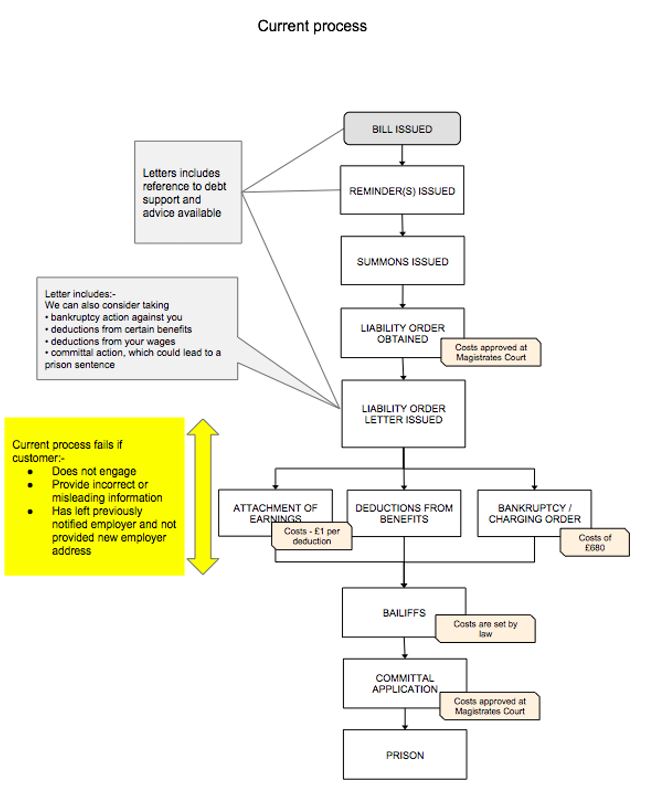
Read an explanation of the debt recovery flowchart in plain text.
Brighton & Hove City Council has identified that customer income-based benefit information from DWP and PAYE and Self-Assessment customer information from HMRC is useful and able to support the managing of overall arrears and further developing of recovery procedures, by identifying:
- customers whose circumstances make them vulnerable and providing appropriate support and appropriate recovery action whereupon they engage with the local authority
- those in employment and allowing the recovering of individual debts by Attachment to Earnings Orders, where appropriate
- forwarding addresses for customers who have moved, leaving arrears outstanding
- those receiving benefits and allowing the recovering of individual debts by Attachment to Benefits Orders, where appropriate
This is a significant change from the current process and allows us to take positive action to identify and support vulnerable customers and recover debt from those customers who are not engaging in the process and who have already been informed of the action the local authority may take.
Overview of the activity under the arrangement and how the data will be used
Brighton & Hove City Council, will undertake a one–off data share as to a reasonable sample of debtors.
This sample is to be of an appropriate size in relation to the City of Brighton & Hove (as may include all debtors contained within our Liability Order dataset). There is no limit to this sample size.
This sample is to be shared with Cabinet Office (CO), who will then collate all of the submitted samples from the pilot’s local authorities (LA) into a single document.
This collated document will then be passed by Cabinet Office to DWP who will match against their benefits records. For those records matched, DWP will add income-based benefits data and add corroborative customer information (like National Insurance number and/or date of birth) and then forward these records to CO.
CO will then store the matched DWP data securely and produce a minimised version of the spreadsheet showing only the LA identifiers and personal information and matched DWP personal information, this minimised spreadsheet will then be password protected, and sent to HMRC.
HMRC will then match these customer records against their systems and return the records to Cabinet Office with the associated address, PAYE and/or self assessment information.
Cabinet Office will then disaggregate this information and provide the respective samples to each local authority, whereupon Brighton & Hove City Council shall receive its sample back.
The sample will exclude debtors who are:
- in receipt of debt support - full or partial
- deceased
- subject to committal and bankruptcy cases
- companies
- subject to a current Attachment of Earnings
A snapshot of data will be taken before being issued to DWP/HMRC for evaluation during and post action.
Proposed debt recovery and vulnerability support pilot data flow process
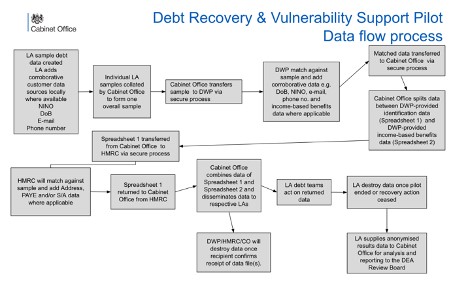
Read an explanation of the debt recovery and vulnerability support flowchart in plain text.
Once the data has been returned, Brighton & Hove City Council will analyse the results from DWP and HMRC and for those in receipt of:
- DWP Income-based benefits:
- pass to debt support team for action
- communicate with the debtor
- if debtor contacted and vulnerability discussed, support offered (where appropriate) and/or payment plan agreed
- if no contact, Brighton & Hove City Council shall continue recovery action
- PAYE:
- 14-day letter (as per the first pilot) to be issued to the debtor
- if debtor contacted, payment plan or vulnerability discussed
- if no contact, Brighton & Hove City Council shall progress Attachment of Earnings action
- self-assessment (SA):
- communicate with the customer noting they are in receipt of SA
- if debtor contacted, payment plan or vulnerability discussed
- if no contact, Brighton & Hove City Council shall continue recovery action
Outline of what types of data will be shared and the data security arrangements to be put in place
Brighton & Hove City Council, will send a password protected Excel spreadsheet to the CO contact, [redacted] by forced Transport Layer Security (TLS) government-secure email relating to a sample of their Council Tax Debtors.
The password will be sent by a separate means to Cabinet Office (CO) on confirmation of receipt of file(s).
The sample will exclude debtors who are:
- in receipt of debt support - full or partial
- deceased
- subject to committal and bankruptcy cases
- companies
- subject to a current Attachment of Earnings
The data items sent from local authorities (LA) to CO are as follows:
- full name, including title, first name and middle name or initials
- current address and postcode
- forwarding address and dates
- date of commencement of Liability Order, if applicable
- unique identifier, future proof
- phone numbers, where available
- email addresses, where available
In addition, either date of birth or National Insurance number will be provided as a minimum (where available) to assist the Department of Work and Pensions (DWP) data matching.
CO will collate our sample with the other samples from the LAs involved in this pilot for onward transmission to DWP.
DWP will match against their benefits records and, for those matched customers, will add additional corroborative data and income-based benefits information as follows:
- match successful – yes or no
- customer name as recorded on DWP records
- National Insurance number, as recorded by DWP, where available
- date of birth as recorded by DWP, where available
- phone numbers, where available
- email addresses, where available
- income-based benefit in payment – yes or no
- payment frequency – weekly or monthly
- benefit amount
The file(s) will then be downloaded as an Excel document. The file(s) will be password-protected, and sent to the CO contact, at the mailbox [redacted] by forced TLS email over a government secure network.
In line with DWP policy, the password will be relayed to by the DWP DST individual to the CO contact, [redacted], by phone once CO have confirmed receipt of the file(s).
CO will then store the matched DWP data securely and produce a minimised version of the spreadsheet showing only the LA identifiers and personal information and matched DWP personal information.
This minimised spreadsheet will then be password protected, and sent to HMRC, split into 10MB files, by forced TLS email over a government secure network.
The password will be sent in a separate email once HMRC contact have confirmed receipt of the file(s).
HMRC will match against their records and, for those matched customers, will add the following data and return to local authorities through Cabinet Office:
- match successful - yes or no
- address as recorded by HMRC
- if person is in current employment, PAYE data, including:
- employer Name
- employer Address
- employer contact details, like name and phone number
- currently employed, as of last PAYE update - yes or no
- employment end date
- employment pay frequency
- taxable pay in period
- taxable pay year to date
- payroll ID in this employment
- individual address
- self-assessment (SA) data, including:
- tax year
- SA total income
- SA correspondence address
- furlough payments data, including:
- furlough payment or average
- payment frequency
- period of furlough payments
- total furlough amount paid
HMRC RIS DAT will produce a single spreadsheet with the matched data. This spreadsheet shall be password-protected and split into 10MB file(s) and returned by forced TLS government-secure email to the CO contact, [redacted] at the mailbox [redacted].
The password will be emailed from HMRC RIS DAT to CO on confirmation of receipt of files(s).
On receipt of the final data product from HMRC RIS DAT, CO will merge the data with the additional DWP benefits data and then disaggregate the final data set and create separate spreadsheets of the data relevant to each local authority.
The spreadsheet for each LA shall be password-protected and sent to that LA by TLS government-secure email by CO.
Each LA will extract the data from the spreadsheet they receive from CO. The data will be used solely for the purpose of this project and will not be retained for the purpose of any other use.
LAs will delete the data on completion of the pilot and its analysis, and this will be confirmed by email to CO, DWP and HMRC contacts.
DWP and HMRC will conduct their own quality matching policy to the data to ensure match quality and data returned meet their standards.
Data will be securely transferred by encrypted email from a secure email address, will be stored in a secure folder and deleted after the completion of the pilot and analysis.
Persons at Brighton & Hove City Council receiving and disclosing data are limited to debt analysts and debt recovery officers.
All such users sign data disclosure agreements before system access is granted. All staff have had DPA and lately GDPR training.
Persons at DWP and HMRC receiving, analysing and disclosing data are limited to data analysts and processors, within the Centre for Data Exploitation, data management team. These staff have been security trained.
For any third-party entity or body which provides services to Brighton & Hove City Council and which has access to its software suppliers and is able to extract data to be used in a search tool available for other councils - Brighton & Hove City Council shall ensure no data supplied to them under this pilot is available for any other council to obtain.
Period of duration for the arrangement, when the data share will be live
The duration period for the pilot will be 12 months from when the data is shared by Brighton & Hove City Council to Cabinet Office (CO), with this period enabling the analysis of the success or otherwise of the data share.
An initial report will be compiled and submitted to the DEA Review Board by the DEA Secretariat after the end of the operational activity, as shall outline the progress made against the success criteria and any issues found.
A provisional timetable is outlined below:
- February 2021 – formal business case submitted to the DEA review board
- February 2021 – ministerial approval
- March 2021 - data shared from Brighton & Hove City Council to CO and this collated data, comprising all pilot local authorities data, is shared with the Department for Work and Pensions
- April 2021 - HMRC to conduct matching and return data to CO, who will then disaggregate and share related data back to Brighton & Hove City Council
- April and May 2021 - pilot authorities begin analysis and operational activity on returned data
- April and May 2021 - initial review of the pilot against the success criteria
- September 2021 - mid pilot review and report and BAU considered
- March 2022 - pilot ends and pilot evaluation report produced
How retention periods will be managed
The retention period for the pilot will be 12 months from when the data is shared with Brighton & Hove City Council to CO.
Personal data that has been part of the DEA legal gateway process will be retained in accordance with the authorities’ data retention policy.
Shared data will be kept separate and recognisable to enable deletion at the end of the pilot.
CO will destroy the collated data once:
- Brighton & Hove City Council has received the match results
- anomalies in the data are resolved
Neither HMRC or DWP is to retain the data beyond its matching operations. CO is not to retain the data beyond its collation of the LAs' spreadsheets, its passing of this to DWP and its return of disaggregated information to respective LAs.
The aggregated report produced will not be subject to a retention period as it will not contain personal data, only aggregated results.
For LAs and HMRC, the pilot data will be deleted one year after the data has been shared with CO, except where the data is being used operationally and will be deleted once recovery action has been completed.
From the information supplied by HMRC, if Brighton & Hove City Council subsequently has this information confirmed by either the employer or the individual, then that information can be classed as having been supplied by another source (other than HMRC), then Brighton & Hove City Council shall be able to retain this data on its systems.
However, the data received from HMRC in its raw format shall be deleted at the end of the pilot.