Due to maintenance, MyAccount will be unavailable between 10:45am and 11:30am on Wednesday 24 June 2026. We apologise for any inconvenience.
About the SEND needs assessment
Background
Improving support for children with Special Educational Needs and Disabilities (SEND), learning disabilities, and neurodivergent young people is a Brighton & Hove priority, as numbers have risen significantly both nationally and locally over the past decade.
These children often face poorer outcomes in education, health, and wellbeing, with higher school absence and greater risk of being out of education, employment, or training at 16, while families experience financial strain and social isolation.
Inequalities in access and outcomes are widening. There are statutory duties aimed at improving integrated support, for example, joint commissioning across health, education, and social care.
This Joint Strategic Needs Assessment (JSNA) was approved as a priority by Brighton & Hove's Health and Wellbeing Board.
This needs assessment and recommendations will inform local evidence-based strategies and commissioning, including the refresh of the city’s SEND strategy to replace the current 2021 to 2026 plan.
The aim of this needs assessment is to describe the current and future health, learning and care needs of children and young people up to 25 years old in Brighton & Hove with SEND, learning disabilities (LD) or neurodiversity (ND).
The needs assessment objectives are:
- To describe what is known about the prevalence and inequalities influencing health and wellbeing, learning, and care outcomes among SEND/LD/ND children and young people and their families.
- To describe outcomes, trends and anticipated needs for SEND/LD/ND children and young people in Brighton & Hove, and how they compare to other areas, including national data.
- To review national evidence on intersectionality and how it applies locally.
- To understand the views and experiences of parents and carers locally using existing voice data.
- To make recommendations based on the findings to inform future service provision, joint commissioning and strategic direction.
Governance
Brighton & Hove's SEND and Alternative Provision Partnership Board acted as the steering group.
A project group guided implementation. The group included:
- public health
- service providers
- health professionals
- community and voluntary sector partners
- parent carers
A working group managed the day-to-day delivery of the assessment.
Timeline and scope
After the scoping phase, the project was initiated in August 2024 and ran for 18 months.
The needs assessment drew on existing evidence, intelligence and data. It includes children and young people who have an Education, Health and Care (EHC) plan, receive SEN support, or both.
The report includes:
- national and local context
- service provision
- the level of need in Brighton & Hove
- evidence reviews on intersectionality
- local parent carer voice
Within this summary, we provide the recommendations and a summary of the findings.
About the recommendations
The recommendations were developed by bringing stakeholders together through 2 workshops, where participants used the needs assessment findings to generate actionable recommendations.
Evidence from local data, feedback from parent carers, and national literature on intersectionality was combined across 4 key finding areas:
- increasing needs and demand for services
- disproportionate impact on disadvantaged groups
- inequalities in education and transitions
- impacts on wellbeing and mental health
The resulting recommendations fall under the following themes:
- inclusion
- improving SEND identification
- parents and carers navigating the system
- workforce training
- improving support/pathways
Taking forward the JSNA recommendations
The following was discussed during the recommendation workshops and at Brighton & Hove's SEND and Alternative Provision Partnership Board:
- the JSNA and recommendations are to inform the refresh of the SEND Strategy in 2026
- the SEND and Alternative Provision Partnership Board are to regularly review findings and recommendations of the needs assessment to ensure the JSNA keeps informing its programme of work
- consideration is to be made of how joint commissioning is informed by the JSNA and oversight provided through the SEND and Alternative Provision Partnership Board
- Commissioners are to support children, young people, parents, and carers to contribute to the joint commissioning process
Recommendations: Inclusion
These recommendations involve understanding and addressing complex, intersectional factors that are barriers to children's achievement.
Improve outcomes
Focus on improving outcomes for those with EHC plans to narrow the attainment gap for Brighton & Hove.
Access to support
Develop a robust local understanding of data on children not receiving support, including its impact on families.
Black and Racially Minoritised families with SEND/LD/ND
Adopt Brighton & Hove City Council’s anti-racism in education model across all services to support SEND children, young people, and families.
Neurodivergence
Adopt the approach of Brighton & Hove City Council’s anti-racism model in responding to the needs of families who are neurodivergent.
Trans, Non-Binary and Intersex (TNBI) children and young people
Recognise and mitigate the impact of national policy shifts on TNBI communities.
Acknowledge and utilise strong local practice and voice in local VCSE organisations.
Use the evidence of compound marginalisation to inform training and practice.
Recommendations: Improve SEND identification
These recommendations involve enabling services to support early identification of needs and prevent escalation:
- reduce variation in the identification of SEN across schools by introducing moderation and reviewing settings with lower and higher than expected prevalence
- use existing intersectional data, voice and evidence, to better target resources
- improve SEND identification through training, sharing voices, and increased cultural awareness, including for:
- girls
- Black and Racially Minoritised
- those whose first language isn't English
- children eligible for free school meals
- neurodivergent children and young people
Recommendations: Workforce training
These recommendations involve improving SEND training for staff and wider workforces to support children, young people, and their parents and carers:
- review, improve and monitor SEND training for staff working in social care, health, and education, who work with children and young people, to improve identification and support
- increase take-up by reducing barriers to accessing training
- training is to include:
- the 4 areas of need in the code of practice and the local offer
- wider neurodivergency training to develop awareness, skills and knowledge in workforces (for neurodivergent children and young people, and ND parents and carers)
- tailor training towards anti-stigma, anti-racism, cultural confidence, trauma-informed, and unconscious bias, including those who are:
- economically disadvantaged
- care-experienced
- in Black and Racially Minoritised communities
- girls and boys - raise awareness of how behaviours are viewed and interpreted
- train wider workforces supporting parents and carers to increase knowledge of the local offer and improve signposting and referrals
- ensure neurodivergent staff and families can share stories, voices and experiences through training, forums and networks, to address stigma, and increase cultural awareness
- make greater use of the voices of those with lived experience, such as Black and Racially Minoritised communities, neurodivergent people, people with intersectionality, school staff, and girls
Recommendations: Improve support/pathways
These recommendations involve improving joint working across services and sectors:
- map services and bring services together to collaboratively clearly understand their roles in supporting children and young people
- strengthen joint working across health, education, and social care
- ensure housing services are fully integrated in the support offer
Improve support for children and young people and parent carers across the pathways using co-design principles:
- improve support for those waiting for ND assessments
- improve support for those with identified needs but no diagnosis, as recommended in national guidance
- increase peer support based on priorities, including different age groups, and Black and Racially Minoritised communities
- strengthen community support, such as through using intersectional network groups to share knowledge, resources, and support (including working with VCS)
- improve support for parent carers to reduce the negative impact on wellbeing, health, and finances
- review and remove barriers to engaging with support, such as cultural stigma
- create accessible pathways for sharing with the wider system, including parent carers
- take a holistic approach to supporting families when school attendance drops
Mental health and wellbeing:
- expand alternative provision pathways to better meet mental health needs
- use multi-disciplinary teams for joined-up, sustained support
- review the offer for families with children and young people who display behaviours of distress
- ensure neuro-affirming therapies are the only type offered to neurodivergent children and young people
- support retention in school by improving the experience of safety and belonging in schools for SEND pupils
Children and young people not in education settings:
- improve support for this community by taking a pragmatic approach to offering support
- identify clear ownership of the support offer
- improve information on the needs of SEND children and young people who are not in education
Improve support for transitions from starting school to adulthood:
- use specialist support workers to guide families through services
- ensure strategic join-up with co-occurring substance use and mental health transitions work and Brighton & Hove City Council’s Transitions Strategy
- ensure a multi-agency approach to transitions planning that includes health, housing, and social care
- keep children in care with complex needs nearer to the city to ensure continuity of offer
- review and monitor a wider range of post-education outcomes for young people with SEND
- ensure that transition data informs operational and strategic planning and delivery of services
Summary of findings
Four key areas of need emerged from the evidence gathered in the needs assessment.
Evidence from local data, service provision, local parent carer feedback, and national literature on intersectionality has been synthesised under each of these areas below:
- Increasing needs and demand for services.
- Disproportionate impact on disadvantaged groups, including:
- sex disparities
- deprivation
- ethnicity
- gender identity and sexual orientation
- care-experienced
- Inequalities in education and transitions.
- Impacts on wellbeing and mental health.
Increasing need and demand for services
Local data
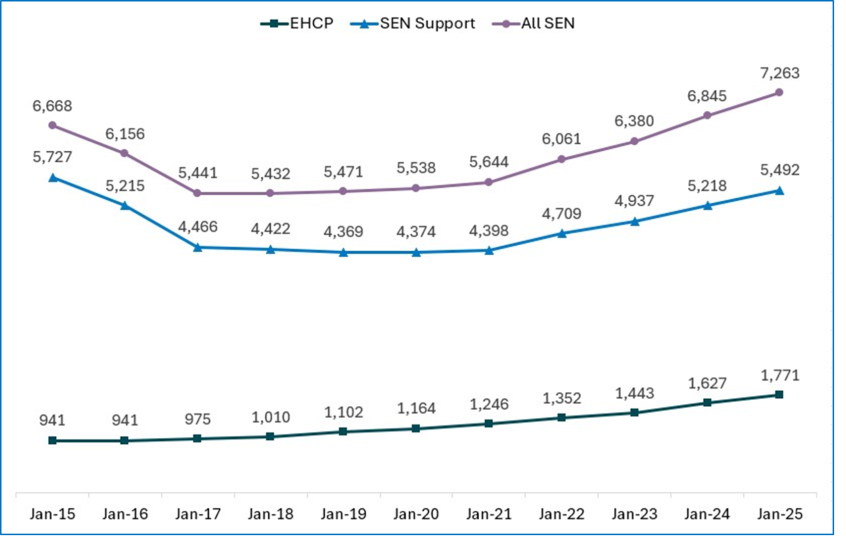
One in 4 (24%) of all pupils aged 4 to 16 years in Brighton & Hove have Special Educational Needs (SEN), higher than England (19.5%) in 2025.
This equates to 7,263 SEN pupils, which includes:
- pupils with an Education, Health and Care plan (EHC plan) (5.8%)
- pupils with SEN support (18%)
Against overall falling pupil numbers in the city, the number of pupils with SEN has increased by 26% in 5 years (January 2020 to January 2025). The number of pupils with an EHC plan has increased by 52% over the same time period.
Local modelling shows that the proportion of children and young people aged 0 to 25 with an EHC plan is projected to increase from 4% to 6% from 2026 to 2032.
Number of children with Special Educational Needs (SEN), Brighton and Hove Schools, January 2015 to January 2025
Source: Brighton & Hove Schools Census, January 2025.
Four primary needs account for the vast majority (88%) of SEN:
- Social, Emotional and Mental Health (SEMH)
- Specific Learning Difficulties (SpLD)
- Speech, Language and Communication Needs (SLCN)
- Autistic Spectrum Condition (ASC)
Since 2015, the ASC demand has increased sixfold, and SEMH has increased by 40%. This could, in part, reflect changes in diagnostic practices.
In Brighton & Hove, half of pupils (48%) with an EHC plan have a primary need of Autistic Spectrum Disorder (ASD). This is higher than in England (33%).
The average wait time for neurodevelopment assessment in children increased from 23 weeks in September 2023 to 27 weeks in June 2024.
The number of children aged 0 to 17 years, waiting for an assessment for suspected Autism referral, increased by 185% from September 2023 (170 children) to September 2024 (485 children).
Percentage of pupils receiving SEN Support (top chart) and ECHP (bottom chart), by primary SEN need, in Brighton & Hove (January 2025) and England (2024)
Source: Department for Education. Schools, pupils and their characteristics, January 2024.
Special Educational Needs in England, 2023 to 2024, and Brighton and Hove Schools Census, January 2025.
Local parent carer feedback
Children and young people, and parent carers, face worsening challenges while waiting. Families need support before reaching the crisis point.
Getting an assessment depends significantly on advocacy by parent carers and individual professionals.
Addressing carers' support needs is essential to prevent escalating negative impacts on both carers and their families, particularly among the most disadvantaged.
Pathways are complicated and inequitable for the most disadvantaged. There's a need to simplify and support their navigation across pathways and the system.
Service provision
Despite the breadth of SEND provision in Brighton & Hove, several development opportunities remain.
Neurodevelopmental (ND) assessments and support are heavily focused on Autism and ADHD, creating inequalities for individuals with other ND profiles, such as:
- Tourette’s
- Fetal Alcohol Spectrum Disorder (FASD)
- Avoidant/Restrictive Food Intake Disorder (ARFID)
- sensory processing differences
- specific learning difficulties
- developmental coordination disorder
Existing data may not reflect the complexity of need, as Autism is often recorded as the primary need even when it forms part of a broader SEND profile.
Opportunities exist to:
- enhance joint working between providers, such as through combined Autism and ADHD assessments
- create more integrated pathways and care oversight for individuals with complex or multiple needs
Disproportionate impact on disadvantaged groups
Children most affected by inequalities in SEND provision are often those who also belong to other groups that are treated unfairly.
The literature highlighted that this is true for:
- children from Black and Racially Minoritised and migrant backgrounds
- those in care or care-experienced
- those living in families experiencing financial hardship
Children experiencing compounding intersectional inequalities are less likely to have their needs identified early and are less likely to receive appropriate support. Therefore, they may be more likely to experience exclusion, not do as well as expected, and experience long-term compounding disadvantage.
Below is a summary of evidence across the following:
- sex disparity
- deprivation
- ethnicity
- gender identity and sexual orientation
- care-experienced
Sex disparity
Local data
Locally, boys are more likely to be identified with SEN (28% boys, 19% girls). More than twice as many males have an EHC plan as females. These patterns mirror national data.
Males are twice as likely to be on the Compass register as females.
Local parent carer feedback
Parent carers report a lack of understanding and adaptations in services, especially for girls with autism and ADHD.
National literature (ref CC report)
Boys are diagnosed with all neurodevelopmental conditions at higher rates, with the largest sex disparity seen in ADHD, followed by ASC.
Autism diagnostic tools are largely based on male presentations, which can overlook how traits appear in girls. Girls are often underdiagnosed due to biases and because they may camouflage their difficulties, increasing the risk of unmet needs and later mental health problems.
There's growing recognition that ADHD identification needs to be reformed to better reflect the experiences of girls.
Intersectionality
National intersectionality evidence highlights compounded disparities; for example, SEN Black Caribbean boys face additional challenges due to cultural misunderstandings, low expectations, and systemic bias in schools.
Deprivation
Deprivation is a significant and persistent factor shaping the experiences of SEND children and young people, parent carers, and their families.
Local data
The proportion of pupils with an EHC plan or SEN support increases with deprivation.
Over a third of those living in the most deprived areas of the city have SEN (34% compared to 18% in the least deprived), and almost 1 in 10 have an EHC plan (9% compared to 3.4% in the least deprived).
More pupils eligible for Free School Meals (FSM) have SEN (38% FSM, 19% not eligible for FSM). Those eligible for FSM are more than twice as likely to have an EHC plan.
Neurodivergent young people (aged 18 to 24), those with sensory impairment, or those with long-term physical illness, are disproportionately living in more deprived areas.
Local parent carers feedback
A local survey of parents and carers identified significant financial hardship, much of it associated directly with their caring roles.
Over 2 in 3 parent carers either do not work, or have reduced their hours or the seniority of their work role, due to their caring responsibilities.
Over a quarter of parent carers of SEN children and young people are experiencing significant economic hardship, often intensified by the demands of their caring responsibilities (such as affecting their ability to work), contributing to a persistent cycle of deepening inequality.
Financial and housing issues are important barriers mentioned by parent carers.
Low-income and single-parent families say that affording childcare is a challenge associated with isolation and lack of peer support.
Almost one in 5 responded yes to “Do you ever reduce the size of your meals or skip meals for the family because there isn’t enough money for food?”.
National literature
The national literature we reviewed highlighted deprivation as a significant factor shaping the experiences of SEND children and young people, particularly in accessing support.
Family economic deprivation was associated with increased unmet need for early support for young children with developmental disabilities.
Parents have to give up work to support children at home. Class intersects with disability, causing inequality of access to in-school support in mainstream secondary school settings.
Ethnicity
Local data
White British pupils are more likely to have recorded SEN (26%) than Black and Racially Minoritised pupils (19%) locally, but there are important differences across communities, with White Gypsy, Roma and Traveller communities most likely to have recorded SEN (46%).
Those who have English as an additional language are less likely to have recorded SEN locally, 25% of pupils who do not have English as an additional language, compared to 18% of pupils who do.
Local parent carers feedback
Parent carers' families from Black and Racially Minoritised backgrounds share that:
- cultural stigma, awareness, and language can be a barrier to engaging with support
- they value peer groups, community groups and mentoring
Parent carers expressed the need to:
- strengthen awareness for families and professionals
- improve diagnostic tools - making them culturally sensitive/appropriate and addressing evaluator bias
- ensure better access to interpreting services for families
- increase inclusion and diversity training for schools and police
- strengthen trauma-informed practice
- increase the diversity of staff and trainers
- have more consultation with people with lived experience to co-design services
- strengthen and signpost to VCSE support for Black and Racially Minoritised families
National literature
National literature highlights that:
- there's under- and over-representation of Black and Racially Minoritised SEN pupils, including the role of racial bias and social understanding of different presentations
- families from Black and Racially Minoritised backgrounds reported widespread experiences of discrimination, dismissal by school professionals, and lack of accessible information (especially for those with limited English proficiency)
- in some communities, there may be limited awareness or differing understandings of conditions like autism, which can result in delayed diagnosis
Literature also highlights the need for training for professionals to improve their ability to differentiate between language difficulties and learning disabilities.
Parents report they or their children have faced discrimination/bias/racism based on their appearance, and that children being bullied because of their ethnicity received little support from school.
Intersectionality
There's a clear relationship between deprivation and ethnicity. National study findings indicate that ethnic differences in ASC diagnosis are closely linked to socioeconomic disadvantage.
Emerging evidence also highlights the compound effects of intersectional inequalities, for example, the intersections of Black or racially minoritised, socioeconomic disadvantage, sex/gender, and SEN.
These intersecting factors can shape experiences and outcomes. For instance, Black boys from lower socioeconomic backgrounds are reported to encounter disproportionately low expectations within school settings.
Gender identity and sexual orientation
We intended to report on gender identity and sexual orientation for SEND young people separately, as they represent distinct dimensions of identity. However, this has not been possible where intersectional literature or reports have not been presented in this way.
Gaps in evidence
This needs assessment highlighted limited UK literature on the experiences of LGBQ+ SEND young people or TNBI SEND young people. In addition, there were limited existing reports that captured parent carers' lived experience that were specific to parent carers of LGBT+ or TNBI young people.
Community organisations and providers working with marginalised groups, including those working with parent carers of LGBQ+ and TNBI young people, will not necessarily have feedback and experiences disaggregated for those parent carers of SEND young people.
Local health and wellbeing survey data: gender identity
Secondary students who do not identify with their gender at birth were more likely to report receiving extra help compared to those who did identify with their gender at birth (Key Stage 3: 18% vs 9%; Key Stage 4: 11% vs 5%).
Over a third of neurodivergent young people aged 18 to 24 are TNBI.
Local health and wellbeing survey data: sexual orientation
Secondary school LGB+ students are more likely to report receiving “extra help”, compared to heterosexual/straight peers (Key Stage 3: 13% vs 9%; Key Stage 4: 8% vs 4%).
Just under three-quarters of neurodivergent young people aged 18 to 24 are LGBQ+.
Young people aged 18 to 24 who were neurodivergent, had mental health issues, a physical difference, or sensory impairment were more likely to be LGBQ+ than all young people aged 18 to 24.
Local parent carers feedback
Parent carers highlight the need for community group sessions targeted for families from groups that are currently underserved, such as LGBTQ+ young people with learning disabilities.
National literature
LGBTQI+ SEND students often faced compounded marginalisation, with higher instances of bullying, a lack of tailored support, and environments that question the validity of their identities.
The 2 papers found highlight an urgent need for further research, targeted resources, and nuanced frameworks to better support gender-diverse children and young people within SEND systems.
Care-experienced
Local data
Data snapshot 2023 to 2024: Children supported by social care.
In Brighton & Hove, in 2023 to 2024, there were:
- 756 children who were assessed as a child in need (CIN)
- 148 children needing a child protection plan (CPP)
- 156 children who are looked after (CLA) by the local authority
Brighton & Hove has a higher percentage of Children in Need (38%), Children Looked After (47%) and Children on Child Protection Plan (16%) with an EHC plan compared to England and the South East (England: CIN 30%, CLA 32%, CPP 12%. South East: CIN 33%, CLA 37%, CPP 14%).
Brighton & Hove has a higher percentage of Children in Need (26%), and Children on Child Protection Plan (41%), on SEN support compared to England and the South East (England: CIN 22%, CPP 30%. South East: CIN 22%, CPP 31%).
In a local survey, care-experienced students were more than twice as likely to report receiving “extra help” in class, compared to non-care-experienced peers.
57% of care-experienced students report receiving extra help in primary school (Key Stage 2), and 35% and 20% in secondary school (Key Stage 3 and 4).
National literature
Care-experienced children are disproportionately identified with SEND. Research shows that care-experienced SEN pupils encounter compounded negative education outcomes, including:
- increased exclusion and suspension
- non-enrolment/off-rolling
- poorer educational achievement trajectories
Inequalities in educational outcomes and transitions
Local data
In 2023 to 2024, Brighton & Hove SEN pupils have poorer educational outcomes throughout school, transitions into Post 16, and progression to higher education at age 19. This is particularly true for those with an EHC plan. This is the same pattern as seen nationally.
Pupils with EHC plans have worse educational attainment throughout their school life, compared to pupils with EHC plans nationally.
Overall absence and persistent absence increased significantly during COVID, for both Brighton & Hove and England.
Brighton & Hove overall and SEN pupils' absence and persistently absent were higher than for England.
Overall, Brighton & Hove has lower suspension rates than nationally (lower for all, SEN support, and those with EHC plans).
Brighton & Hove pupils with EHC plans do worse compared to pupils with EHC plans nationally.
Brighton & Hove pupils with EHC plans do worse for educational attainment, absence and persistent absence compared to those with EHC plans nationally.
A lower proportion of Brighton & Hove pupils with an EHC plan are meeting the expected standard than for England, for educational attainment, including:
- Key Stage 1 (phonics screening, Brighton & Hove 14%, England 20%)
- Key Stage 2 (reading, writing and maths, Brighton & Hove 7%, England 9%)
- Key Stage 4 (average attainment 8 score, Brighton & Hove 13, England 14)
There's a large percentage difference in absences for pupils with EHC plans:
- absence in Brighton & Hove (16%), compared to England (13%)
- persistent absence (43%), compared to England (36%)
Transitions: education and employment
Compared to national averages, in Brighton & Hove, a greater proportion of 16 to 17-year-old SEN young people are not in Education, Employment or Training (NEET), with rates changing little between 2019 to 2020, and 2023 to 2024.
13% of 16 to 17-year-olds with an ECHP (9% England) are NEET.
8% of 16 to 17-year-olds with SEN support (6% England) are NEET.
Destination of students beyond the age of 16 to 18 years in Brighton & Hove
SEN students are less likely to have a sustained education destination than those without SEN (36% compared to 43%, respectively).
SEN students, compared to students without SEN, are more likely to be in sustained employment (33% compared to 24%) or an apprenticeship (8% compared to 2%).
The proportion of young people progressing to higher education at age 19 is lower for SEN young people compared to those without SEN. In Brighton and Hove, this inequality gap has widened in recent years.
Only 9% of pupils with an EHC plan progressed to higher education by age 19, compared to 25% of pupils with SEN support and 51% for pupils with no SEN provision.
Local parent carer feedback
Educational settings lack recognition of behaviours and accommodations for sensory needs or emotional dysregulation.
Parent carers share feelings of shame and failure connected to their child’s poor school attendance.
Support is needed to enable SEN children to remain in school.
Further support for transitions between schools and into adulthood is needed, including earlier transition planning, with clearer pathways into adulthood.
Black and Racially Minoritised parent carers report their children's disproportionate experience of school exclusion and NEET.
There's a need for:
- greater inclusion and transition options
- bespoke mentoring and advice
- alternative strategies to exclusion
- educational support
- school inclusion
- diversity training
- trauma-informed practice
There's a need for flexible provision and reasonable adjustments within schools, for example:
- provision for sensory difficulties, such as quiet rooms
- provision for pupils unable to attend school
- an ongoing relationship with a key professional to facilitate tailored support and communication between school and home
There's also a need for effective co-production of services, such as school transport.
National literature: Intersectionality SEN, care-experienced and ethnicity
Care-experienced children and young people are more likely to have SEND.
There's lower educational attainment for care-experienced SEND pupils.
There's higher exclusion and off-rolling for SEND pupils, particularly for care-experienced and Black boys.
There's increased discrimination in higher education for Black and Racially Minoritised students with identified SEND needs.
Impacts on wellbeing and mental health
Local survey data
A local school survey (SAWSS, 2023) highlights overlapping vulnerabilities of SEND/LD/ND children and young people who are more likely to be care-experienced, adopted, from more deprived socioeconomic backgrounds, be LGBQ+, be TNBI, and have poorer mental health and wellbeing indicators.
Students receiving “extra help” were less likely to feel safe and like they belong at school, and less likely to agree that people like them do well at school.
They were more likely to experience bullying at primary and secondary school and more likely to fear and experience violence in the community as they get older (18 to 24-year-olds).
At all Key Stages (ages 8 to 16), those receiving extra help are less likely to agree that they have often been happy recently and are more likely to agree that they have often felt sad.
At secondary school, those who received extra help were more likely to have helped someone who was being picked on and helped someone who was hurt.
In the Health Counts survey 2024, many measures of low wellbeing were higher in those who reported long-term physical or mental health problems. They were more likely to:
- report low happiness
- have self-harmed in the previous 12 months
- have experienced suicidal thoughts
- have ever attempted suicide
This was especially high for neurodivergent young people and those with a mental health condition, physical difference, or hearing/sight impairment.
Local parent carers feedback
Taken from a local survey of parent carers.
Parent carers report the significant impact of caring duties on the mental health and wellbeing of the parent carers themselves, which in turn impacts the whole family's well-being.
Half of parent carers (51%) have experienced mental ill-health as a result of their caring role (such as depression or a stress-related condition).
The strain on the whole family of caring responsibilities, compounded by the cost-of-living crisis, has a detrimental impact on the mental health of the carer and a negative effect on wellbeing across the family.
If a child does not attend school, parent carers share that they have feelings of shame and fear of fines.
Some parent carers reported that a feeling or fear of being judged for their parenting skills prevented them from accessing support.
Parent carers express the need for:
- schools and services to consider:
- mental health
- trauma and neurodevelopmental conditions together
- adaptations
- trauma-informed approaches
- training for educators and providers
- improved access to mental health services
- addressing high thresholds for support
- earlier support before reaching a crisis point
- building on good practice (parent carers report positive experiences when they do access mental health services)
- better planning for transitions for continuity of care between child and adult health and social care
- support to address the strain on the mental health of advocating parent carers and to address the challenges they have accessing social care support for their children, as well as themselves
National literature
National intersectional literature highlights:
- an increasingly negative impact of SEND and trauma on children and young people
- poor mental health and early trauma experiences of SEND/neurodivergent children and young people may affect their peer relationships and other relationships, as well as increase negative experiences (including bullying) within the school environment and in the community
- SEND/neurodivergent children and young people who are also care-experienced or have multiple marginalised identities encounter unique and often compounded challenges, disadvantages, and negative mental health outcomes
- children and young people describe the impact of shame, negative interactions with peers and adults, low expectations and compounding effects of discrimination on self-esteem and wellbeing
Acknowledgements
We thank our steering group and working group, including service providers, health professionals, public health, community and voluntary sector partners, and parent carers.
We thank all those who provided evidence for and gave feedback on the needs assessment.
Children and young people
We thank the primary and secondary school children who completed the Safe and Well at School Survey 2023, and the young residents aged 18 to 24 who completed the Health Counts survey 2024.
Without your participation, we would not have this vital information on the health and wellbeing of children and young people across the city.
Parents and carers
We thank the parents and carers whose feedback, captured by our CVS partners, provided valuable perspectives that informed the needs assessment recommendations.
Terminology
Language changes over time, and the words people prefer to describe their experiences, identities and needs are not fixed.
We recognise that views differ, and that individuals and communities have the right to choose the terms that feel right for them. We also recognise that different groups within the areas of special educational needs and disabilities, learning disabilities, and neurodiversity may use language in different ways.
As a council, it's not our role to decide the “correct” terms for people to use. However, we do need to be clear about the language we're using in this needs assessment so that our meaning is understood and our work supports inclusion.
The terminology used in this assessment reflects current local and national practice, as well as the preferences expressed by children, young people, adults, families, and community groups we work with. We're committed to listening and adapting as language continues to evolve.
We understand that people describe themselves in varied ways. We respect and aim to use language that's inclusive and clear, while recognising the right to self-identification.
We acknowledge that many needs are not visible, and that people may experience barriers even if they do not identify with a particular label or diagnosis. We also recognise that not all people who experience barriers consider themselves to be disabled.
Our use of language is guided by the social model of disability, which focuses on removing barriers, and by the principle that people are experts in describing their own experiences.
We'll keep terminology under review for all JSNA reports. As language and understanding develop, we'll continue to update our approach.
Read the full assessment document
The full assessment document (with appendices) is available to download on our webpage, Special Educational Needs and Disabilities, Learning Disabilities and Neurodiversity in-depth needs assessment, 0 to 25-year-olds.