Purpose of the RGG
The need for a process for considering research standards and associated risks in a consistent manner within the HASC and FCW Directorates has been identified.
The HASC and FCW Research Governance Group was set up to develop a system for use by people in the HASC and FCW Directorates who are carrying out or commissioning research (hereafter referred to as ‘researchers’) for or within the Directorates. Its purpose is to support researchers to:
- minimise harm and risk to individuals and to the organisation
- ensure best practice and sound methodologies
- ensure the reasons for carrying out the research are ethical and appropriate
For the purposes of research governance, ‘research’ means the attempt to derive generalisable new knowledge by addressing clearly defined questions with systematic and rigorous methods.
The Defining Research table produced by the Health Research Authority and Is my study research? by the NHS Health Research Authority.
Support provided by the RGG
The RGG exists to provide guidance on research governance to researchers working within or for the HASC and FCW Directorates.
The RGG has developed a process which should be followed by researchers carrying out research for or within the HASC and FCW Directorates. Line managers should be aware of the process and ensure use.
Researchers are invited to engage initially with the RGG to discuss their research proposals and then to provide relevant information to the RGG. For example, proposal documents and or via the research planning template. The RGG will give consideration to the information provided.
Feedback from the RGG to the researchers is for guidance and support. Responsibility for responding to the guidance sits with the sponsor and or their respective HoS/ DMT member.
The RGG can signpost to tools to support in research ethical approval but does not act as an ethical approval body (RGG is not a Research Ethics Committee – REC).
Membership and meetings
The RGG consists of members of staff across Adult Social Care (ASC) and Public Health (PH) and Family Children and Wellbeing (FCW) teams who are knowledgeable and/or experienced in research practice.
The RGG (or selected members thereof) will meet as appropriate in response to incoming applications, but at least every 3 months as a whole group.
Processing and feeding back on applications
Research governance applications can be submitted at any time to the initial point of contact of the group. Two group members (at least one member from the originating section of the HASC or FCW directorates (such as, PH, ASC or FCW) , to review the application independently, and then to confer over their feedback. Depending on expertise required to review the application, one member of the ‘pool of reviewers’ to also review application.
Where the application is deemed by the two initial reviewers to require wider RGG discussion on account of complexity or risk, a meeting with other relevant members of the RGG (with specialist knowledge) will be called.
Within 3 calendar weeks of receiving the initial application, feedback and recommendations will then be passed to the most relevant HoS, copied to the applicant, for feedback and or sign off to proceed. HoS will confirm, reject or conditionally accept the research proposals and provide feedback to the applicant, copying in the RGG. DMT members will be made aware of the research proposal.
A record of research governance applications and outcomes will be kept by the RGG, including initial enquiries which do not proceed through the process.
The work of the RGG over the past 12 months and the Terms of Reference will be reviewed annually.
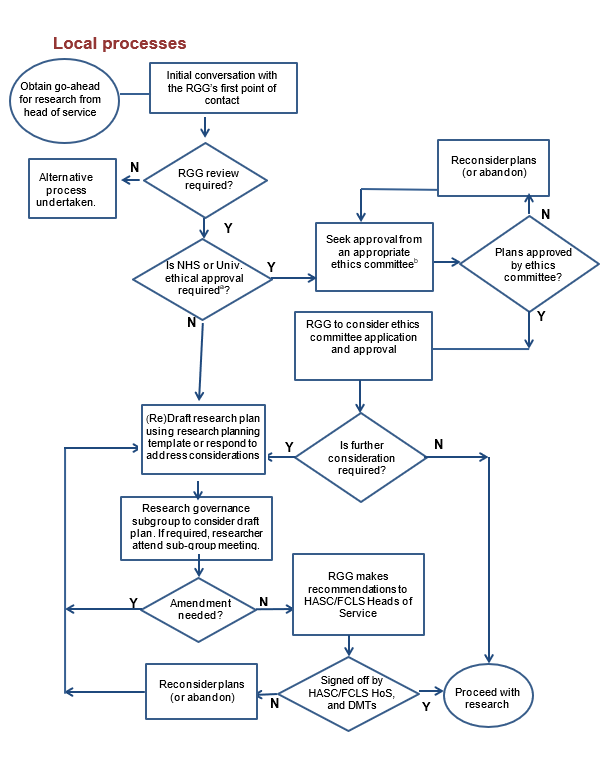
Local processes
Research Governance Group – Local processes flowchart
The process for submitting an application for review by the Research Governance Group is as follows:
- The applicant should first approach the Research Governance Group’s first point of contact, detailing their plans.
- If a review from the Research Governance Group is not required, an alternative process can be explored.
- If a review from the Research Governance Group is required, the applicant should consider whether NHS or university ethical approval is required. If it is not required, the applicant should draft a research plan using the Research Planning Template, which will then be reviewed by the Research Governance Group.
- If NHS or university ethical approval is required/appropriate, the applicant should seek approval from the appropriate ethics committee. If the ethics committee do not approve of the proposal, the applicant should reconsider their plans or abandon.
- If the ethics committee approves the application, the application and confirmation of approval should be sent to the Research Governance Group.
- The Research Governance Group will then consider and review the application.
- If no further consideration is required, the Research Governance Group will provide a statement of approval and the applicant may commence with their research.
- If the Research Governance Group asks for further considerations to be made, the applicant will make any amendments, and/or complete the Research Planning Template.
- The Research Governance Group will then consider the amendments/research plan.
- Once approved, the applicant may commence with research, making their appropriate Head of Service aware of their plans.