This year, reducing the impact of severe weather in the city will be a leading priority for the council and its partners.
2023 was the second warmest on record in the UK*, and flash-flooding in Brighton & Hove during the summer affected homes and businesses** in 18 incidents.
The threat of groundwater and surface water flooding has continued over the winter. Flood risk in Brighton & Hove is significant, with the city ranked 8th out of the top 10 Flood Risk Areas in England.
A strategic approach
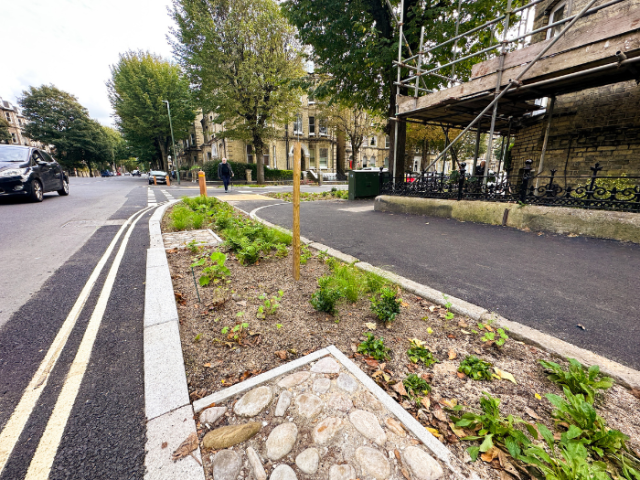
Surface water run-off from heavy rainfall poses the biggest problem, causing ‘flash’ flooding. The council is already acting to ‘climate proof’ the city. This includes creating ‘rain gardens’ in streets to slow down heavy rainfall, reducing the burden on the drainage system, and coast protection works such as the new sea wall at Black Rock.
In 2024 the council will take a strategic approach to climate adaptation. It has commissioned an independent study to understand how climate change is affecting the city. Collaboration with partners to research climate risks, for example to the city’s food supply chain and housing, will be used to build a strong case for investment and to target funding and action.
Extreme heat and cold and poor air quality particularly affect people who are more vulnerable because of pre- existing health conditions.
A strategic approach means that the council will consider opportunities for improving places and sustainable growth alongside measures that reduce risk from extreme weather events.
Councillor Trevor Muten, chair of the Transport & Sustainability Committee, said: “Changing weather patterns as a result of climate change are already affecting people, economy, and the natural environment in Brighton & Hove.
“We’ll be using an evidence-based approach to work with stakeholders in the city to bring forward adaptation initiatives that respond to local needs.
“It is also an opportunity to make adaptation part of the wider strategy to improve public health, develop a low carbon economy, create jobs and develop new skills. It’s an opportunity to position the city as a leader in sustainable solutions, and plan for public and private investment targeted to where it will have the biggest impact on improving the prosperity, health and quality of life for all the city’s residents.”
Climate-friendly places
In the autumn the council published its 100-year plan for managing farmland and open spaces on the City Downland Estate. The plan focuses on climate-friendly actions for people and nature, such as improving biodiversity, ‘capturing’ carbon through trees, ponds and soil management, and providing a local food supply.
Improving and creating new green spaces, planting native trees, protecting water resources under the Downs, and restoring hedges and ponds will contribute to local cooling and stormwater management as well as connecting people with nature and providing places to enjoy and relax in. Increasing and protecting biodiversity helps to increase resilience to climate change for both people and nature.
One example is the Wild Park rainscape where planted shallow basins will filter water run-off from the A27 road. When the water drains down into the chalk it filters out the oil and other road surface contamination. The rainscape will reduce flood risk and prevent polluted water from reaching the underground chalk aquifer, which provides most of the city’s drinking water.
The project is led by The Aquifer Partnership, which includes the council, and is funded by National Highways from its Environment and Wellbeing Fund.
Multiple benefits
Councillor Tim Rowkins, chair of the Environment, South Downs & The Sea Committee, said: “There are multiple benefits of making the city more resilient to climate change. Reducing heat exposure and flood damage has a direct effect on public health and wellbeing, but more resilient homes, locally produced food and energy will help reduce the effects of food and fuel poverty.
“Restoring nature in and around the city and connecting more people to the South Downs is good for mental and physical wellbeing and helps to improve air quality.
“Our work on climate adaptation is therefore not just about reducing risk, it’s also about making those wider connections and using it as an opportunity to link in with people’s day to day lives to make lasting improvements.”
Further information
Reducing climate risk by adapting to climate change is one of the priority actions in the council plan.
The Climate Risk & Vulnerability Study will be presented to the Transport & Sustainability Committee in February. It will guide priorities for a council-led programme of actions aimed at protecting communities and making Brighton & Hove more resilient to climate change and extreme weather events.
Brighton & Hove has looked to what other successful cities have done to in order to adopt best practice. These include Copenhagen’s ‘green’ infrastructure, Enfield’s natural flood management measures and the ‘Keep Bristol Cool’ tool which identifies the areas most affected in a heatwave.
*2023 was second warmest year on record for UK
**Homes and businesses flooded after thunderstorm hits Brighton and Hove