Due to the hot weather, some council services may need to change, but the majority of our services are operating as normal. Read our news story for more information.
Five unitary option could unlock £52.4m in annual net benefits
We've formally published our proposal for local government reorganisation in Sussex, proposing an option which could unlock £52.4 million in annual net benefits for the region, following engagement with residents and local partners.
The proposal will be debated at Full Council on Wednesday 24 September and a final decision taken by Cabinet on Thursday 25 September, ahead of submission to government on Friday 26 September.
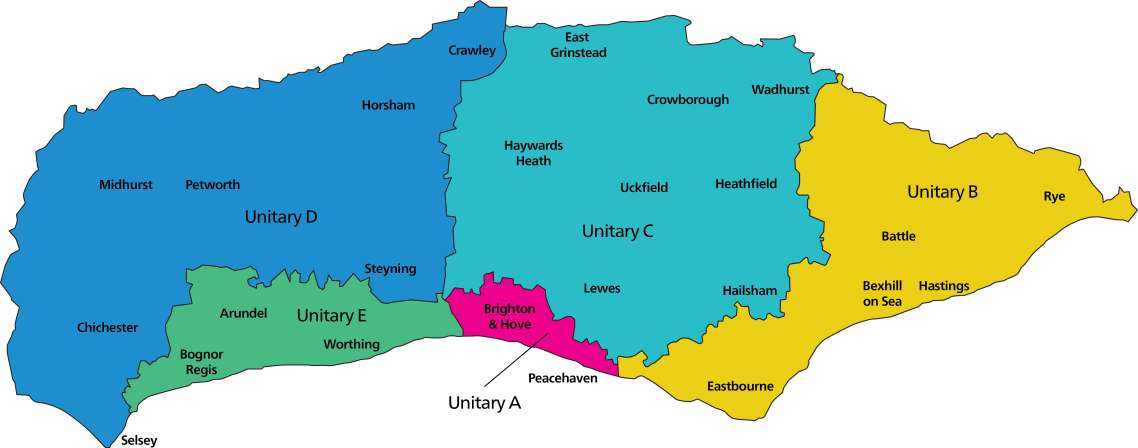
We support a new vision for local government in Sussex: a five-unitary model, with each authority serving between 300,000 and 400,000 residents. This structure aligns strongly with government criteria, offering the right size and scale, high quality and sustainable services, support for devolution and community empowerment.
Details of proposed footprint shared
Our proposed footprint includes:
Brighton & Hove
East Saltdean
Telscombe Cliffs
Peacehaven
Falmer Parish
It excludes 2 of the options consulted on, namely Newhaven and the remainder of Kingston Ward, which under the proposals would move to unitaries B and C respectively, reflecting both local identity and practical alignment in transport links, economic activity, and geographic boundaries.
Ensuring decision-making remains responsive
The 5 councils model strikes a careful balance between scale and local identity, offering a resilient and connected framework for governance. Each council is large enough to deliver essential services, such as adult and children’s social cares with the necessary capacity and expertise yet remains small enough to stay rooted in the communities it serves. This ensures that decision-making remains responsive and grounded in local realities.
The boundaries of each council have been thoughtfully drawn to reflect how people actually live, travel, and work. They align with real-world economic corridors and commuting patterns, creating a functional fit that supports joined-up planning and service delivery across sectors.
Importantly, the councils are of similar size, fostering a fair and balanced partnership. This prevents any single authority from dominating and provides the mayor equal partners to collaborate with and strengthening regional leadership and collective decision-making.
Enabling innovation and efficiency
The model is also designed to be deliverable. It supports phased implementation and shared platforms, helping manage complexity while enabling innovation and efficiency.
Finally, each council footprint is recognisable and rooted in existing community identities. The model respects parish boundaries and preserves the integrity of local places that residents already identify with ensuring that reform enhances rather than erodes the sense of belonging.
Once all Sussex proposals are submitted, the government will assess them and decide which to progress to statutory consultation, allowing residents across the region to have their say before any final decisions are made.