Asset type
Historic Building - Street furniture
Local Listing Reference
LLHA0019
Conservation Area (CA)
Brunswick Town CA
Description
The first telephone kiosks emerged in the later 19th century, but the earliest standardised design (the K1, constructed in concrete with a wooden door) was designed only in 1921. The design was not well-received, which led to a competition in 1924 for a replacement design. The winning design was by Giles Gilbert Scott (the K2), which comprised a Neo-classical cast iron cubicle with segmentally vaulted roof and a perforated crown below roof level.
The design was further developed in 1935 with the K6, to commemorate the silver jubilee of King George V.
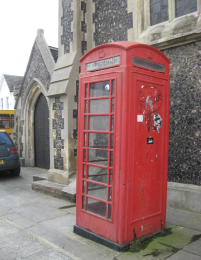
The kiosk is formed of bolted cast-iron sections on a concrete base. Square in plan with a segmentally domed roof. Three sides of the kiosk are glazed, with eight horizontal panes of glass divided by margin glazing to the sides. Illuminated ‘telephone’ sign above on each side, with serif capital lettering on opaque glass. Crowns in relief beneath the domed roof.
In comparison to the K2, the kiosk was much smaller. The crowns were no longer perforated and the margin glazing was a new introduction. The altered design was much more affordable to produce and thus rolled out across the country. A more vandal-proof ‘mark II’ version was introduced in 1939. K6 kiosks were produced until 1968, with over 60 000 examples installed. From 1962, much more modern designs started to be introduced, which departed from the iconic ‘red telephone box’ design.
The K6 design is the most common historic telephone kiosk to survive. As such, statutory listing of such structures is determined on the basis of group value with other listed assets. A policy has been agreed between DCMS and BT. To be listable, a kiosk needs to meet one of the following criteria: a strong visual relationship with more than one listed building; a setting of exceptional special interest in its own right; proximity to a single Grade I listed building; a particular contextual relationship between a neighbouring Grade II listed building and the kiosk (e.g. a rural post office).
Source: Historic England Designation Listing Selection Guide – Street Furniture 2011
View the design of a typical K6 kiosk.
A. Architectural, design and artistic interest
ii. The K6 telephone kiosk is an iconic design.
iv. Giles Gilbert Scott is a notable national architect, having designed such listed buildings as Liverpool Cathedral, Battersea Power Station and Waterloo Bridge.
C. Townscape interest
iii. The iconic status of the K6 telephone kiosk means that – whether in a conservation area or not – they contribute to the historic streetscene.
iv. The K6 telephone kiosk can be of particular interest when viewed in association with listed buildings, historic parks or where they form part of a group with other historic street furniture such as letterboxes or groups of telephone kiosks.
D. Communal value
ii. An iconic element of the British streetscape.
E. Rarity and representativeness
i. 60,000 K6 telephone kiosks were installed in the UK. In December 2013, there were only 10,762 examples remaining, of which only 2,562 were listed. On a local basis, examples of unlisted K6 telephone kiosks are relatively rare.
Date of inclusion
Pre-2015
K6 Kiosks in Brighton
The surviving telephone kiosks in Brighton are listed, they can be found on:
- Bedford Square
- Dyke Road
- Madeira Drive
- Marine Parade
- New Road
- Pelham Square
- Powis Square
- St Peter’s Place
- Upper North Street
- Vicarage Lane, Rottingdean