Conservation Area (CA)
Montpelier and Clifton Hill
Local Listing Reference
LLHA0276
Description
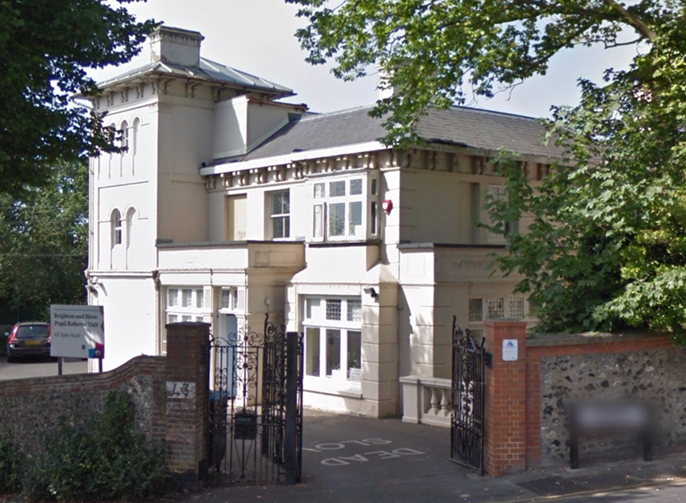
A large, detached Italianate Villa of two to three storeys with distinctive corner tower, dating from c1846; occupies a prominent site with entrance from Clifton Terrace through gates in tall flint and brick wall. The building is a visual focal point and local landmark. It was built as Norman Villa for (and probably by) William Beedham, who was a builder and at various times held positions as a town commissioner, High Constable and Brighton Corporation alderman. He lived there until his death in 1858. Known from 1881 as Clifton Lodge and later as St George’s House, the building has for much of its existence been associated with education.
A. Architectural, design and artistic interest
ii. A fine example of a large, detached Italianate-style villa in stucco with feature corner tower and bracketed eaves, which was a fashionable style for high status dwellings of this period and a notable element of the Montpelier and Clifton Hill conservation area. It was extended to the north-west in the late 19th century. The flint and brick wall likely pre-dates the villa.
B. Historic and evidential interest
i. William Beedham’s legacy relates to the city’s water supply. From the 1830s running water had been available just to a very few affluent households in the town and then only for a couple of hours each day intermittently. As a founder – and subsequently manager - of the Brighton, Hove and Preston Constant Service Water Works in the early 1850s, Beedham was integral to extending the water supply, which led to much needed improvements in sanitation and public health. In 1872, Brighton Corporation purchased the company.
ii. During the latter 19th century it was for nearly 20 years the home of Marriage Wallis and his family, Quakers committed to widening educational opportunity in Brighton. Marriage Wallis himself was an early member of the Brighton School Board, with which he was involved for over two decades, including six as Chairman. The building was Clarke's College from the 1940s to 1967 and was then acquired by Brighton Borough Council and became Brighton Tutorial and Secretarial Centre and later the Pupil Referral Unit. It has a longstanding connection with education history in the city. (In the 19th century Brighton was referred to as ‘school town’ due to the number of private educational establishments).
C. Townscape interest
iv. The building occupies prominent corner site within the Montpelier and Clifton Hill conservation area, which was developed from the 1830s onwards, and is publicly visible on all sides, including from St Nicholas Rest Garden. The building is a visual focal point and local landmark and has group value with the grade II listed Clifton Terrace and the locally listed Rest Garden with its grade II listed burial vaults.
F. Intactness
i. The building is fairly intact externally as original, but was extended in similar style in the late 19th century and some of the windows have been enlarged and rectangular bays added, probably in the early decades of the 20th century.
Date of inclusion
2023