Conservation Area (CA)
Valley Gardens CA
Local Listing Reference
LLHA0080
Description
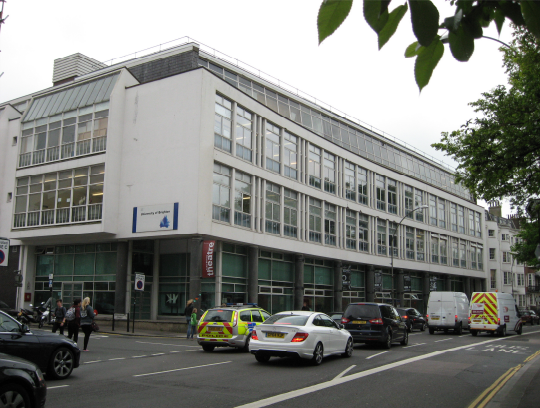
Built as the Brighton Polytechnic Faculty of Art & Design in three phases; 1958 to 1961, 1967 and 1969.
The first two phases were by the Brighton Borough Architect Percy Billington with Sir Robert Matthew & S A W Johnson-Marshall as consulting architects. After the first phase Sir Hugh Casson also advised on the design, raising it over a podium and introducing more verticality to the fenestration.
Phase 1 was the rear to William Street; phase two the Kingswood Street frontage and return to Grand Parade with the Grand Parade frontage completed in 1969 as phase 3. Three storeys plus an angled clerestory level on a corner site. It has a concave street frontage following the curve of Grand Parade with a glazed ground floor set behind pilotis. Two bands of fenestration above, articulated in a rhythm which reflects the width of the Regency terraced frontages. The Kingswood Street elevation has four projecting bays of windows, slanting back at the top. Source: Antram & Morrice 2008
A. Architectural, design and artistic interest
ii. A good quality example of a purpose-built further education building from the 1960s and specifically designed for the arts faculty with plenty of natural light. It is described by Antram & Morrice as ‘one of Brighton’s better postwar buildings and remarkably considerate to its site’. The involvement of Sir Hugh Casson is notable
v. The building has aesthetic interest derived from the conscious design of its street elevations, which are also very much linked to the building’s function.
B. Historical and Evidential Interest
ii. The building’s use illustrates the social development of Brighton & Hove, reflecting the rapid expansion of further education provision in the 1960s and 1970s. Polytechnics were built across the country in the 1960s
C. Townscape Interest
ii. The building sits on a prominent corner site opposite the public open space of Victoria Gardens and its sweeping front elevation, with its counterpoint vertical rhythm, forms a striking contrast to the neighbouring 19th century terraces.
E. Rarity and Representativeness
i. It is unique as a purpose-built art and design higher education faculty in Brighton & Hove.
F. Intactness
i. It retains a sense of completeness despite replacement glazing and a more recent disabled access ramp.
ii. It remains in the use for which it was designed.
Date of Inclusion
2015