The findings of the assessment for needs for rugby facilities in Brighton & Hove are summarised in this appendix to the Playing Pitch Strategy. Site visits to the home grounds used by clubs in Brighton & Hove have been made and club officials/site managers have been consulted regarding floodlit training provision and match use.
Consultation with Rugby Football League (RFL) suggests there is one club in the area, Brighton & Hove Rugby League, who operate a men’s team playing in the London Premier Division and a women’s team playing in League 1 South East. Sussex is an area which the RFL are looking to develop teams in in the future, as the nearest affiliated clubs are based in South London (Bromley Bengals, South London Silverbacks), Maidstone (Invicta Panthers), and Portsmouth (US Portsmouth Seahawks). These clubs are all approximately 40 miles from Brighton & Hove. There is also an Australian Rules Football team based in Brighton & Hove, the Sussex Swans who have one male adult team playing at Waterhall Sports Ground (bottom area).
Since the last assessment of Rugby Union in 2016, there has been a significant change in the total supply of rugby pitches available for community use. There has been a loss of community use on both junior and mini pitches in the city, with Patcham High School and Longhill High School now being the sole users of their rugby pitches. Dorothy Stringer School, Hove Park School, Varndean High School, University of Sussex, Brighton College, and Cardinal Newman Catholic School do not receive any community use on their pitches, with only Varndean High School (who currently advertise bookings on their school website) expressing interest in providing community use if there is sufficient demand. This results in a total of 10 senior pitches (11 including Varndean High School) available for community use, 6 fewer than reported in the 2016 study.
Following the assessment report in 2016, the 3G pitch at Brighton Rugby Club is no longer World Rugby Compliant, meaning no contact rugby can take place on the facility, but improvements to the two senior pitches at Hove Rugby Club were made to increase the carrying capacity of the pitches.
A facility audit compiled from the research, consultation and site visits was reviewed by the RFU Facility Development Team and is included in this report (Figure 3.1).
1. Rugby pitch supply (Step 2)
There are two rugby clubs in Brighton & Hove based on playing field sites with rugby pitches – Brighton RFC and Hove RFC.
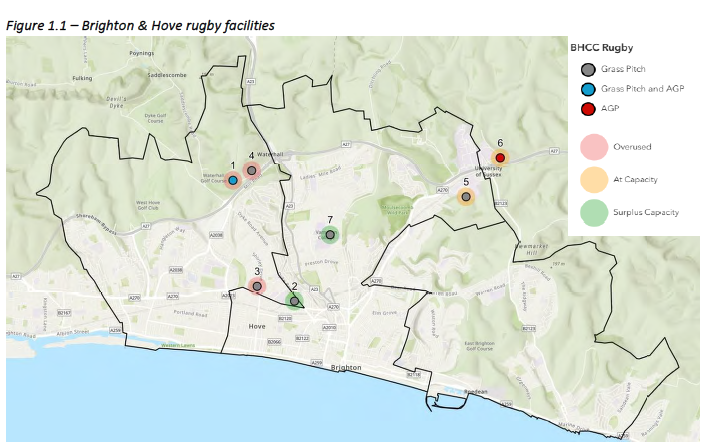
Figure 1.1 shows the distribution of grass rugby pitches in Brighton & Hove. Four of the 5 rugby sites are located in the West of the City (Brighton Rugby Football Club, Brighton Hove and Sussex Sixth Form College, Hove Recreation Ground, and Waterhall sports Ground), with one being located in the East (Brighton University) and one in the centre of the city (Varndean High School).
1.1 Rugby pitches in Brighton & Hove
In the 2023/24 season, Brighton & Hove had a total of 10 adult size grass rugby pitches marked out with posts in situ available for community use. It should be noted that whilst available for community use the pitch at Varndean High School it is currently only used by the school. There are additional pitches at Dorothy Stringer School (1), Hove Park School (1), University of Sussex (2), Brighton College (1), and Cardinal Newman Catholic School (2) but these are not currently available for regular community use.
The city has one AGP pitch in the area which is World Rugby compliant (WRC) at the University of Sussex, however this is used mainly for student rugby and football training. The AGP at Brighton Rugby Club is no longer compliant due to the condition of the pitch. There are 3 floodlit natural turf pitches at Brighton Rugby Club (1) and Hove Recreation Ground (2), with Brighton RFC also using the 3G for non-contact training. Details on individual sites can be found in figure 1.3.
1.2 Ownership and security of access
Brighton RFC are the sole users of the rugby pitches at their site and use the pitches for home matches and training. The club have a lease with Brighton & Hove City Council for 90+ years for the use of the clubhouse and hire the pitches at Waterhall Sports Ground (top area) annually. The club occasionally use the pitch at Waterhall Sports Ground (bottom area) as a secondary site. Hove RFC have an 80 year lease for the pitches, clubhouse, and outlying buildings at Hove Recreation Ground.
Figure 1.1 – Brighton & Hove rugby facilities
- Brighton Rugby Football Club BN1 8YR
- Brighton Hove & Sussex Sixth Form College Sports Centre BN2 0AL
- Hove Recreation Ground (Hove RFC) BN3 6LL
- Waterhall Sports Ground BN1 8YR
- University of Brighton BN1 9PH
- University of Sussex BN1 9PL
- Varndean High School BN1 6NP
1.3 Pitch quality – Maintenance and drainage
The public pitch maintenance in Brighton & Hove is mostly the responsibility of the city council, who maintain the pitches at Brighton RFC, Hove Recreation Ground, and Waterhall Sports Ground. Whilst the council are mainly responsible for maintenance, both clubs carry out additional maintenance at their own expense to ensure pitches are suitably maintained. Brighton Hove & Sussex Sixth Form College and University of Brighton both maintain their own sites. As shown in figure 1.2 the maintenance of grass pitches varies between poor and adequate across the city.
Figure 1.2– Pitch maintenance and drainage ratings from site visits and club consultation
| Drainage | Poor (MD) | Adequate (M1) | Good 9M2) | Total |
|---|---|---|---|---|
| Natural Inadequate (D0) | 3 | 1 | 4 | |
| Natural Adequate (D1) | 1 | 3 | 4 | |
| Pipe Drained (D2) | ||||
| Pipe and Slit Drained (D3) | 2 | 2 | ||
| Total | 6 | 4 | 10 |
1.4 Park pitches
All 3 public access sites (Brighton RFC, Hove Rec., Waterhall Sports Ground) receive frequent recreational use from walkers, joggers, and dog walkers. There is significant use of the Waterhall Brighton RFC pitches by dog walkers, with one large commercial company using it as the main site for its dog walking operations and it is a key event site. Baseball is also played at Waterhall Sports Ground (top area).
1.5 At risk sites
The pitch at Brighton Hove & Sussex Sixth Form College is being considered for replacement by the college, with discussions around developing a MUGA in its place. This pitch is largely unused due to its significant slope and is no longer used by Hove RFC, however consultation would be needed with Sport England to determine the new provision would be suitable mitigation for loss of a rugby pitch. Brighton & Hove Rugby League Club have a 1 year rolling agreement for use of the pitch at the University of Brighton, which whilst it’s not at risk, is unsecured community use.
1.6 Proposed new supply
Cardinal Newman School have recently developed a new 3G AGP which will be available for rugby clubs to use for training on and includes a rugby specific shockpad, however at the time of this report is subject to testing to confirm world rugby compliance, if approved this allow contact rugby and could be used for some matches. The school is with easy reach of Hove RFC being only half a mile away.
Longhill Sports Centre are exploring options to develop a new 3G pitch with WRC shockpad, providing facilities which could be used for training and contact matches. The sports centre has been in discussions with Hove Rugby Club and Lewes Rugby Club about their appetite for training use. Longhill Sports Centre is located in the East of the city, 10.2 miles from Hove RFC and 8.2 miles from Brighton RFC, so may not be an ideal location for training for either club.
Brighton & Hove City Council are exploring options to develop a 7v7 3G AGP at Moulsecoomb Community Leisure Centre which would have a World Rugby Compliant surface. This would be too small to satisfy match demand but with the Leisure Centre between 4 and 5 miles away from each rugby club, It could be a suitable facility to satisfy some youth training demand from either club.
1.7 Ancillary facilities
Brighton RFC currently have a 90+ year lease on their clubhouse, which has 6 changing rooms, 2 shower blocks, and a 200 person capacity clubroom. The club have aspirations to increase the capacity of the changing facilities so they can cater for more than 3 matches at once. Brighton RFC have fully accessible ancillary facilities with an outside bar, lift up to the club room, and accessible toilets.
Hove RFC have a large pavilion with 4 changing rooms (2 of the larger changing rooms can be divided in half to create 6 in total) which the club state are in good condition.
The pavilion at Waterhall Sports Ground (bottom area) has been permanently closed following significant vandalism and damage to the interior in 2021. Although this pavilion was not previously used for Rugby, with a single rugby pitch on site, there is potential for the pavilion to also be used by a rugby union or rugby league clubs if the pavilion was reinstated.
1.8 Rugby supply in neighbouring boroughs
The following rugby clubs have home grounds within reach of residents in Brighton & Hove:
- Shoreham RFC – To the West, Adur
- Lewes RFC – To the East, Lewes
- Plumpton RFC – To the North, Lewes
- Ditchling Wild RFC – To the North, Lewes
- Burgess Hill RFC – To the North, Mid Sussex
It is expected that some of these clubs may have members from Brighton & Hove particularly Shoreham RFC from the far West of the City and Lewes RFC from the East of Brighton & Hove where there is limited rugby provision.
Figure 1.3: The situation at individual sites
Brighton Football Club
90+ year lease with Brighton & Hove City Council for the clubhouse. The club hire pitches annually.
| Pitch | Rating | Pitch capacity | Estimated use 2023/2024 | Supply and demand balance | RAG |
|---|---|---|---|---|---|
| P1 - In front of Rugby Club building (floodlit) | M1/D0 | 1.5 | Matches 1.5 (3 adult teams) Training 1 (adult) Total 2.5 |
-1 | Red |
| P2 - Northeast corner | M1/D1 | 2 | Matches 3 (Juniors) Total 3 |
-1 | Red |
| P3 – North of pavilion (training) | M1/D1 | 2 | Training 1.5 (Juniors) Total 1.5 |
0.5 | Green |
| P4 - AGP | Full sized Floodlit 3G Poor – Not WRC | N/A | Only used for non-contact training | N/A | N/A |
Clubhouse and pavilion on site. 6 changing rooms, 2 showers, and a 200 person capacity clubhouse.
Club rate the quality of facilities as 3/5 and would like to increase the changing room capacity to facilitate more matches at once.
Brighton Hove & Sussex Sixth Form College
Half the pitch is on Council land, the other half is on school owned land. Pavilion is owned by the school.
| Pitch | Rating | Pitch capacity | Estimated use 2023/2024 | Supply and demand balance | RAG |
|---|---|---|---|---|---|
| P1 - Full-size Main pitch | M0/D1 | 1.5 | Training 0.5 (Try Tag Rugby) Total 0.5 |
1 | Green |
Unused changing and clubroom facilities. Poor condition.
Hove Recreation Ground (Hove RFC)
80 year lease from the Council for the pitches, clubhouse, and outlying buildings.
| Pitch | Rating | Pitch capacity | Estimated use 2023/2024 | Supply and demand balance | RAG |
|---|---|---|---|---|---|
| P1 – Main pitch | M0/D3 | 2 | Matches 3.5 (3 adult male, 2 adult female) Total 3.5 | -1.5 | Red |
| P2 – Floodlit training pitch | M0/D3 | 2 | Training 5 (adult teams) Total 5 | -3 | Red |
| P3 – Grass pitch | M0/D0 | 0.5 | Matches 4 (juniors / vets / BHSS) Total 3 | -2.5 | Red |
| P4 – Grass pitch | M0/D0 | 0.5 | Training 4 (juniors/minis) | -3.5 | Red |
Changing provision in pavilion with 4 main changing rooms. The two larger changing rooms can be divided to make 6 changing rooms in total. The club rate the facility qualities 4/5.
Waterhall SG (bottom area)
Brighton & Hove City Council owned site
| Pitch | Rating | Pitch capacity | Estimated use 2023/2024 | Supply and demand balance | RAG |
|---|---|---|---|---|---|
| P1 – Main pitch | M0/D0 | 0.5 | Matches 1 (Sussex Swans Australian Rules Football Club) 0.5 (BRFC)Total 1.5 | -1 | Red |
Pavilion was permanently closed in 2021 due to damage from vandalism.
University of Brighton
1 year rolling agreement between the university and Brighton & Hove Rugby League Club
| Pitch | Rating | Pitch capacity | Estimated use 2023/2024 | Supply and demand balance | RAG |
|---|---|---|---|---|---|
| P1 – Main pitch | M0/D1 | 2 | Total 2 | 0 | Amber |
Large changing block with 8 changing rooms, all of which are standard quality.
University of Sussex
Education unaware of CUA.
| Pitch | Rating | Pitch capacity | Estimated use 2023/2024 | Supply and demand balance | RAG |
|---|---|---|---|---|---|
| P1 – Main pitch | M0/D1 | 34 peak hours | Used 27 hours (80%)(student rugby use and football matches / training | 7 hours | Amber |
9 changing rooms - 4 designated male/female, 5 shared.
2. Rugby pitch demand (Step 3)
Findings relating to rugby pitch demand in Brighton & Hove are summarised below.
2.1 Clubs and teams
Brighton RFC have two regular men’s Saturday league teams, one social team and a full junior section offering both youth boys age grade rugby and mixed mini rugby. Hove RFC have 4 men’s teams, 3 who play regular league matches, a social team, a veteran team, 2 women’s teams, and a full junior section.
Figure 2.1: Table of senior rugby club information
Brighton RFC home ground and training ground
Rugby clubs
- Brighton RFC 1st XV Men’s - London & SE Division – Regional 1 South Central
- Brighton RFC AS XV Men’s - London & SE Division – Counties 2 Sussex
- Brighton RFC Social - Training Only
Youth teams (squads)
- U7 (3)
- U8 (3)
- U9 (3)
- U10 (3)
- U11 (3)
- U12 (1)
- U13 (1)
- U14 (1)
- U15 (1)
- U16 (1)
- U18 (2)
Hove Recreation Ground home ground and training ground
Rugby clubs
- Hove RFC 1st XV Men’s - London & SE Division – Counties 1 Surrey/Sussex
- Hove RFC 2nd XV Men’s - Harvey’s Brewery Counties 3 Sussex
- Hove RFC Beefeaters - Harvey’s Brewery Counties 3 Sussex
- Hove RFC Vets - Friendlies
- Hove RFC Women’s 1st XV - Women’s Championship South East 2
- Hove RFC Women’s 2nd XV - Women’s NC 2 South East (South)
Youth teams (squads)
- U7 (2)
- U8 (2)
- U9 (2)
- U10 (2)
- U11 (2)
- U12 (3)
- U13 (3)
- U14 (3- 2B &1G)
- U15 (1)
- U16 (3 - 2B &1G)
- U18 (3 - 2B &1G)
2.2 Active lives survey
The most recently published findings of the national Active Lives Adult Survey1 showed that self-reported regular participation (i.e., taken part at least twice in the last 28 days) in rugby in England by adults (aged 16+) increased from 0.4% in November 2021-22 to 0.5% in November 2022-23, an increase in participation of 0.1%. If rugby participation in the city were at the national average (i.e., 0.5%), this would indicate around 1,041 adults (aged 16+) living in the area play rugby out of a 16+ adult population of approximately 208,187. This playing population considers both regular club participation and regular informal recreational play in parks and hired facilities, and Brighton & Hove residents who participate outside of the city.
With approximately 9 senior rugby teams based in Brighton & Hove, the adult rugby club playing memberships in the city is roughly 315 players (assuming an average squad size of 35 players per team). Assuming that adult rugby participation in Brighton & Hove is in line with the national average of 0.5%, this suggests that over a two thirds of adults (70%) play rugby at clubs outside of the area (displaced demand) or participate in informal, social game formats such as Touch Rugby at clubs and parks within Brighton & Hove and outside the city.
2.3 Casual rugby demand
Demand for less formal forms of play – such as non-contact Touch or Try rugby - is a growing in popularity as it provides flexibility to be able to enjoy the game and stay active without the pressure of the regular commitment or risk of injury.
TryTag Rugby Brighton runs two mixed adult social leagues in Brighton & Hove. The activity launched in April 2023 and already attracts up to 150 people each week, over two evenings. They use Hove Park in Summer and in the Winter have used Brighton Rugby Club and Southwick FC in the past but are now moving to use of the new 3G at Cardinal Newman School for two nights a week from September 2024.
2.4 Imported and displaced demand
There is no imported or displaced demand for match or training sessions from rugby clubs outside of the city, although Lewes RFC have been in discussions about potential training demand if Longhill Sports Centre are to develop a WRC 3G pitch.
3. The situation at individual sites for rugby (Step 4)
The pitches were assessed during March of the 2023/24 season, with the sites assessed using the methodology established by Sport England and the RFU in the published Playing Pitch Strategy Guidance (2013) - i.e., a non-technical visual site assessment. Hove RFC have undertaken PitchPower Assessments, which rated all their pitches as Basic. These assessments were reviewed in discussion with the RFU and ratings for each agreed as a basis for comparison of the amount of play each site could accommodate (it’s carrying capacity) against the amount of play that takes place.
Carrying capacity is a measure of the number of match equivalent sessions per season for community use each pitch can take without adversely affecting its quality and use. The following pitch carrying capacities according to each quality rating was used to be consistent with the approach adopted in similar assessments across the country:
Figure 3.1: Rugby pitch carrying capacity
| Drainage | Poor (M0)) | Adequate (M1) | Good (M2) |
|---|---|---|---|
| Natural inadequate (D0) | 0.5 | 1.5 | 2 |
| Natural adequate (D1) | 1.5 | 2 | 3 |
| Pipe drained (D2) | 1.75 | 2.5 | 3.25 |
| Pipe and slit drained (D3) | 2 | 3 | 3.5 |
- Pitch supply (including the quality ratings) and conclusions reached as to the amount of play a site can accommodate (i.e., its carrying capacity for community use)
- The amount of play that takes place at each site (i.e., the expressed demand) adjusted to reflect any casual or education use in addition to club use for matches and training:3.The comparison (shown as a RAG rating) as to whether, for each pitch type it contains, a site is:
- Red - Being overplayed (current use exceeds the carrying capacity)
- Amber - Being played to the level the site can sustain (current use matches the carrying capacity)
- Green - Potentially able to accommodate some additional play (current use falls below the carrying capacity)
There are 3 sites, highlighted from the site audit spreadsheet as Red rated sites where the majority of the available natural turf rugby pitches are overplayed.
- Brighton RFC
- Hove Recreation Ground
- Waterhall Sports Ground (bottom area)
One site is rated as Amber indicating that the majority of the available natural turf pitches are played at (or very close to) their playing capacity.
- University of Brighton’s pitch
Brighton Hove and University of Sussex’s pitch was rated as GREEN indicating that their natural turf pitch has spare carrying capacity.
4. The current and future picture of provision for rugby (Step 5)
4.1 Current
Overall, the rugby pitches in Brighton & Hove are currently overused or at capacity for the amount of demand for training and matches, with 7/10 community pitches being used in excess of their carrying capacity. The location of facilities is concentrated in the West of the city, with 8/10 pitches located in the West. Although the facilities in the West are no more than a 30-minute drive from residents in the East, some players may travel outside of the city to clubs such as Lewes RFC.
4.2 Future
Planned/expected growth
Brighton RFC reported a growth of adult teams whereas Hove RFC reported a loss of adult players since COVID-19 but a significant growth in junior and social teams. Both clubs are looking to grow in the next three seasons with Brighton RFC looking to grow the number of teams they have across adult and junior sections, specifically focussing on women’s and girl’s, whilst Hove RFC are planning a senior player recruitment drive.
Potential effect of population change
To estimate the potential impact of population growth over the strategy period to 2041 on the need for rugby pitch capacity in the peak period, Sport England’s Playing Pitch Calculator (PPC) has been used to determine the demand likely to be generated in the future due to population growth (figure 4.1).
| Sport | Match equivalent sessions (MES) |
Training demand MES on floodlit natural pitch |
Estimated demand for new grass pitches (match & training demand) |
|---|---|---|---|
| Rugby Union | 0.74 | 0.89 | 0.74 |
| Rugby League | 0.06 | 0.06 | 0.06 |
| Total | 0.80 | 0.95 | 1 (rounded up) |
To meet rugby demand from 12,477 additional residents (as currently forecasted2) and assuming current levels of rugby demand by age group for matches and training in peak period, the PPC indicates that the equivalent capacity of +1 additional full size natural turf pitches is needed to accommodate the additional demand. Pitches will require sufficient floodlighting to accommodate training demand for new teams.
There is also likely to be an increased demand for women and girls’ rugby as England will host the 2025 Women’s Rugby World Cup, with some games being played in Brighton & Hove at Brighton & Hove Albion FC’s stadium. As such the above future demand should be considered the minimum amount of additional provision needed when planning future provisions.
5. Key findings and issues for rugby (Step 6)
Figure 5.1 - Rugby key findings and issues
The main characteristics of the current supply of and demand for provision
Since the last assessment of needs for rugby union in 2016, there has been a change in the total supply of rugby pitches available for community use. There has been a loss of community use at six pitches across the city, all of which are located on education sites, with only students using the pitches. Varndean High School expressed an interest in providing community use if there was sufficient demand for the pitch. Hove RFC previously hired the pitch at Brighton College but have not in the 2023/24 season and will not be hiring it in the future due to parking requirements and pitch quality.
There are two clubs based in Brighton & Hove, Brighton RFC and Hove RFC, with 3 and 4 adult male teams respectively. Hove RFC also have two women’s team. Both clubs have full junior and mini sections offering age grade rugby. There is also a Rugby League and Australian Rules Football team playing in the city using rugby pitches.
Is there enough accessible and secured community use provision to meet current demand?
No - Overall, the rugby pitches in Brighton & Hove are overused and cannot maintain the current demand for training or matches. Clubs in the area manage the quality of their pitches through careful operational management and are often required to cancel training and matches to protect the pitches.
Both clubs have secure use of their sites, with long term leases in place at both Hove Recreation Ground (80+ years) and Brighton RFC (90+ years), although only the pavilion is covered by the lease at Brighton RFC whilst the pitches are under annual license.
There is significant overplay on the pitches at Hove Recreation Ground (Hove RFC), particularly on the two training pitches. Whilst the pitches at Brighton RFC are largely used above capacity, this is to a lesser extent than those at Hove Recreation ground as non-contact training can take place on their 3G pitch. Should this pitch be resurfaced and approved for contact rugby again, this would further reduce the overuse of grass pitches at the site.
Is the provision that is accessible of sufficient quality and appropriately maintained?
No - The 8 naturally drained rugby pitches across Brighton & Hove are split evenly between ‘Natural Adequate’ and ‘Natural Inadequate’, with only 2 pitches having a built drainage system (Hove Recreation Ground). The maintenance of pitches is generally poor, improvements to the maintenance of pitches would greatly increase the playing capacity of pitches but this is likely to be difficult due to the pressures on council and club budgets.
Hove RFC are currently accessing Football Foundation funding to improve their pitch maintenance having undertaken Pitch Power Assessments, which rated all pitches as Basic. Improved maintenance of the 6 pitches rated poorly to an adequate rating would, in most cases, increase the carrying capacity of pitches by 1 match equivalent session per week. This would result in additional capacity for 5.5 MES per week across the city. Improving the maintenance of pitches at Hove Recreation ground wouldn’t completely offset the current level of demand but would reduce the overuse from 10.5 MES to 6.5 MES. At Waterhall Sports Ground, improved maintenance would balance out the current overuse of 1 MES per week.
A capital scheme to develop engineered drainage may be a further solution to increasing the capacity of rugby pitches in Brighton & Hove. Developing pipe drainage at adequately maintained pitches increases their capacity by 0.5 MES, whilst developing pipe & slit drainage increases MES capacity by 1.
What are the main characteristics of the future supply and demand for provision?
To meet rugby demand from the projected population growth of 12,477 additional residents (as currently forecasted) and assuming levels of rugby demand for matches and training remain at the current levels, the equivalent capacity of +1 additional floodlit natural turf pitch would be required in the city.
It is anticipated that women’s and girls’ participation for rugby will increase as England are set to host the Women’s Rugby World Cup in 2025, with games taking place in the city creating additional demand for matches and training provision. The RFU have launched Impact 25, a legacy programme for the 2025 Women’s Rugby World Cup which has committed funding to facility development, coaching and match officials, playing and volunteering, and community and fan engagement. This programme aims to grow women’s rugby to 100,000 female players by 2027. Sport England’s Active Places Survey suggests that 0.1% of the female population regularly participate in rugby union, roughly 30,400 participants. Should the RFU achieve the ambitions set out in Impact 25, female participation nationally could increase by roughly 70,000 over the next 3 years.
Both clubs are looking to grow in the next three seasons with Brighton RFC looking to grow the number of teams they have across adult and junior sections, specifically focussing on women’s and girl’s, whilst Hove RFC are planning a senior player recruitment drive.
Is there enough accessible and secured community use provision to meet future demand?
No - There is currently insufficient provision for rugby to meet future demand. Improvement to the maintenance and drainage at all pitches would increase the number of match equivalent sessions in the city, but this is likely to be difficult due to the pressures on council and club budgets and would still not bring all the pitches within their carrying capacity due to amount of training demand.
Additional capacity could also be accommodated by exploring regular community access to the pitches at Dorothy Stringer School (1), Hove Park School (1), University of Sussex (2), Brighton College (1), Varndean High School (1), and Cardinal Newman Catholic School (2).
The current capacity deficit in Brighton & Hove is 12 MES including training sessions. To accommodate this on natural turf pitches (assuming adequate natural drainage and adequate maintenance) would require 6 natural turf pitches. Due to the lack of alternative green space which would be suitable for developing additional grass pitches, this demand may be reduced by considering enhanced maintenance and drainage of current rugby pitches.
If it is assumed that the maintenance of all poorly maintained pitches can be improved, the deficit is reduced to 6.5 MES, requiring 3 new pitches plus 1 for future demand. An alternative method of increasing MES capacity is to develop engineered drainage systems such as pipe or pipe & slit drainage. Assuming all naturally drained pitches in the area have pipe drainage installed, the surplus MES demand is reduced to 5, and if all naturally drained pitches have pipe & slit drainage installed, the surplus demand falls to 2.5 MES. Whilst enhanced maintenance and drainage could considerably reduce the pitch deficit across the City, it is likely not feasible to undertake these enhancements at all sites due to the financial demand on the council. A targeted approach to improving the maintenance and drainage at sites which are heavily used, such as Hove Recreation Ground, may be more feasible.
The overuse of grass pitches is mainly due to the level of training demand. Whilst Brighton RFC currently use their 3G pitch for non-contact training, there is a need for this pitch to be resurfaced in order to comply with World Rugby regulations. If resurfaced and certified for contact rugby, it could accommodate the clubs training demand and match demand of up 4 MES across adult and youth teams. This is a priority project for the area, ensuring there is appropriate management of the facility, community use is secured and a sufficient sinking fund is in place for a future resurface.
The 3G pitch developed at Cardinal Newman School during the process of this study is proposed to be suitable for rugby, subject to testing, this would be an ideal location to absorb some of the training demand and possible youth match demand for Hove RFC, especially as it is less than a mile from the club. The new facility is subject to a community use agreement, and this should be monitored by the council to ensure there is good community access and that a sinking fund is in place for a future resurface.
The council are also exploring options to develop a small sized WRC 3G AGP at Moulsecoomb Community Leisure Centre which may also be able to accommodate some youth training demand from each club.