Due to maintenance, MyAccount will be unavailable between 10:45am and 11:30am on Wednesday 24 June 2026. We apologise for any inconvenience.
Document information
Product number: BHCC/AM/1 and 2
This Highway Asset Management Policy and Strategy demonstrates how the highways infrastructure asset services are delivered through the implementation of a risk-based approach to operational service delivery.
Document history
Version 2.0:
- Status: Approved
- Author SH
- Date: February 2026
Updates include alignment with the City Council Plan 2023 to 2027, latest government funding levels, updated asset and condition data and general review to ensure alignment with national best practice. Approved at Full Cabinet on 12 February 2026.
Version 1.0:
- Status: Approved
- Author SH
- Date: January 2023
Document approved at ETS Committee on 17 January 2023.
1. Foreword
The Highway network in Brighton & Hove is the city’s single most valuable publicly owned asset. With the Highway network being used daily by residents, businesses, visitors and tourists it provides an ongoing and vital contribution in creating a city of growth and opportunity whilst meeting the economic, social and environment needs of our community.
The Policy and Strategy that are presented below highlights how the council will deliver the Highway service to support the delivery of the Brighton & Hove City Council Plan and ensure our purpose and values are supported.
The importance of asset management has been reinforced by central government who have asked authorities to assess their progress to the implementation of good practice asset management and have linked this performance to funding incentives. This is a driver for continual improvements to asset management within the city as this approach over the long term leads to the delivery of better services for our residents.
The council is committed to following a strategic risk-based asset management approach with regards to highway service delivery to ensure that not only are we getting the best value for money possible, but also to ensure that public money is used in the most efficient and effective way possible, reflective of how, where and when it is most needed.
2. Introduction
The importance of highway infrastructure to Brighton & Hove
The highway infrastructure within Brighton & Hove City Council is critically important to the ongoing economic growth and development of the City. The Highway network is the most valuable publicly owned asset managed by Brighton & Hove City Council. Its total replacement cost is estimated at over £4 billion and therefore a robust asset managed approach to highway infrastructure asset service delivery is essential.
Brighton & Hove City Council Plan 2023 to 2027
Brighton & Hove City Council’s ‘Highways Infrastructure Asset Management Policy and Strategy’ is supportive of the Council Plan 2023 to 2027 ‘A better Brighton & Hove for all’. This is aimed at improving the quality of life for people living and working in Brighton & Hove and for those visiting and investing in the city.
The Highways Infrastructure Asset Management Policy & Strategy sets out to support the council’s ‘Vision and Priorities’ in helping residents through tough times to live a happy, healthy and rewarding life, to improve health and wellbeing and to promote the city as a place where people want to live, work and learn.
Effective highways asset management ensures that everyone, from all areas of the city, can get around with a safe, accessible, and sustainable transport network. In addition, the responsible use of material resources will help to tackle environmental challenges relating to climate and biodiversity issues and will help foster a strong and vibrant city.
Vision and priorities
Brighton & Hove’s ‘vision’ is a city which is proud to promote a healthy, fair and inclusive environment where everyone thrives.
Four outcomes will be focused upon over the next 4 years supported by the council’s Directorate Plans:
- A city to be proud of
- A fair and inclusive city
- A healthy city where people thrive
- A responsive council with well-run services
In support of these priorities Brighton & Hove City Council will invoke strategic Highways Infrastructure Asset Management processes and practices that provide a holistic approach that encompasses all facets for the delivery of highways and transportation services, and we will listen to key stakeholders in order to communicate and help identify the priority needs of the service.
Highways Infrastructure Asset Management underpins the delivery of a safe, serviceable and robust highways and transport infrastructure that provides the platform upon which Brighton & Hove City Council operates.
Why a highway asset management approach
Asset management is a strategic approach taken by an organisation to realise the value from its assets. It takes into consideration the short, medium and long-term highways service delivery planning and initiatives in order to promote optimal interventions, develop annual and forward scheme plans along with their associated funding needs. It also takes a risk-based asset cross-cutting approach for the priority delivery of mutually supporting infrastructure maintenance services in order to optimise asset performance and to deliver solution longevity in support of lifecycle planning and condition projection initiatives.
The council recognises that in taking an all-inclusive infrastructure asset management approach for the delivery of our Highway maintenance services, we will not only maximise value for money and the best use of valuable resources, but this also supports informed and robust decision making. This approach will also support the city’s ambition to become Carbon Neutral by 2030.
Scope
Brighton & Hove City Council is responsible for maintaining 609km of highway road network with 1159km of pavements.
This document covers the following infrastructure assets associated with the highway network:
- Carriageway, footway and cycleway surfaces
- Surface water drainage infrastructure associated with highways
- Bridges, coast defence structures (that impact on highway safety), cliffs and other highway retaining walls and subways
- Street lighting and illuminated highway signs, illuminated/solar bollards and belisha beacons
- Variable Message Signs (VMS), Traffic Control and Intelligent Transport Systems (ITS)
- Vehicle Restraint Systems (VRS)
- Pedestrian guardrails
- Bus shelters
- Parking infrastructure including signs, lines and pay and display machines
- Cycle parking and covered cycle parking
- EV Charging points
- Non-illuminated highway signs and posts
- Line markings and road studs
- Public Rights of Way
- Other street furniture
Highway Infrastructure Asset Management Policy
The councils Highway Infrastructure Asset Management Policy sets out the high-level principles by defining ‘what’ and ‘why’ the council will maintain the highway infrastructure network and to ensure this approach aligns with and supports the Council Plan 2023 to 2027.
The policy is founded on a long-term strategic risk-based approach to service delivery and works prioritisation in order to provide safe, serviceable and sustainable highway infrastructure assets that deliver an accessible and inclusive highway network with a consideration of current and future risks.
Highway Infrastructure Asset Management Strategy
This Highway Infrastructure Asset Management Strategy section of this document sets out ‘how’, ‘when’ and ‘where’ the services covered by the Highway Asset Management Policy will be delivered within the city. The strategy has been informed by the ‘Asset Management Framework Model’ promoted by the ‘Highway Maintenance Efficiency Programme’ (HMEP), which considers the factors of ‘context’ (or ‘governance’) around which the Strategy is defined and developed, also the ‘planning’ elements of service delivery, the ‘enablers’ that promote the delivery of the services, and finally the ‘delivery' aspects of the services.
Legislative requirements
The council as a highway authority has a duty to maintain its highways under the Highways Act 1980: Section 41. The same Act, in Section 58, grants a ‘special defence against a highway authority for damages for non-repair of the highway’ if it can demonstrate that it has taken reasonable care to ensure that the highway was not dangerous, having regard to:
- the character of the highway and the traffic which was reasonably expected to use it;
- the standard of maintenance appropriate for a highway of that character and used by such traffic;
- the state of repair in which a reasonable person would have expected to find the highway;
- whether the Authority knew or could reasonably have been expected to know that the condition of the highway was likely to cause danger to users;
- whether warning notices were displayed when immediate repair could not reasonably be expected.
This duty has been further clarified by case law. The law does not require a highway authority to maintain the highway as new and free from any defects, because this is not possible both practically and in terms of affordability. However, case law has set out certain expectations about maintenance and repair, particularly for roads, footways and cycleways.
The duty and obligations of the highway authority under the Highways Act 1980 is aligned with the risk-based guidance provided in the Highways Code of Practice ‘Well-Managed Highway Infrastructure’ October 2016.
The Code of Practice provides several asset management and service delivery recommendations, two key such recommendations relating to policy and strategy are given below:
Recommendation 3 - asset management policy and strategy
An asset management policy and a strategy should be developed and published. These should align with the corporate vision and demonstrate the contribution asset management makes towards achieving this vision. (HIAMG Recommendation 3)
Recommendation 7 - risk based approach
A risk-based approach should be adopted for all aspects of highway infrastructure maintenance, including setting levels of service, inspections, responses, resilience, priorities and programmes.
3. Highway Infrastructure Asset Management Policy
Policy statement
This overarching policy is aimed at council Members, service delivery officers and key service stakeholders, and it is important that their understanding and buy-in to this policy and its associated strategy is sought and attained.
Managing stakeholder expectations and addressing their needs is a key aspect of asset management service delivery. Engagement with the council and stakeholders shall be undertaken in respect of the asset management process, the challenges faced by the service, and the determination of service levels, works prioritisation modelling and works programming.
This will be achieved through:
- cross-boundary coordination with our neighbouring highway authorities
- external cross-organisational coordination and operational agreement with the utility companies and with other highway works and stakeholder organisations via Streetworks Coordination Workshops.
- in-house cross-service partnerships meetings and coordination reviews will be set up via quarterly meetings with a newly formed “Highway Asset Management Group” for consultations between the various council highways service departments in support of reviewing and updating service delivery progress and performance and promoting efficiency and effectiveness.
- other key stakeholder inclusion through external partnership consultation with the Transport and Travel Partnership, Emergency Services, Network Rail, bus and transport companies and other similar organisations.
- public inclusion through ward member representations and by engaging with the annual National Highways and Transportation customer satisfaction survey.
- implementation of a Highways Infrastructure Communication Strategy which is presently being developed.
The policy outlines the principles adopted in shaping a Highway Infrastructure Asset Management Strategy which is effective in supporting the council’s vision, corporate priorities and their duty and obligations under the Highways Act 1980 in alignment with the risk-based guidance provided in the Highways Code of Practice ‘Well-Managed Highway Infrastructure’ October 2016.
The policy alongside the strategy demonstrates how asset management supports the council’s corporate plans, vision and other relevant service policies and it outlines the benefits of adopting an asset management approach to service delivery.
Effective asset management will be at the heart of the council’s approach to maintaining Brighton & Hove’s highway infrastructure and will reflect the core vision and priorities within the ‘Council Plan’ 2023 to 2027, namely:
A better Brighton & Hove for all
- A city to be proud of
- Investing in our city
- An accessible, clean, and sustainable city
Highways will provide and maintain the highways asset infrastructure required to deliver council services and economic growth via a sustainable approach to service delivery.
- A fair and inclusive city
- An inclusive and more equitable city
- A city where people feel safe, included and welcome
- Homes for everyone
Highways infrastructure asset services will be provided that promote social inclusion, public safety and accessibility for all city residents and visitors.
- A healthy city where people thrive
- A better future for children and young people
- Living and ageing well
Highways will deliver the highways infrastructure services that provide access to work, education, social and leisure facilities across the city.
- A responsive council with well-run services
Highways infrastructure services will provide a robust platform in support of the delivery of all council run and externally delivered services in a responsive and customer focused manner, at optimal cost via a risk-based and prioritised approach to service delivery.
Policy principles
Our policy principles denote why we shall adopt a robust risk-based asset management approach to the delivery of our highway works and services and how we propose to address the issues raised.
In recognition of UK government’s guidance and direction through the Highways Maintenance Efficiency Programme (HMEP), we can realise operational efficiencies and determine service priorities by adopting the following generic asset management principles:
- Adopt a long-term strategic approach to highways maintenance management
- Consideration of stakeholder expectations needs and aspirations
- A systematic approach to maintenance management activities
- Optimal allocation of resources
- Management of investment over the asset life cycle
- Efficient asset performance management
The adoption of these generic principles will enable us to set and realise short, medium and long-term operational objectives in order to manage and maintain our highways and transport assets.
These operational objectives will be achieved through:
- the collection of core asset inventory and condition data as a platform from which to make informed decisions and develop annual and forward priority works programmes.
- the setting of asset service levels and performance targets that supports corporate priorities and addresses customer needs and expectations within the limitations of funding and resource availability.
- a determination of priority highway infrastructure maintenance and investment needs through a process of “condition appraisals” and “value management” taking account of lifecycle planning principles in order to realise annual and future funding needs and to identify timely and affordable maintenance solutions.
- the undertaking of durable pothole repairs, reflective of customer and operational safety needs, traffic management requirements and street works coordination measures.
The generic policy principles serve to form the basis for the delivery of the following highways service initiatives.
- Our priority is to minimise risks to the safety of people using Brighton & Hove’s highway network or who live and work nearby by adopting a risk-based approach to service delivery.
- We recognise that our aspirations for the economy, community safety and resilience, health and well-being and environmental sustainability are dependent on the maintenance of a highway network that is resilient to major risks such as extreme weather events. We will prioritise planned, routine and preventative maintenance operations on key routes and on the ‘Resilient Network’ that enable us to reduce these risks and consequences over the long term.
- Highway assets have long service lives and decisions that we make now about how we maintain these will affect the economy, the environment and the social well-being of future generations. We will adopt the principle that decisions on budgets for highway maintenance must not result in unaffordable costs or environmental impacts being passed on to future generations. This principle will reflect our UN Biosphere Reserve status.
- We recognise that a well-maintained public realm can underpin our aspirations to attract inward investment, quality housing and sustainable transport and regeneration initiatives. We will adopt a holistic approach to planning for highway maintenance alongside new infrastructure proposals to ensure budgets are targeted to achieve the greatest benefit for residents, businesses and visitors to Brighton & Hove.
- We will support our objective for a sustainable economy by developing an indicative long-term forward works programme based on an asset lifecycle considerations for highway infrastructure maintenance planning and associated funding needs. This will enable us to appraise future highway investment planning needs and it will allow us to minimise disruption to traffic, residents and businesses over the whole life of our highway infrastructure. We will also develop indicative medium-term (2-3 year) programmes of work that will enable us to strategically plan for our forthcoming planned maintenance works and funding needs and to co-ordinate works in a way that will minimise disruption to traffic.
- Our annual priority highways schemes programme will be derived from the forward plan which will be driven by asset condition and further prioritised and established through a ‘value management’ modelling process. This accounts for such criteria as:
- maintenance hierarchy
- asset condition
- asset and user risks
- usage
- trafficking
- resilience
- accessibility
- social inclusion
- demographics
- sustainability
- environmental benefits
- We will adopt a risk-based approach to the delivery of our services and works programmes in determining the needs and priorities for works implementation and their associated funding requirements. We will review the current and future risks associated with all assets at a strategic, tactical, reputational, financial and operational level, using a robust and systematic approach, understanding their significance to users, stakeholders and the authority.
- We will select long term maintenance investment options on the basis of evidence that they will deliver high value for money and carbon reduction for the council and residents and businesses in Brighton & Hove. We will maintain accountability in developing our programmes of work by regularly reviewing the criteria for prioritising and selecting scheme proposals.
- We will liaise at an operational level with internal service providers, with external transport and emergency services, with other highways related organisations, and with the utility services in order to plan and coordinate the management of our works activities and their timings, in order to minimise traffic disruptions, to avoid works conflicts and duplications, and to achieve economies of scale.
- We will monitor maintenance backlogs and shortfalls in long term budgets for maintenance and manage the risks arising through the corporate risk management framework.
- We will listen to the views and influences of our residents and businesses when determining the allocation of transport budgets for highway infrastructure maintenance and in consideration of developing our priority planned and reactive works programmes.
- We will continue to develop relations with our local contractors and with national and regional working groups such as LGTAG and LCRIG in order to draw on their expertise and Research & Development initiatives in identifying new solutions that will reduce whole life costs, lessen the consumption of primary raw materials and minimise other environmental impacts of our highway assets. We will also disseminate our own innovation and best practice through other Local Authority alliances.
- We will regularly review our approach to asset management for each of our asset groups to ensure it aligns with the latest priorities and actions set out in other key documents including the:
- Council Plan
- Circular Economy Action Plan
- Local Cycling and Walking Implementation Plan
- emerging Local Transport Plan 5
- emerging Accessibility Strategy
- 2030 Carbon Neutral Programme
- We will apply the principle of ‘reduce, reuse and recycle’ to each of our asset groups with a focus on assessing whole life cost, exploring innovation and we will focus on extending the life of our existing assets by undertaking preventative maintenance programmes for carriageways, footways and cycleways, and for other ancillary highways infrastructure assets and street furniture (as applicable), subject to available funding and affordability.
- We will work in collaboration with other teams and organisations to maximise value for money through shared resources to exploit opportunities to support safe active and accessible travel around our city.
- We will establish all necessary protocols to ensure that our asset information and asset maintenance management systems are fit for the purposes of supporting the principles listed above.
Roles and responsibilities
Highway asset management principles and methodologies will only be successful if key decision makers and stakeholders, such as elected members and those who provide and make use of the service or network, are on board and are able to realise and assimilate the long-term benefits and savings to be made from this approach.
Cabinet members, portfolio holders and elected members
To develop, approve and adopt policy and to ensure their actions are consistent with the strategic corporate principles of this policy. They play a central role in ensuring that they are integral to supporting the local authority's aims for Highway Infrastructure Asset Management.
Corporate directors
To be proactive in the implementation and promotion of the strategic corporate components of Highway Asset Management.
Service directors
To maintain a service delivery overview to ensure the effective integration of the tactical principles of Highway Asset Management within their service plans. To analyse and plan the best approach to improving asset performance and fulfil the financial investment made in support of providing the asset and service.
Managers
To implement the policy principles into their tactical service delivery and operational work activities and identify appropriate staff training needs and provide training opportunities to further promote and instil asset management regimes into daily work activities.
All staff
To take responsibility and be accountable for the operational service delivery and the implementation of the policy principles.
4. Funding
Highway infrastructure asset maintenance for planned and reactive works and services is funded from various sources reflective of the priorities and provisions of central and local government services.
Funding for highway infrastructure capital and revenue maintenance works shall be allocated to projects based on local service priorities via a risk-based approach to service delivery and reflective of compliance with the council’s asset management principles and Policy and aligned to and supportive of the council’s corporate vision and priorities.
For local authorities there are several different ways that the Highway service is funded.
Capital funding
Capital funding is generally used for planned structural works, whole surface renewals and preventative maintenance operations that either restore the long-term performance of an asset or prolongs the asset life in its current state. Capital funding can come from several sources including allocation of the council’s capital resources or reserves by the authority or from central government grants and funding bids.
Revenue funding
Revenue spending for highways services mainly covers reactive and emergency repairs to the Highway infrastructure assets as well as street lighting energy costs, premises and depot costs, staff and salaries, also repayments on borrowing and payments against third party claims. More specifically, revenue budgets also cover safety inspection repairs which are vital to the council’s management of risk and may provide a defence against third party claims.
Highways Maintenance Grant funding
In December 2025, the government announced £7.3billion of capital funding for local highway maintenance between 2026 to 2027 and 2029 to 2030 to maintain and improve local roads across the country. The funding includes an incentive element that is conditional on Local Authorities demonstrating that they are following a risk-based, whole lifecycle asset management approach across all highway asset groups.
Table 1 summarises the funding that is available to this authority.
Table 1 – Department for Transport Capital Highways Maintenance Block Grant Funding
| Department for Transport (DfT) grant funding and other funding sources  | 2026 to 2027 (£000's) | 2027 to 2028 (£000's) | 2028 to 2029 (£000's) | 2029 to 2030 (£000's) |
|---|---|---|---|---|
| DfT Maintenance Block Fund (used across all highway assets)  | £4,037 | £4,508 | £5,008 | £5,968 |
| DfT Incentive Fund   | £1,438 | £1,921 | £1,930 | £1,962 |
| Total | £5,475 | £6,429 | £6,938 | £7,930 |
5. Highways Infrastructure Asset Management Strategy
This section of the document considers the strategic components of the ‘Asset Management Framework’ that drives the delivery of the asset management process. It also reviews the existing highway infrastructure assets that are maintained by the council, with its condition and a summary of the strategy that is being used for each asset type in the future. It is critical to understand the current state of the asset and the level of service required in order to plan for the successful delivery of each asset strategy.
Asset Management Framework
The council have developed its own asset management framework model based on the recommendations within the Highways Maintenance Efficiency Programme (HMEP) Infrastructure Asset Management Guidance. The framework includes all asset management activities and processes that are necessary to develop, document, implement and continually improve our service delivery operations.
This includes:
- context
- planning
- delivery
- enablers
Brighton & Hove’s ‘Highway Infrastructure Asset Management Policy & Strategy’ is modelled to provide connectivity between top level context and governance protocols and operational service delivery processes in order to provide an asset service outcome which is affordable within annual budget constraints, founded on risk-based considerations, fit for purpose, and reflects the existing and future priority and functional needs of the council and its stakeholders.
Context
Context depicts the overarching governing factors that underpin the processes, approach and delivery of Highways Asset Management for Brighton & Hove City Council.
This includes:
- apply national and local transport policies and strategies, corporate plans and directives, industry guidance and good practice initiatives
- utilise the guidance provided in the Highways Code of Practice
- adopt a risk-based approach to service delivery
- follow legal requirements
- operate within funding provisions and affordability constraints
- use the best information available from the provision of supporting data
- consider stakeholder expectations and interactions
- promote carbon reduction and sustainability
Active and accessible travel
In support of our policy context and governance provisions, the council has committed to supporting active, accessible and sustainable travel through improved infrastructure as part of the ‘City Council Plan’, the ‘Local Cycling and Walking Infrastructure Plan’ and as part of the emerging ‘Local Transport Plan 5’ and the emerging ‘Accessibility City Strategy’.
Carbon reduction
The management and mitigation of high carbon generating processes, systems and materials production and usage is of paramount significance and importance in the effective governance and delivery of today’s highways asset infrastructure services.
European standards for Carbon Management in Infrastructure (PAS 2080:2016) provides a common framework for all infrastructure sectors on how to manage whole life carbon management when delivering infrastructure assets and programmes of work. This framework sets out a hierarchy for tackling carbon emissions which identifies prevention as the biggest opportunity for radical reduction in carbon emissions within an infrastructure context.
In Highway asset management terms, this hierarchy of mitigation means that we must either not build new assets in the first place or not replace existing assets with new. However once we have provided new assets, we must find ways to increase their resilience and longevity, and drive down the need for subsequent and inordinate maintenance activities by reusing and recycling assets and construction materials and by adopting a lifecycle approach to the provision of asset maintenance management activities.
In keeping with the council’s risk-based approach to asset management and to support the council’s ambition to be Carbon Neutral by 2030 we have adopted a renewed focus on extending the service life of all our highway infrastructure assets.
We are seeking to secure further capital investment to support a lifecycle preventative maintenance-based approach to highways asset maintenance management by developing sustainable works programmes for carriageways, footways, cycleways and street lighting and by further extending this all our asset groups.
Planning
Planning describes the key activities, processes and drivers employed in the strategy, and it advises on how these should be applied and implemented by the council as part of our highway infrastructure asset management planning process:
Policy
The council’s published commitment to Highway Infrastructure Asset Management.
Strategy
A statement as to how we will deliver against the policy which includes implementation of the framework, the strategy for each of the major assets and the council’s commitment to continuous improvement.
Performance
Levels of service are being developed for highways infrastructure asset management with targets and performance measured and reported.
Data
Our approach to the provision of highway asset data and information management.
Lifecycle planning
The development of lifecycle plans for all major highway asset groups, including expected future performance based on different investment scenarios and desired levels of service. These will be used to inform on works programming decisions and planning for funding investment needs as they are further developed for each major asset.
Works programme
The council’s rolling programme of highway work to meet the asset management approach set out.
Policy
The policy outlines the council’s core vision and priorities, and it denotes the key principles to be adopted for the delivery of highway infrastructure works and services through the implementation of a risk-based approach to service delivery.
Strategy
The strategy is to assist council members and service stakeholders in demonstrating how highway infrastructure asset management is shaped and delivered to support the council Plan 2023 to 2027 ‘A better Brighton & Hove for all’ and their statutory maintenance obligations under the Highways Act 1980.
It sets out the platform against which Highways Infrastructure Asset Management is to be implemented and achieved and it provides the basis for the council to adopt sound highway’s asset management principles to achieve greater efficiency and value for money and to bring the benefits of economic prosperity to the wider community. The strategy also sets out the benefits of investing in the highway infrastructure and how asset management activities are implemented, measured, reviewed and improved.
Performance
The levels of service for each major asset group are being developed and emerging, reflective of a consideration of stakeholder expectations aligned to the Council Plan and these are balanced against our ability to provide affordable maintenance solutions and services within funding limits and resource availability.
Service levels will be monitored and reviewed annually against defined targets and measured performance criteria, and if necessary, affordable and feasible, service delivery operations will be adjusted to achieve better compliance.
Data
Infrastructure asset records are set up against which inventory and condition data is collected, registered, processed and managed. This forms the platform from which condition performance and trend measures are collated and service level target setting protocols are established. From this platform the future priority needs of the infrastructure assets can be established, modelled and implemented.
Lifecycle planning
Lifecycle planning principles will be used to consider asset performance, maintenance interventions and indicative works priorities using condition treatment milestones. When applied to condition projection modelling initiatives, this supports highway investment planning considerations to inform on asset performance and budget optimisation for our current and future investment needs for highways asset maintenance.
A lifecycle planning approach will in time be implemented for all major assets (where possible) to assess the impact of varying levels of annual funding on asset performance and asset maintenance needs. By identifying the level of funding required, whole life costs can be minimised, and resources can be better allocated.
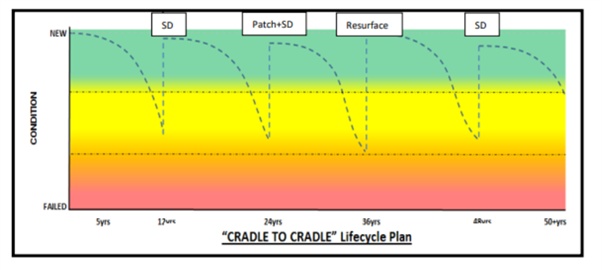
In support of this we have adopted a balanced approach to lifecycle planning by employing a “cradle to cradle” life cycle maintenance strategy. This maintenance strategy is demonstrated indicatively in the diagram below in respect of the carriageway asset in which a series of cost effective ‘preventative’ and surface maintenance treatments are used, aimed at considerably prolonging the whole service life of the existing road and optimising its performance and serviceability.
Works programme
Annual and forward priority highways work programmes are developed within budget availability and resource constraints, reflective of a consideration of maintenance management lifecycle planning initiatives, asset performance, condition modelling, and value management considerations.
This process supports the determination of our annual and future funding needs, and it promotes the identification of affordable and timely maintenance solutions.
The sites selected for priority maintenance are reflective of them reaching lifecycle maintenance milestones along with a consideration of service levels and performance targets (where they apply), aimed at securing a safe, serviceable, sustainable and accessible network environment which supports the council’s corporate priorities.
Short-term outcomes (current year)
These are the priority ranked schemes within annual funding limits selected from the forward programme through a risk-based condition driven, value management approach. They have been approved by senior management and at member level and are of high confidence they shall be delivered in the timeframe and funding allotted.
Medium-term outcomes (2 to 5 years)
These indicative schemes are selected from the forward programme through a risk-based value management approach, however they fall outside the current years funding allocations. They are of high to medium confidence of being delivered, however they are subject to the subsequent years condition surveys which may be reflective of worsening condition, due for example to winter degradation effects, and they can therefore result in some schemes being promoted or demoted from the indicative programme.
Long-term outcomes (5-10 years and longer)
The remaining schemes on the forward programme beyond 5 years are generally indicative of the scope, nature and magnitude of the residual highway network maintenance needs and are of medium-low confidence reflective of their ongoing mode and rate of deterioration and the relative uncertainties as to the future demands of the forward programme.
However, such long-term planned maintenance indications will assist with the determination of future funding requirements for the service and they may evidence the need to seek and secure additional funding in support of the Council Plan.
Enablers
Enablers are a set of activities that support the implementation of the Highway Asset Management Framework.
Leadership and organisation
The commitment from senior decision makers in adopting the asset management principals throughout their organisation and culture.
Risk management
Establish an approach to risk, identify risks, evaluate risks and manage risks to mitigate the impact.
Asset management systems
The strategy for the use of different asset systems to support the data and information to enable asset management.
Performance monitoring
Benchmarking and collaborating with other authorities and establishing a culture that thrives for continuous improvement.
Leadership and organisation
We will continually promote understanding and buy-in to the ‘Highway Infrastructure Asset Management Policy and Strategy’ from senior council leaders in order to seek optimal investment in service delivery within the constraints of the council’s financial provisions.
The council’s appreciation of highways asset management protocols will enable them to make informed choices and will provide them with the ability to defend their decisions reflective of a risk-based approach to asset maintenance management.
Risk management
We will identify, evaluate, manage and mitigate service delivery risks as far as is reasonably practicable. Any potential threats to achieving our operational objectives and core priorities will be identified and we shall seek to manage and mitigate those threats within the provisions and limitations of our operational and funding resources and reflective of council policy and direction.
A ‘Risk Register’ is set up to account for operational and fiscal threats and their impact and likelihood with mitigating control measures to address the risks. This shall include a ‘Resilient Network’ which may influence asset inspections and maintenance priorities for highways, bridges, highway flood risk and transport services and related critical infrastructure.
Asset Management (AM) Systems
We employ robust asset management systems and principles to facilitate service functionality, identify priority investment needs, consider ‘invest to save’ initiatives, determine budget needs and invoke procurement processes.
The inputs of the AM System identify the various supporting data components that feed into and underpin the development, provision and operation of the asset management system. The quality, currency, appropriateness and completeness of all data supporting asset management will be regularly reviewed to reflect the current status of the highways asset in order to apply data modelling processes that will provide meaningful and correct outputs.
The Highway Asset Management System comprises of the functional components that support the operational decision making and reporting processes that feed into a single or multiple AM systems which are used to model asset condition and to determine priority works programmes and investment planning needs.
The outputs from the AM System provide the information and data required to support the asset management process. These outputs relate to the operational service delivery aspects of the asset management process that give rise to priority works programming and funding allocations.
Performance monitoring
Where available and suitable, industry established performance monitoring processes will be utilised to review condition trends, to support benchmarking initiatives and to attain continuous asset improvement.
By highlighting improvements which are underway, and by making progress more transparent, it can be demonstrated how the condition of assets is improving and what more needs to be done to achieve the set performance targets. Increasing the visibility of asset performance is essential in managing costs, promoting quality services and meeting customer expectations.
Programme and service delivery
This final part of the asset management process considers the delivery of effective and efficient work programmes and services for individual asset groups following the asset management approach.
Prioritised works and services shall be delivered via Highways Framework contracts and we shall engage in robust cost-effective procurement processes for the programmed delivery of works and services in order to secure their correct, timely and quality delivery and to ensure value for money.
Procurement will be through the industry standard competitive tendering and framework arrangements in accordance with the council’s financial and procurement procedure rules and they shall be inclusive of collaboration and alliance initiatives with other Local Authorities in order to secure best value services and economies of scale.
Various modes of service delivery may be used reflective of the nature of the works, the capabilities of the highway authority and the resources it can offer at any point within the year.
- In house – use of the internal provision of highway services and staff remaining within the employment of the highway authority.
- External sub-contractor and multiple providers – a highway authority managed contract with various specialist organisations to ensure the delivery of relevant highway maintenance service elements for a defined task or period of time.
- Framework – the highway authority will use framework contracts for the provision of particular works and services where appropriate.
Highway asset condition
Find a summary of the highway assets together with their quantities and current condition:
Carriageway
- Quantity: 609km
- Condition: Road condition performance is measured using annual engineering inspections (AEI). The data for 2025 is:
- 9.57% (58km) Red (resurfacing/reconstruction required)
- 23.21% (141km) Amber
- (suitable for preventative treatment)
- 67.22% (410km) Green
- (up to standard)
Footways and cycleways
- Quantity:
- 1159km Footway
- 49km Cycleway
- Condition: A full network condition survey was completed in 2024 which determined the following condition:
- 15% (175km) Red (resurfacing/reconstruction required)
- 50% (580km) Amber
- (suitable for preventative treatment)
- 35% (404km) Green
- (up to standard)
Structures
- Quantity:
- 52 Bridges
- 3 Footbridges
- 11 Pedestrian Subway (or underpass
- 93 Retaining Wall
- Condition: At present the Bridge Condition Stock Indicator rates the average condition of all Highways structures at 80%
Drainage
- Quantity:
- 21,926 gullies
- 4,977soakaways
- Condition: During the last inspection 88% of the gullies were defect free.
Street lighting
- Quantity:
- 21,000 street lights
- 4,100 lit signs and bollards
- Condition: The current condition of the street lighting stock is:
- 54% Green (Good condition)
- 34% Amber (Fair condition)
- 6% Red (urgent upgrade or replacement)
- 6% Awaiting testing
Traffic signals
- Quantity:
- 1776 Traffic Signal poles
- 1474 Traffic Signal lanterns
- 1697 Ped crossing lanterns
- 89 cycle signal lanterns
- 79 Signalised junctions
- 100 Stand-alone pedestrian crossings
- Condition: By the end of the 2025 to 2026 refurbishment programme:
- 6% of stock will be functional but beyond its useful economic life (20yrs)
- a further 5% will require urgent upgrade (25 years+)
CCTV
- Quantity: 205 CCTV cameras
- Condition:
- 75% in good condition. 25% in poor condition
- Preventative maintenance is carried out every 12 months
Pay and display machines
- Quantity:
- 13 pay and display machines in operation
- 580 pay and display machines out of operation
- Condition:
- 13 in good condition, preventative maintenance carried out every 12 months
- 580 in poor condition are awaiting decommission. In the meantime, they are inspected every 6 months to ensure safety.
EV charging :
- Quantity
- 382 lamp post chargers
- 95 fast charger bays
- 24 rapid charger bays
- Condition: These assets are relatively new and therefore are in good condition.
Road markings, signs and street furniture
- Quantity
- 752km of road markings
- 33,113 Signs
- 200 Real-time information signs
- 508 Bus shelters
- 6,240 Street name plates
- 15,834 Safety bollards
- 1445 Directional bollards
- 2,023 Cycle parking stands
- 152 Bike hangers
- 11,886m of pedestrian guard rail
- 4213m of vehicle safety barriers
- Condition: Condition is not currently measured for all of these assets however pedestrian guard rails, bollards, vehicle safety barriers, road markings and signs are maintained to the safety standard set out in the ‘Highway Reactive Safety Maintenance and Inspection Policy 2025’.
- Real-time information signs
- 60 old signs were replaced in 2025 and the full roll out of a further 163 signs is ongoing. In total there will be 223 new real-time information signs across the City by March 223.
- Vehicle Safety Barrier Condition
- 6% Red (require repair, replacement or removal)
- 79% Amber (require repair, replacement or removal within 4-6 years
- 15% Green (up to standard)
Highway asset hierarchy
The Highways Code of Practice – ‘Well-managed Highways Infrastructure’ 2016, advises that a network hierarchy should be defined for all elements of the highway network in support of providing a strategic approach to highways asset maintenance management.
The maintenance hierarchy for carriageway and footway is based on the guidance provided in the Highways Code of Practice 2016, and it encompasses factors of network resilience and the protection of critical asset infrastructure. Tables 3 and 4 below highlights the current hierarchy definitions for the carriageways and footways. This hierarchy is the foundation of a risk-based maintenance strategy, and it reflects the needs, priorities and the use of infrastructure.
M101
- Footway type: Strategic and main distributor roads
- Description: Roads connecting to the motorway, primary routes to the city centre, dual carriageways, and national diversion routes. AADF Traffic Flow >18,000.
M102
- Footway type: Main distributor roads
- Description:
- A class roads connecting directly to M101 roads and primary routes between M101 roads or to neighbouring Authority M101 equivalent roads.
- AADF Traffic Flow >12,000.
M103
- Footway type: Main distributor and secondary distributor roads
- Description:
- A, B and C class roads connecting directly to higher hierarchy roads or that form part of a predominantly A, B or C class primary route between M101 and M102 roads.
- Part of the ‘Winter Resilient Network’.
- AADF Traffic Flow >8,000.
M104
- Footway type: Secondary distributor and link roads
- Description:
- Part of the ‘Resilient Network’.
- Part of a major public transport infrastructure or bus route connection to M101/102/103 roads or to isolated communities.
- Provides direct access to large public amenity facilities such as sports stadia, hypermarkets, etc.
- HGV route.
- HGV Traffic Flow >(to be notified)
M105
- Footway type: Link roads and local access roads
- Description:
- Roads containing recurring known accident hotspots.
- Roads providing direct access to schools.
- Feeder or arterial road serving urban residential areas.
- Road serving more than 40 properties.
- Designated as ‘Traffic Sensitive’.
- Part of a bus route.
- Carries HGV’s.
- HGV Traffic Flow >(to be notified)
M106
- Footway type: Local access roads
- Description:
- Roads with 3 or more shops or a supermarket.
- Provides access to medical centre/doctors surgery.
- Provides access to industrial units.
- Provides sole access to/from village or isolated community.
- Is not a feeder or arterial road to urban residential areas.
- Is not designated as being ‘Traffic Sensitive’
M107
- Footway type: Minor roads
- Description: Road width >3m.
M108
- Footway type: Minor roads
- Description: Cul-de-sac with road width >3m.
M109
- Footway type: Minor roads
- Description:
- Road is denoted by name as a ‘Back Road’ or ‘Service Road’.
- Road width <3m.
- Layby
- (Note:- if the road is ‘gated’ and does not accommodate vehicular traffic, then the section should be treated as a footway).
M110
Footway type: Minor roads
Description: Roads that are not paved or metalled, ie, unpaved gravel roads or tracks that can accommodate limited vehicular traffic.
M201
- Footway type: Prestige route
- Description:
- Very busy areas. Often areas of high public space and streetscene contribution allowing for and attracting large footfall.
- 12hr Footfall > 10,000
M202
- Footway type: Primary route
- Description:
- Busy urban shopping and business areas considered main pedestrian routes.
- 12hr Footfall > 3,000
M203
- Footway type: Secondary route
- Description:
- Medium usage routes and priority strategic active travel routes. Includes regular pedestrian hubs.
- Part of Priority Strategic Active Travel Network
- Serves approach or access to Hospital.
- Serves approach or access to School.
M204
- Footway type: Link footway
- Description:
- Footways that provide a direct link between known busy footways and strategic active travel routes. Includes non-regular pedestrian hubs.
- Part of the Strategic Active Travel network.
- Serves approach or access to Place of Worship
- Serves approach or access to Park or Cemetery.
- Serves approach or access to Care Home.
- Link between M201/M202/M203 Footways.
M205
- Footway type: Local access footway
- Description:
- Footways associated with low usage with no specific destination routing. Predominantly footways that connect to link footways.
- Link between M204 Footways.
M206
- Footway type: Minor footway
- Description: Little used footways serving limited numbers of properties. Includes little used rural footways and urban cul-de-sacs.
M207
- Footway type: Highways footpath
- Description: Rights of way that fall within the urban realm and have a hard surface. These paths are not Public Highway but are identified within the Highway Terrier as ‘Highway Footpaths’ and are inspected by the Highways Operations Team.
6. Strategy for the main highway asset groups
Carriageway
Brighton & Hove is a busy and compact city, with the highest number of bus users outside of London.
In terms of quantity, carriageway surfaces are the largest physical asset managed by the council, and therefore have the highest value. For this reason, changes in the condition of carriageway surfaces across the network can lead to significant and long-term financial and environmental consequences for the council.
The council maintains 609km of carriageway across the city, made up mostly of unclassified local roads. This network also includes a 150km network of aging concrete roads that are reaching the end of their serviceable life and will therefore require considerable future investment to maintain safe and serviceable.
A one-off funding injection was previously provided to undertake an extensive and successful concrete road rehabilitation programme, however there are no plans at this time to further fund and extend the programme across the city.
The condition of the carriageway is measured on an annual basis via an Annual Engineering Inspection (AEI). These figures are reported to the Department for Transport on an annual basis and are aligned with the new National Road Condition Monitoring Standard (PAS2161) for road condition data collection.
Table 5 sets out the latest road condition data by road classification.
| Road classification | Road length | Up to standard | Suitable for preventative treatment | Requires resurfacing or reconstruction |
|---|---|---|---|---|
| A roads | 62km | 56% (35km) |
27% (17km) |
17% (10km) |
| B and C roads | 67km | 54% (37km) |
32% (21km) |
14% (9km) |
| Unclassified roads | 480km | 70% (338km) |
22% (103km) |
8% (39km) |
| Overall Network | 609km | 67% (410km) |
23% (141km) |
10% (58km) |
The annual carriageway survey data is used to determine the current condition status of the road network, to calculate the magnitude of maintenance backlogs and to determine the current and predicted future maintenance funding requirements. Through a process of value management modelling, the condition data is then used to prioritise works and to generate our forward works programmes. This includes a detailed forward works plan for the coming year and we are working towards the creation of indicative forward programmes for years 2 to 3.
The value management process includes not only condition data but it also factors including road maintenance hierarchy, predicted deterioration rates, condition reporting from Highway Safety Inspectors, historic reactive maintenance costs, proximity to key services and ride quality.
The latest condition modelling indicates that reduced funding over decades has resulted in a carriageway maintenance backlog of approximately £57 million. Furthermore, if budgets remained at 2024 levels going forward then it is predicted that this maintenance funding deficit could increase to £200 million by 2043.
In support of the council’s ambition to be Carbon Neutral by 2030, we will focus on extending the life of all our highway assets and reduce the maintenance backlog by continuing to adopt preventative maintenance and rejuvenation treatment processes for carriageways and we shall seek to secure additional capital investment in order to address the backlog position and to promote a position of stability, future sustainability and improvement.
Short-term desired outcomes (current year):
To develop a current 1-year prioritised and funded works programme that includes both planned and preventative maintenance treatments. This will ensure we address the worst of the poor condition sites, maximise the lifespan of the fair condition sites to prevent them from deteriorating and becoming poor, reduce our carbon footprint and provide value for money.
Review and improve the detailed policy and strategy for the planned maintenance of carriageways.
Medium-term desired outcomes (2 to 5 years)
To seek to secure the required additional capital funding to maintain the carriageway to a steady state condition across the city and by further developing and implementing good asset management practices.
Long-term desired outcomes (5 to 10 years)
To maintain the carriageway to a steady state and then an improving condition level through delivering a fully inclusive and effective risk-based asset management approach to highway maintenance which is supported by adequate annual and long-term financial investment funding to meet the future demands of the service.
Footways and cycleways
Footways and cycleways are key assets that support access, social inclusion and mobility for people in the city. By ensuring that the footways and cycleways are in a safe and serviceable condition it encourages a method of transport alternative to a car, which supports the council’s ambition to be carbon neutral by 2030, especially as much of the city is a dense, urban area.
The council is responsible for maintaining 1159km of footway and 49km of cycleways. The condition of footways and cycleways have been recently assessed by condition surveys (AEI), from which the annual programmes of maintenance are developed. It is proposed that these AEI surveys will in the future be conducted on a percentage of the footway network annually, (circa 20% to 25%), subject to funding provisions. These surveys are supplemented with footway condition reports that are generated by our Highway Inspectors as part of their safety and routine inspections of the highway.
The 2024 condition data indicates that 15% (175km) of the footway network is in red condition and requires resurfacing/reconstruction. 20% (580km) is amber and is showing signs on deterioration and would benefit from preventative maintenance. 35% (404km) of the network is green and is up to standard. Condition modelling also indicates that there is a £37 million maintenance backlog for footways and off-road cycle lanes. Within this data there are 240km of footway that are impacted by tree roots.
The council adopts a risk-based value managed approach to prioritising footway and cycleway planned maintenance, concentrating on those locations with high footfall in the urban area. This approach takes account of ancillary damage being caused by vehicle over-riding, pavement parking, utility damage and tree roots, a consequence of which, resulting in our footways deteriorating faster than previously anticipated, thus requiring additional funding investment to achieve a stable network that is safe and fit for purpose.
By working in collaboration with other teams across the council and externally, we will look for opportunities to share resources to deliver additional schemes beyond the principal footway network and to align these with priority areas set out within the ‘Local Cycling and Walking Implementation Plan’. This will make our footways more accessible for all road users and support active and accessible travel within local areas as well as the city centre.
Going forward we shall seek to secure further investment to support an enhanced planned and preventative footway and cycleway planned maintenance programme. We will adopt a lifecycle approach to the maintenance management of our footway and cycleway assets and ensure that we use products and processes that will be resilient and long-lasting, thereby lengthening the maintenance and renewal cycle and reducing the financial cost of on-going reactive maintenance and promoting carbon reduction measures.
Short-term desired outcomes (current year)
Maintain and update a comprehensive inventory of both footways and cycleways and review the on-going approach to the collection of condition data.
Use risk-based methodology to identify walking and cycling routes for priority planned maintenance and align these with the additional priorities identified within the ‘Local Cycling and Walking Implementation Plan’. We will also seek additional funding to support this enhanced programme and to meet the steady state needs of the footway network.
Undertake a further targeted programme of works to address the increasing problem with tree roots, to promote user safety and accessibility.
Review and improve the detailed policy and strategy for the planned maintenance of footways and cycleways.
Medium-term desired outcomes (2 to 5 years)
Prioritise planned maintenance on the primary footway network and improve the condition of the identified formal and informal cycleway networks by developing medium to long-term funded works programmes that includes both planned and preventative maintenance.
Long-term desired outcomes (5 to 10 years)
Continue to improve the condition of the primary footway and cycleway networks while maintaining a steady state on the secondary, link and local footway networks, eventually leading to their condition improvement.
Structures
There are 159 Highway structures in the council’s ownership. These include road bridges, seafront arches and many Highway retaining walls, particularly on the seafront.
The council’s overall approach to management of Highway Structures is set out in the ‘Highway Inspection Procedure (2013)’. This details the types and frequencies of inspection and monitoring that the council carries out on different types of structure.
Many of the Highway structures within the city date back to Victorian times and require regular and continued maintenance. Some of these structures have long passed their design life and will require significant investment over the next decade to either replace or substantially repair. The seafront arches, due to the historical and economical importance to the city, have been the focus of significant investment over the last decade. The continued improvements to the arches that are yet to be repaired is required in the short to medium term.
Work on Highway structures require extensive planning and design in the medium and long term to minimise disruption to traffic, residents and businesses and to take account of local environmental and bio-diversity matters. For this reason, the council has developed a risk-based programme to extend the seafront structures with works required over the coming 5 to 10 years. Programmes are constantly reviewed based on the outcome of inspections and surveys to ensure urgent reactive works are prioritised as required to ensure public safety. A 20-year structures maintenance programme is required more broadly across the city requiring funding of approximately £150 to £200 million.
The city’s coast protection structures defend the Highway network from erosion and encroachment by the sea. Two approved lifecycle plans are in place for their long-term maintenance management. These are periodically updated in line with Environment Agency guidance.
Structural failure may occur through a situation of sudden impairment, for example as a consequence of a collision with a bridge or retaining wall, flood scour or structural collapse. Such incidents are usually unforeseen and will likely result in the asset being closed or temporarily decommissioned until it is made safe and/or a fix can be undertaken. This may result in road closures and diversions, considerable delays and inconvenience, and it may have an adverse impact of the subsequent performance of the emergency services. In such circumstances capital funding may need to be diverted from existing structures/highways budgets or from council capital reserves to address the crisis and to mitigate long-term consequences of the incident.
Sea front protection measures are a very costly and an ongoing process that requires strategic direction to project selection, funding, preparations, design, delivery and future demands.
The council has secured £11 million funding to deliver the first phase of a 10-year project to improve sea defences along Hove seafront up to Shoreham Port. Improvements will include groyne replacements, sea wall strengthening and shingle recycling.
Short-term desired outcomes (current year)
To improve the asset inventory across all structures including the digitisation of all hard copy information.
Medium-term desired outcomes (2 to 5 years)
Continue to win external bids for funding.
To support continued improvements to the seafront arches.
To promote a lifecycle approach to preventative asset maintenance.
To support and further develop a holistic whole service asset management approach to the identification and delivery structural asset maintenance.
Review and improve the detailed policy and strategy for the planned maintenance of Highway structures.
Long-term desired outcomes (5 to 10 years)
Continue to win external bids for funding and with this additional funding, see an improvement in structural condition.
To support continued improvements to the seafront arches and for seafront protection measures.
Drainage
With the increasing risk of extreme rainfall events as a result of climate change, the City Council faces growing challenges to mitigate the risk of flooding from surface water run-off from Highways and from adjacent land areas.
We currently have 21,926 gullies and 4,977 soakaways that drain surface water from the highway. There is currently a maintenance backlog of approximately £1.25m including broken/jammed gully lids and broken infrastructure.
Most of the gully discharge is directed into a combined surface/foul water sewer system which is managed by Southern Water, and at times this historic and aging sewer system is unable cope with the extreme weather events we are experiencing.
To avoid further overloading this system, Brighton & Hove City Council cannot connect additional gullies to it, nor replace existing gullies with bigger capacity gullies, as by doing so would further increase the risk of sewage surcharging and then discharging on to the public highway and perhaps into private properties at times of exceptional rainfall.
Since there is limited action that can be taken to improve the existing highway drainage system to a point where it will cater for extreme rainfall, the current strategic priority is therefore to supplement the cyclical cleansing of our existing drainage assets with additional sustainable urban drainage schemes (SuDS). These schemes, where appropriate, will accept water away from roads into a series of natural basins, soakaways or bespoke water retention features from where it can gradually be absorbed into the surrounding ground.
To deliver a serviceable and sustainable drainage service into the future, the two elements of efficiency and effectiveness must be appropriately balanced to ensure the best use of limited budgets.
Historically, Brighton & Hove City Council’s risk-based approach to cleansing, repairing and improving highway drainage assets has been predominantly enhanced by improving the quality of the asset inventory data and the condition performance data. Through this we are able to adopt a risk-based approach across all our drainage assets in support of cyclical operations and proactive maintenance regimes.
This risk-based approach follows the guidance and direction provided in the Well-managed Highway Infrastructure Code of Practice 2016 and allows the council to focus maintenance on the high priority assets which may pose a greater risk of flooding and disruption to road users and consequential damage to private property.
Short-term desired outcomes (current year)
Continue to maintain the existing asset inventory to a high standard to inform decision-making.
Continue to deliver and periodically review an efficient and effective Highway Drainage Cleansing Service based on asset condition and the risk of flooding.
Explore innovations in the industry to support the risk-based maintenance of the network of soakaways.
Medium-term desired outcomes (2 to 5 years)
Continue to build a closer working relationship with key stakeholders and in particular with Southern Water, with the common aim of reducing the amount of surface water that discharges into their combined sewer system.
Continue to review and deliver a risk-based drainage maintenance programme and seek external funding to promote more extensive service delivery.
Secure additional funds to reduce the maintenance backlog of broken/jammed gullies and damaged infrastructure, (approximately £1.25 million).
Make improvements to the underground asset register of drainage assets across the city and share this information with NUAR
Review and improve the detailed policy and strategy for the planned maintenance of highway drainage.
Long-term desired outcomes (5 to 10 years)
To continue to deliver the long-term risk-based approach across all drainage assets.
Street lighting
Street lighting is a critical Highway asset which contributes to public amenity, safety and the night-time economy. The council currently maintain approximately:
- 21,000 street lights*
- 4,100 lit signs and bollards
*this includes 4,750 cast iron columns and 250 columns identified as being of historic and architectural significance.
The overall condition of the council’s street lighting asset is monitored in accordance with guidance from the Institute of Lighting Professionals (ILP), this is combined with a well-designed risk-based cyclical maintenance programme that prevents the performance falling below the designed level. A risk-based review of street lighting needs will also inform on possible strategic changes to lighting times and levels that may be regulated to promote adequate user safety and cost efficiencies.
In addition, visual data is collected on all street lighting assets to map degradation following GN22 guidance from the ILP informing of future maintenance strategies and anticipated required funding.
Lifecycle planning considerations will allow future street lighting asset replacements and maintenance to be predicted, thereby supporting the needs for future stock replacement and maintenance funding.
The council has completed a city-wide programme to replace older lighting technology with LED lanterns. This investment into our street lighting assets has substantially reduced the Councils energy costs and carbon emissions while providing asset improvements for all service users.
The council has also allocated £1.4 million from the Carbon Neutral Fund to support the delivery of a Seafront Heritage Lighting Restoration Project. Working with Historic England this project will restore the historic Grade II listed cast iron street lighting columns along Brighton’s Seafront to preserve the cities heritage and expedite the replacement of existing lanterns with new LED variants.
Short-term desired outcomes (current year)
To continue working on the restoration of the historic seafront columns working with Historic England.
To continue improving the quality of asset data utilising the increased capabilities of the new asset management system.
Deliver a preventative maintenance painting programme on a selection of the city’s cast iron lighting assets.
Review and improve the detailed policy and strategy for the planned maintenance of street lighting assets.
Medium-term desired outcomes (2 to 5 years)
To seek reduced energy savings and continue to investigate all opportunities to make additional energy and carbon efficiencies.
Undertake and complete the restoration of historic seafront columns.
Secure additional funding to support a continued annual preventative maintenance painting programme.
Secure funding to install a CM System across the city once cost effective to do so.
Long-term desired outcomes (5 to 10 years)
Utilise information gathered to develop a long-term risk-based strategy for the maintenance of all street lighting assets.
Traffic signals
Traffic signals are used to control the safe flow and movement and efficiency of vehicular traffic, public transport, cyclists and pedestrians and they are typically placed at road junction intersections, key crossing points. Under the Road Traffic Regulation Act 1984: Section 122 and the Traffic Management Act 2004: Part 2, the traffic signals need to be maintained to operate safely and correctly.
The council hold a good level of asset inventory and condition data for traffic signal assets which is key to effective and strategic asset management. We currently maintain and operate 79 signal junctions and 100 stand-alone signal crossings. In combination there are a total of 1776 signal poles holding 1474 vehicle lanterns, 1697 pedestrian lanterns and 89 cycle lanterns.
All the junctions can operate at a minimum level of Vehicle Actuation (VA), with many having Micro-processor Optimised Vehicle Actuation (MOVA) and/or Split Cycle Offset Optimisation Technique (SCOOT) control, which is a real time adaptive traffic control system for the coordination and control of traffic signals across an urban road network that automatically adjusts traffic signal delays to traffic conditions ensuring signal timings remain as efficient as possible.
It is evident that the effective and efficient maintenance management needs of traffic signal assets and their components and operation are vital to the reliable, safe and optimal running and control of this essential service.
The city's traffic signal sites are remotely monitored for faults, inspected at least once annually and are subject to routine maintenance and running repairs. Lifecycle planning generally deems the useful expected life of a traffic signal site to be around 20 years, and they are considered to be at risk after 25 years. Ideally sites will be refurbished before they reach the ‘at risk’ stage and a refurbishment programme is put in place that prioritises sites based on a combination of age, number of reported faults and the result of the annual periodic inspection. When possible, these risk-based refurbishments are carried out in coordination with other schemes underway in the city in order to optimise resource and cost efficiencies and minimise traffic control delays.
Short-term desired outcomes (current year)
Complete this year’s maintenance refurbishment programme (4 sites).
Move 6 sites currently on RMS/Stratos to UTC monitoring and control.
Reduce carbon emissions by use of LED lanterns and extra low voltage (ELV) signals systems.
Expand the current use of MOVA/SCOOT control throughout the city.
Complete the annual inspection and validation regime.
Medium-term desired outcomes (2 to 5 years)
Complete the replacement of final incandescent lamps with LED's preferably in conjunction with ELV.
Continue to trial the use of Plus+ to reduce required signal infrastructure (cabling etc) and civils works.
Replace existing high level cycle phase lanterns with low level RAG's.
Consolidate site communications onto UTC for monitoring and control.
Investigate methods of more reliable (non-loop) detection for all traffic and in particular the detection of pedestrians and cyclists.
Continue validation program for MOVA/SCOOT/UTC control.
Long-term desired outcomes (5 to 10 years)
Achieve a balance in the maintenance programme where signal equipment is used for the expected life period but where no more sites reach the 'at risk' category than can be refurbished in the annual programme (currently would need to be 8-10 sites/year).
Road markings, signs and street furniture
Road markings, signs and ancillary street furniture are important assets to a local area, not only ensuring road safety, but also offering information, direction and contribution to a pleasant public realm environment. The council’s overall objective is to ensure the city’s streets and public spaces are designed to bring maximum benefit to all residents.
The council has invested in updating their asset inventory data to gain a greater understanding of the inventory across the Highway network for all road markings, signs and street furniture. In addition, there is a need to introduce a process to ensure that new inventory data is collected and maintained as the network changes and grows.
This needs to be explored further to ensure that our asset inventory data accurately reflects all necessary assets. Asset data from other services such as street trees (City Parks) and bins and benches (Environmental Services) is also being explored in order to create a one stop shop for all asset data associated with the public highway.
Poor condition of road markings, signs and street furniture are identified as part of routine highway safety inspections, and via reports from the public, and then notified to the relevant service to action. The frequency of inspection is reflective of the network hierarchy on which the asset is located which provides a proxy for the maintenance priority status.
Line markings are renewed on a rolling programme but other options to collect condition data using AI technology are being explored. This enhanced condition data combined with asset lifecycle planning considerations and future condition projection modelling will provide the basis for developing forward plans for planned maintenance and funding needs. The forward plan through a risk-based prioritisation process and value management considerations will further inform our annual service plans and their associated budget needs.
Preventative maintenance such as sign washing and the painting of cast iron street furniture, etc, is also undertaken on a reactive ad hoc basis to promote highway safety and to support the upkeep of the public realm.
In line with the Well-Managed Highway Infrastructure Code of Practice, the council are taking the opportunity during schemes and projects to declutter the Highway network of street furniture where it is obsolete or redundant. With accurate data, this approach could be accelerated by identifying redundant assets for removal as part of specific decluttering projects, subject to suitable funding being identified.
Short-term desired outcomes (current year)
To continue to maintain signing and lining regimes which are required for enforcement, safety and efficiency purposes.
To engage in the process of decluttering the highway network of redundant and obsolete signs and street furniture assets.
To explore AI technology to support the collection of condition data for road lining and signage to inform forward works programmes.
Medium-term desired outcomes (2 to 5 years)
Continue to declutter the network in line with the Code of Practice whilst retaining and maintaining those assets that are critical to the safety and the essential operation of the network.
Deliver a cyclical programme of preventative maintenance for key street furniture, subject to funding.
Long-term desired outcomes (5 to 10 years)
To have a network with no redundant items cluttering the highway and with a reduced palette of approved sustainable materials with known lifecycles.
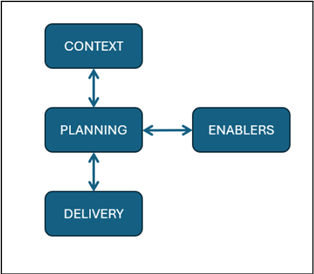
7. Highway asset data and information
Highway data and information strategy
The council understands that the data we hold is as important an asset as any other and therefore having good quality data allows us to make informed and robust strategic choices and decisions for Highway asset maintenance.
Our supporting ‘Data and Information Management Strategy’ therefore forms an important part of our ‘Asset Management Framework’ and is currently being reviewed and updated to reflect the contents of this document.
Highway data and information asset management systems
The asset management systems within the council store the highways data and information, and provide a platform for data ownership, upkeep and maintenance and sharing should be sustainable and able to support the information required to enable effective asset management to take place. Improved asset management systems feature strongly in the council’s ‘Asset Management Framework’.
A new asset management IT system has been introduced to support the effective asset management of a wide range of Highway Assets. This system is used to store and maintain highway asset data, record defects, raise works orders and carry out inspections. The system provides transparency across service areas and works towards a one council approach, whilst also providing a strong evidence base to protect the council against third party claims.
A new online form has also been developed that brings together options across a range of service areas. This has been designed to make it easier for the public to report issues on the highway and includes a new map function to make it easier to locate issues. The new form is now live and has been integrated with the new asset management system. This has improved the efficiency of a number of service areas within city Infrastructure and will speed up our response times and improve safety.
Work continues to further enhance the new system to improve efficiencies and to bring on board additional asset groups.
8. Best practice and performance monitoring
The council is committed to the ongoing development of good practice and continuous improvement. Some examples of activities that demonstrate this include:
- membership of LGTAG
- membership of the CIPFA HAMP Network
- attendance at a variety of local and regional highway industry events, conferences and workshops
- membership to NHT Survey for benchmarking initiatives
- membership of LCRIG
Performance monitoring
It is critical as the council continues our asset management journey, that we set targets and measure our performance, not only to ensure what that we are doing is working but also to continuously seek improvement. Performance objectives and targets have been identified and set in the ‘Performance Management Framework’, and these objectives will ensure the council continues to maintain our Highway asset in the most efficient and effective manner.
In addition, the council has a NEC ‘Highways Framework Contract’ for the provision of highway construction services. The framework has embedded Key Performance Indicators relating to Carbon Reduction, Innovation, Social Value and Collaboration. These KPIs will be monitored monthly and offer financial incentives for compliance. A new street lighting contact is also in the process of being developed and procured which shall also have embedded KPI’s attached.
Commitment to continuous improvement
The council is committed to seeking continuous improvement in its asset management practices by incorporating an all-inclusive, comprehensive and coordinated approach to service delivery through:
- adopting a strategic, affordable, and sustainable approach to highways infrastructure asset maintenance.
- monitoring annual asset condition trends and service delivery through the setting of service levels and asset performance indicators, thereby driving forward targeted asset improvement measures within affordable funding limits.
- a consideration of the future demands of the service in relation to traffic and population growth, asset condition, lifecycle planning, funding and investment provisions, regeneration initiatives, prioritisation/risk-based approach, resource needs/availability, asset safety, serviceability and sustainability, carbon reduction measures and the effects of climatic changes.
In addition, the skills and competencies of staff in asset management roles will be continually assessed and development action plans shall be developed accordingly. The vocational, educational and professional training needs identified in the development action plans will be appropriately supported and implemented. Managers will work with their staff to align their existing personal development objectives to the priorities of the Council Plan.
Strategy review
The ‘Highway Asset Management Policy and Strategy’ will be reviewed, updated and re-published within 3 years.