Conservation Area (CA)
No CA.
Local Listing Reference
LLHA0239.
Description
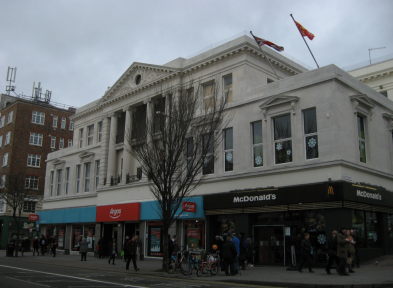
Originally built for Boots in 1927 to 1928 by Bromley, Cartwright & Waumsley. Classical-Revival style. Ashlar-faced, symmetrical composition. Two storeys, rising to 3 in the centre with a central pediment and Ionic colonnade. Similar Classical detailing to the 2 side elevations. Modern shopfronts to the entirety of the ground floor.
Western Road was initially developed (from c.1809) for housing, but as the area developed the front gardens were built over to provide shops.
From 1906 the Brighton Corporation began acquiring property on the north side and the road was widened between Hampton Place and North Street between 1926 and 1936. This provided the opportunity to consolidate the building plots and develop a number of large department stores. This stretch of road was described in 1953 as ‘Oxford Street-by-the-Sea’ by Harold Clunn.
The concept of the department store emerged in the late 19th century, though the finest examples in England date from the early 20th century.
It was not until the 1920s that the department store made an appearance in Brighton & Hove, probably because there were few opportunities before then for retailers to accumulate the necessary consolidated blocks of High Street property, given the tight-knit 19th-century urban grain of Brighton & Hove.
The 1920s and 1930s saw a boom in department store buildings, particularly on London Road and on Western Road.
Source: Antram & Morrice 2008, Carder 1990.
A. Architectural, design and artistic interest
ii. A good example of a building of its style.
B. Historic and evidential interest
ii. Illustrative of the physical, social and economic development of Brighton & Hove, being one of a number of department stores that transformed the main shopping streets in the inter-war period.
C. Townscape interest
ii. Not within a conservation area, the facade contributes greatly to the street scene.
E. Rarity and representativeness
ii. The building is representative of the rise of the department store in the city. It forms part of a group of department stores built at a similar date but of strongly contrasting architectural styles.
Date of Inclusion
2015.