Brighton & Hove Strategic Energy Partnership Prospectus
Advancing Brighton & Hove’s Net Zero Transition - Brighton & Hove City Council
Foreword
Brighton & Hove is a city with a long tradition of climate action and leadership. We were among the first councils to declare a climate and biodiversity emergency, and we are totally committed to driving down the city’s emissions.
Our city-wide net zero programme is focused on providing future-proofed infrastructure and technology that will improve lives, support a resilient local economy, and move away from fossil fuels.
This prospectus sets out the opportunity for a new kind of partnership between the public and private sector to deliver these ambitious projects at pace and scale.
The city has considerable strengths to bring to a partnership: strong and consistent political commitment; a large and varied asset base; a mature ecosystem of community energy organisations; and a track record of securing major external funding.
Our Decarbonisation Pathways Study and Local Area Energy Plan provide a clear, data driven roadmap for how Brighton & Hove can transition to a net zero energy system. It identifies a coherent and investible pipeline of 110 priority projects across heat, power, buildings, transport and land use - opportunities that are ambitious in scale, but real, tangible and ready to be taken forward.
These include: heat network zones in the city centre; large scale domestic and non-domestic retrofit programmes; citywide rooftop and ground mounted solar generation; electric vehicle charging infrastructure; opportunities for grid flexibility and smart energy infrastructure, and the decarbonisation of the council’s own estate.
We also bring a clear long-term vision: that the transition to net zero must produce economic growth and opportunities for developing new technologies to support good local jobs, new skills, warmer homes, lower bills and thriving neighbourhoods.
We welcome your interest, ideas and expertise. We look forward to working with partners who recognise that Brighton & Hove is not only committed to a low carbon future—but is ready to deliver it.
Councillor Tim Rawkins Deputy Leader of Brighton & Hove City Council and Cabinet Member for Net Zero & Environmental Services
Introduction
Brighton & Hove City Council (BHCC) invites potential partners to engage in a unique opportunity to shape the city's transition to net zero. With a defined pipeline of capital projects, we are seeking a strategic partnership that can accelerate delivery, unlock innovation, and create long-term value for both the city and its investment partners.
Our ambition is to enable energy decarbonisation for the whole city, whilst tackling inequality, generating economic benefit and providing a better Brighton & Hove for all of our residents and businesses.
Strategic context
The population of Brighton & Hove has a long tradition of engagement in climate action. The city council has consistently shown leadership in this area, with:
a formal declaration of a climate and biodiversity emergency in 2018
Our Carbon Neutral Programme (launched in 2021) laid critical foundations for action. This plan is refreshed in our Climate and Nature Action Plan (expected February 2026), which covers actions relating to climate change mitigation, climate change adaptation and nature recovery. Our Decarbonisation Pathways Study, published in 2024, identifies the transformational changes required across the city’s energy system to reach net zero.
Located in The Living Coast UNESCO Biosphere, Brighton & Hove has long been recognised as a fantastic place to live, work and visit. The city boasts excellent transport links via road, rail and sea. Our Council Plan sets out our vision and priorities for the city and provides further information on our demographics.
In addition to our large urban assets, the council also owns 13,000 acres of land around the city periphery, and our nature recovery and carbon sequestration activity includes the:
Our net zero ambition aligns with regional frameworks such as Sussex Energy, a collaboration between public and private sector stakeholders across Sussex, with the aim of achieving energy neutrality for the region by 2040.
Sussex and Brighton are in the Devolution Priority Programme, which includes Climate and Environment as an area of competence in the devolution framework. This is expected to further enable the aims of Sussex Energy, with Brighton & Hove City Council taking a leading role, as the only already-established unitary authority in the region.
The council currently has a large Labour majority, with primary political opposition coming from the Green Party. Priorities are therefore strongly aligned with the Government’s clean energy mission, and political commitment to decarbonisation is expected to remain a council priority long into the future.
Strategic Energy Partnership – scale of the opportunity
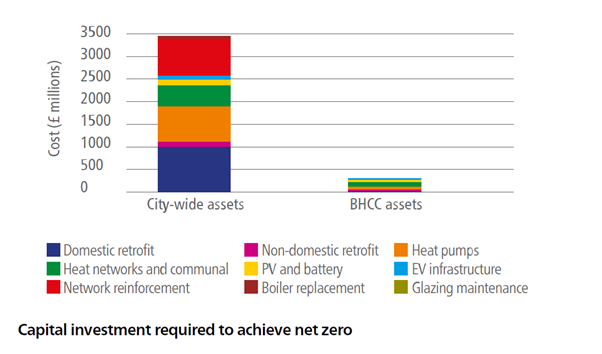
The Decarbonisation Pathways Study (the city’s Local Area Energy Plan) outlines a capital investment of nearly £2.6 billion required to deliver the transition to net zero, including investment from property owners but excluding network reinforcement costs.
Return on investment varies by project type and may improve under future energy market shifts, in particular, changes to the electricity to gas price ratio included in the scope of Ofgem’s energy system cost allocation and recovery review.
The Decarbonisation Pathways Study uses spatial analysis and local insights to identify 110 priority projects to push forward the city’s net zero transition. View a map of these projects, along with supporting energy system data.
Opportunities
Further information is provided on selected opportunities in the latter part of this document.
In summary, these include:
Solar Farm
Feasibility and concept design is currently being undertaken for up to 6.5MWp of ground-mounted generation, at a site located close to potential direct-wire off-takers.
Heat Networks
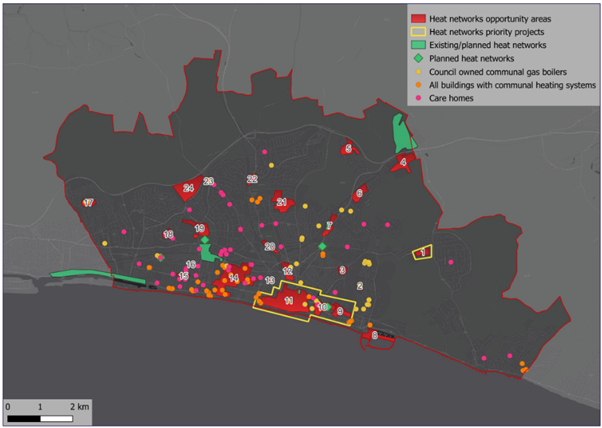
Brighton city centre, together with an area of Kemptown, contains 181 MWh annual heat demand and a linear heat density exceeding 8MWh/m/y. Central Hove also has high linear heat density with 20 smaller heat network opportunities identified in outer parts of the city.
Domestic retrofit and fabric upgrades
Around 105k properties in Brighton & Hove have an Energy Performance Certificate (EPC) rating of D or below. The report identifies geographical groupings of over 8,000 domestic properties where specific, simple measures could yield significant energy savings.
Non-domestic retrofit and fabric upgrades
There is 60.4GWh/annum of heat demand from non-domestic buildings on council-owned land, with energy rating D or below. From 2027 the Minimum Energy Efficiency Standards (MEES) for commercial properties will be raised to C, improving the retrofit business case.
Individual heat pumps
There are around 37,000 heat pump ready domestic properties currently using gas or electric heating, of which nearly 4,000 are owned by the council. Heat pump deployment for non-domestic properties will likely need to exceed 2,400 properties, 20% of which are on council land.
Rooftop solar generation
As the sunniest city in the UK, Brighton & Hove is estimated to have 670 MWp potential for rooftop Photovoltaic generation (PV) of which 75% is on domestic buildings.
There are opportunities for combining decarbonisation projects with our planned pipeline of regeneration projects.
Low carbon technology innovation
There are opportunities to trial innovative technologies using our asset base, such as vehicle-to-grid and smart grid technologies at our fleet depot or a pyrolysis/biochar plant located close to a third-party heat network.
Why partner with Brighton & Hove City Council?
There are numerous benefits for potential partners from joining Brighton & Hove City Council in their proposed Strategic Energy Partnership. Some would apply, to a greater or lesser extent, to any Strategic Energy Partnership with a local authority, however there are additional advantages specific to partnering with Brighton & Hove City Council.
As an established unitary authority, the council’s operations are unlikely to be deeply affected by Local Government Reorganisation, though potentially the geographical area might increase. This will enable the council to retain a strong focus on the partnership.
There is a coherent set of policies supporting the council’s net zero and energy ambitions, for example:
our downland estate (4,880 hectares of land within the South Downs National Park) is unmatched in terms of rural landholdings by a UK urban local authority.
outside of the National Park, the council owns 1,753 hectares comprising 29% green spaces, 24% Housing, 10% educational use and 29% commercial.
a city-wide Local Area Energy Plan that has already been undertaken and forms the backbone of this prospectus
the findings have been shared digitally and stakeholder dialogue already established
close engagement with UK Power Networks, including providing input into the 2026 Distribution Future Energy Scenarios (DFES) to be published in February
this engagement ensures that UKPN's mid-term investment plans take into account Brighton & Hove’s strategic energy projects
a coastal location that provides potential additional opportunities related to wind and tidal generation
a vibrant SME-led economy, with strong employment and business growth driven by the creative, digital and visitor economy sectors in particular.
the city’s Economic Plan sets out an ambition to create an economy that is more competitive, fairer and greener, driven by core missions including to “decarbonise and create a more regenerative economy”.
our role as a key partner in established regional collaborative partnerships, including with:
Sussex Energy which is a regional collaboration, whose evidence is expected to influence energy strategy and policy of the Sussex and Brighton Combined County Authority.
access to strategic land and planning control
the council’s remit includes planning, road use, land release, social housing and public assets - key levers for unlocking, speeding up, and derisking complex infrastructure projects.
a strong track record as a highways authority.
Net Zero projects, such as heat network deployment, often entail periods of disruption and changes to the public highway. Through initiatives such as Valley Gardens and the rollout of bus service priority measures, the council has consistently demonstrated its ability to effectively manage changes to enable innovation.
a good track record of delivery and of achieving grant funding, including for:
By forming a Strategic Energy Partnership with Brighton & Hove City Council, the partner would gain the following advantages:
Access to underexploited market segments
Through mixed asset bundling, the SEP would generate investment opportunities in mid-ticket, distributed infrastructure (eg heat network, EV charging, building retrofit, and solar farm) that are underrepresented in traditional infrastructure portfolios due to fragmentation. These emerging infrastructure classes have long-term growth potential but are harder to access without intermediaries such as local authorities.
Long-term, Inflation-hedged returns
The SEP would provide access to long-term, inflation-hedged returns.
ESG and Impact Delivery
For impact-oriented investors or those with Environmental, Social and Governance (ESG), Taskforce on Climate-related Financial Disclosures (TCFD), Sustainability Disclosure Requirements (SDR) and net zero portfolio alignment obligations, a Brighton & Hove SEP would offer unique and credible ESG value. Central to the partnership’s mission is the city’s net zero target, as well as measurable social value such as job creation, affordable housing, reductions in fuel poverty, and regeneration of underinvested areas.
Predictable revenue streams
The council can act as an anchor tenant (eg energy offtaker, lease guarantor, long-term buyer of retrofit) derisking projects through predictable revenue streams.
Reputational legitimacy
Co-investing with local authorities enhances social licence and community acceptance, critical for infrastructure in dense or politically sensitive areas. This legitimacy can also facilitate forming partnerships with other stakeholders in the city.
Pathways to blended finance
As a local authority, the council may have access to funds, such as the National Wealth Fund, Community Municipal Investments and grant funding, which would not be available to the private sector acting in isolation.
Model flexibility and first-mover advantage
The council is open to a wide range of partnership models. Early partners can shape the design and benefit from proprietary deal flow (capturing significant market share), reputational leadership and co-investment opportunities. Partners could also benefit from governance influence and alignment with future public capital flows.
Spotlight on: solar farm
Project stage: Techno-economic feasibility and design work for a large-scale, ground mounted solar farm up to RIBA Stage 3 currently underway
Project scale: Expected to be 6.5 MWp
Level of council influence: High (Landowner and commissioner)
A site has been earmarked for developing a solar farm on council land. This project would form a crucial element of the council’s net zero ambitions and enable renewable power generated at scale within the city to be utilised by local off-takers. The council is dedicated to ensuring long-term community value from a project of this nature, as well as providing value for money for prospective customers.
The investment opportunity
The council has commissioned detailed feasibility and design work for large-scale ground mounted Solar PV on council land. This piece of work, due to complete in Spring 2026, aims to establish the conditions under which planning consent could be granted, including engagement with key stakeholders and planning authorities. The study will also determine appropriate biodiversity and environmental actions, as well as develop a technical design which is both financially viable and reflective of identified constraints.
The area:
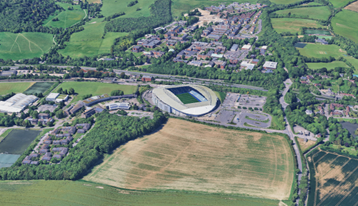
10 hectare field on the fringe of the city boundary
Neighbouring three different high demand off-takers, who have notionally confirmed interest in exploring a power purchase agreement.
Spotlight on: city centre heat network
Project stage: Project identification; Letters of support for feasibility study from large third-party heat load stakeholders
Project scale: 181 MWh annual heat demand; > 8MWh/m linear heat density; £450 million development cost
Level of council influence: Medium (Planning authority; key asset owner and potential land owner for city centre heat network; able to bid for feasibility study funding)
There is strong potential to deliver a major, low-carbon heat network in the city centre– a key infrastructure element of our net zero transition with identified opportunities for network expansion. It is expected that this area would be designated a heat network zone. Delivery of a city centre heat network will require strong leadership from the private sector in its commercialisation, construction, and long-term operation. By partnering with the council, developers can unlock access to public finance and strengthen credibility with local stakeholders.
The investment opportunity
The city centre, including extension into Kemptown (see areas 9, 10 and 11 below), is expected to be designated as a heat network zone under upcoming regulation, which would require particular developments to connect to heat networks where one is available. Modelling by the Department for Energy Security and Net Zero (DESNZ), corroborated by the council’s decarbonisation pathways study, identifies this area as having the greatest potential in the city for a heat network, to deliver a substantial reduction in carbon emissions.
The area:
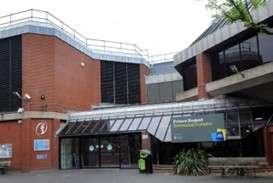
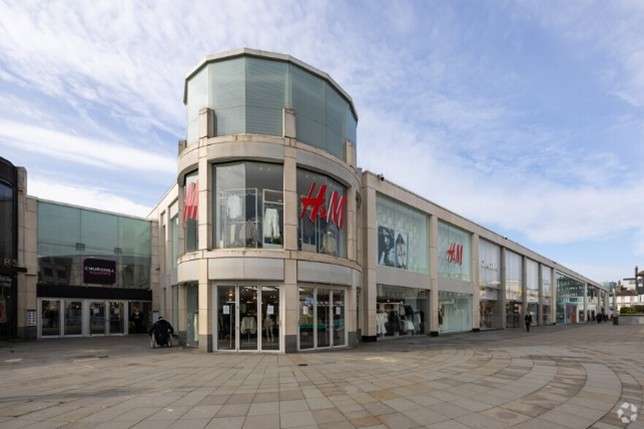
City centre area (~142k MWh annual heat demand) includes potential off-takers such as the council’s Prince Regent Swimming Complex, Jubilee Library, Brighton Centre, Royal Pavillion, Brighton University's Grand Parade Building and St. Peter’s House Library, Churchill Square Shopping Centre, hotels and several commercial properties.
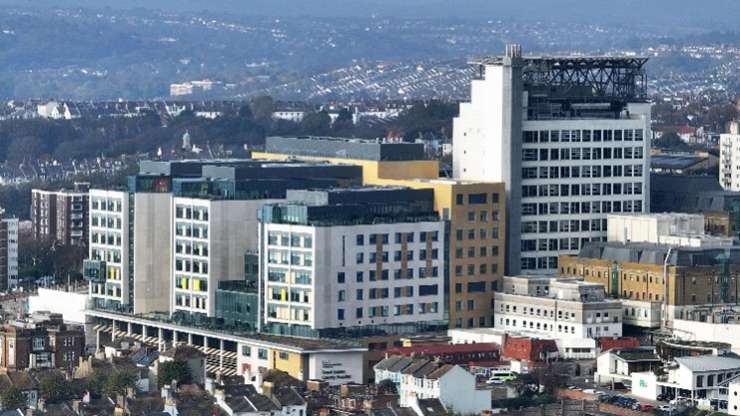
Kemptown area (~39k MWh annual heat demand) includes potential off-takers such as the Royal Sussex County Hospital, Brighton College and the council’s residential properties with existing communal heating systems.
Importantly, many domestic and commercial properties in the city centre are not suitable for individual heat pumps due to high density, low fabric efficiency, and stricter planning controls in the conservation areas. These limitations, alongside efficiencies owing to high linear heat density, makes district heating the preferred option for heat decarbonisation in the city centre.
The city council owns several heat demand potential anchor loads in the area, and other major heat demand stakeholders (University Hospitals Sussex NHS Trust, Museums Trust including the iconic Brighton Pavillion, Brighton University) have indicated support for development of a techno-economic feasibility study for this heat network and a connection would enable continued progress on decarbonisation across these key buildings.
The council is committed to ensuring that all off-takers, including its own estate, benefit from substantial energy cost reductions. This will be achieved through targeted retrofit measures that lower heat demand ahead of heat network connection, maximising efficiency and value for all participants. The council is also keen to explore options through the SEP to enable development of small- and medium-size heat networks with lower returns.
Heat network opportunity areas
Spotlight on: whole building retrofit – domestic
Project stage: Council-owned social housing - Established programme with existing contractual arrangements Private sector housing - Established programme of fuel poverty energy efficiency grants and small-scale community energy programmes for able-to-pay households (for example, the Carbon Neutral Communities programme)
Project scale: 105,000 domestic properties require 241,000 fabric improvement measures, with potential for 152.5 GWh/yr energy savings, at a cost of £1,019 million 73,000 domestic properties require heat pump (HP) installations 4,000 council homes identified as being potentially suitable for HP installation with minimum fabric improvements (~1,100 currently direct electric heated) 7,000 houses and flats require rooftop solar installations; albeit potential far exceeds requirement, with 515 MW domestic rooftop solar potential identified
Level of council influence: High for council housing; Moderate for private rental (MEES enforcement); Planning authority and promoter opportunity for privately owned and occupied (planning and promotion)
New low- and zero-interest loans and low-income grant scheme to support package of measures (rooftop solar, home batteries and heat pumps)- Warm Homes Plan
The council is keen to leverage its assets and Minimum Energy Efficiency Standard (MEES) enforcement to contribute toward a SEP-led, city-wide programme of domestic, whole building retrofit in Brighton & Hove that bundles fabric improvements, rooftop solar, battery storage, and renewable heat technologies – a strategic focus of Government’s Warm Homes Plan. Importantly, delivery models should support, rather than compete with existing community energy organisations.
Proven delivery and local expertise
Council housing
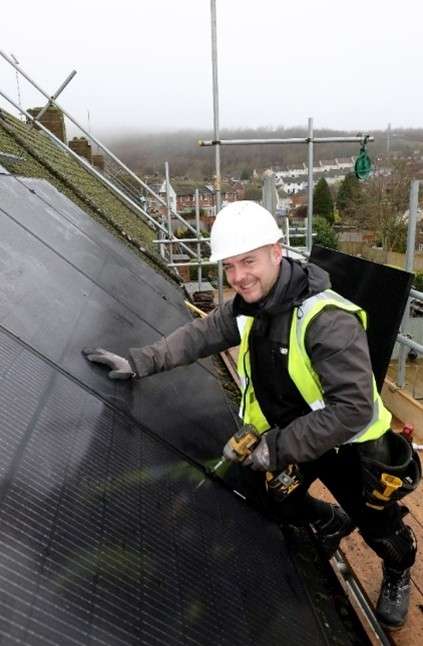
Since early 2024, more than 850 solar PV systems have been installed on council houses and bungalows, bringing the total generation on council housing to 3MWh/year. Trials with EDF have taken place for domestic battery storage, we have installed thermal batteries in many properties and 2025 saw the first installation of a communal ASHP. We have a strong record of securing external funding including recent success with both Warm Homes: Social Housing Fund and Local Grant.
Private sector housing
Solar Together Sussex group buying scheme (2020-24):
The council is keen to explore options for neighbourhood‑level, whole building retrofit schemes, utilising ‘priority areas’ identified in the Decarbonisation Pathways Study, which include neighbourhoods where retrofit measures (heat pump installation, fabric upgrades and rooftop solar) would be best targeted.
Improve the business case for decarbonising heating and hot water services
Increase renewable generation capacity on our assets for the benefit of residents
Increase bill savings for council housing tenants, and (iv) accelerate delivery.
Private sector housing
Brighton & Hove presents a strong market opportunity for heat pump installation. The Decarbonisation Pathways Study identified 33,300 private sectorhomes that are likely suitable for heat pump installation without major retrofit, with over one third currently dependent on expensive, direct electric heating.
Many of these homes are concentrated in central neighbourhoods with high fuel poverty. With the Warm Homes Plan providing low income households with fully funded upgrades—including solar panels, battery storage, and heat pumps—and providing the able-to-pay market with low-/no-interest loans, the commercial outlook for domestic deployment of all these measures in the city is highly favourable.
Spotlight on: whole building retrofit – non-domestic
Project stage: Council-owned - Concept design to delivery and operation, progressed on a case-by-case basis; Intention to establish a portfolio approach enabling cross-subsidy Private sector -Established projects with existing contractual arrangements on rooftop solar (managed by community energy); No established programme for city-wide whole building commercial retrofit
Project Scale: Among the 11,300 non-domestic properties in Brighton & Hove, more than 6,800 (61%) have an energy rating D or below (1100 on council-owned land). £76.9 million investment in non-domestic fabric improvements could yield 25 GWh per year energy savings (with 26% from properties on council land). Potential to generate 96 GWh per year of rooftop solar on council-owned land
Level of council influence: High on council-owned and managed properties; Moderate on council-leased properties; Low on private sector non-domestic buildings
The council is keen to leverage its assets to develop a SEP-led, city-wide programme of non-domestic, whole building retrofit in Brighton & Hove that bundles rooftop solar, fabric improvements, and heat decarbonisation. Importantly, delivery models should support, rather than compete with existing community energy organisations.
There are more than 6,800 non-domestic properties in Brighton & Hove with an energy rating D or below (see bar chart). There is a density of low performing buildings in the city centre and central Hove, due to the prevalence of old and listed buildings. Many of these properties are likely to require minor upgrades prior to heat network connection. More than 2,400 non-domestic properties will likely require more substantial fabric upgrades to enable heat pump installation, 20% of which are on council-owned land. The total net zero investment requirement for non-domestic fabric improvement is estimated at £76.9 million (see table).
Breakdown of EPC ratings across different non‑domestic building types
Overview of fabric improvement in all non-domestic properties with EPC D or below
EPC rating
Number of properties
Current heat demand (GWh)
Energy saving (GWh)
Cost (m£)
Properties with EPC D
3260
109.5
12.5
39.2
Properties with EPC E to G
3610
116.9
12.5
37.7
Total of EPC D and below
6870
226.4
25
76.9
The council’s corporate estate
Energy audits of the 73 highest emitting corporate buildings and schools owned and managed by the council identified £90 million of capital works, and a potential annual carbon reduction of 3,400 tonnes CO₂e. With project development support from the SEP, further feasibility work could be carried out to assess financial and carbon ROI, putting the council in a stronger position to bid for future grant funding.
The council does not currently have a retrofit programme for its leased buildings. However, given the age profile of the council’s 365 commercial properties, and with commercial MEES standards set to rise, there is a significant opportunity to leverage these assets to deliver wide-scale non-domestic building retrofit.
Spotlight on: Rooftop solar
Project stage: Council owned (housing and corporate estate) -Established programmes (could potentially be integrated into / enhanced by SEP) Private sector (domestic and non-domestic) -Established community energy programmes
Project scale: City-wide rooftop solar potential - 670 MWp (621 GWh/yr generation) with 15.4% on properties located on council-owned land City-wide rooftop solar requirement - 74 MWp, which could be achieved through installation of rooftop PV on 7,000 domestic (515 MWp) and 580 non-domestic buildings
Level of council influence: Council owned and managed - High Council owned and leased - Moderate Private sector - Low (planning authority and promotion of community energy)
There is opportunity to significantly scale rooftop solar in Brighton & Hove, both as part of and independent from programmes of domestic and non-domestic whole building retrofit. Importantly, delivery models should support, rather than compete with existing community energy organisations.
Proven delivery and local expertise
Brighton & Hove City Council has a strong track record in solar deployment:
Corporate Estate
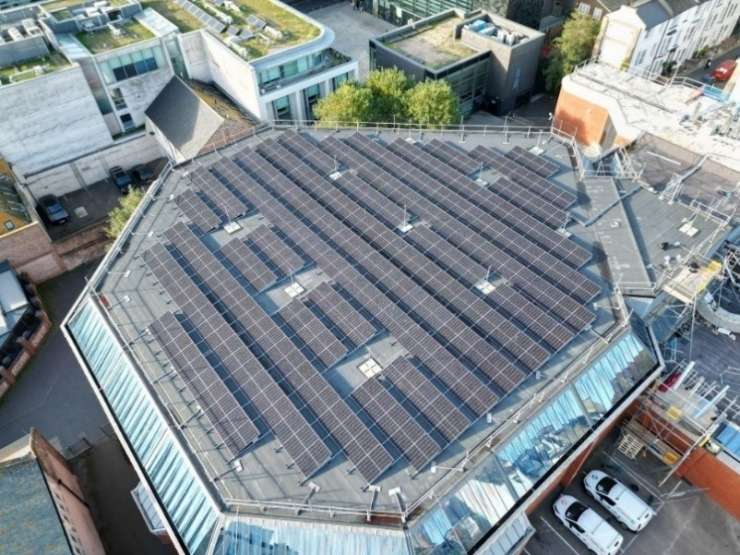
Solar PV installed across 17 council-owned sites, generating around 700 MWh annually and saving approximately £105,000 per year.
Schools Portfolio
35 school sites equipped with solar PV systems.
10 self-owned systems generate approximately 160,000 kWh annually, saving around £25,000 per year.
Community Energy Framework (facilitated by BEC and BHESCo) powers 30 schools, delivering approximately 1,650,000 kWh annually.
Community energy companies currently own 6.5 MWp of rooftop solar capacity across Brighton & Hove, demonstrating a thriving local ecosystem of expertise and collaboration.
The investment opportunity
Brighton & Hove is a leader in renewable energy, with over 15 MWp of rooftop solar PV capacity installed across the city. To achieve the city’s net zero target, this figure must increase fivefold. Independent analysis by Buro Happold confirms that the city’s rooftop potential far exceeds this requirement, creating a unique opportunity for large-scale solar deployment. As one of the UK’s sunniest cities, Brighton & Hove offers optimal conditions for solar generation, with sufficient capacity in the local grid to accommodate significant additional solar connections.
To scale to at least 74 MWp rooftop solar capacity, significant investment is needed in:
expanding delivery to privately owned homes and businesses (a breakdown of commercial rooftop solar capacity by typology and sector is provided below).
enhancing council-led programmes to accelerate deployment.
partnering with community energy organisations to ensure growth supports, rather than competes with, existing initiatives.
integrating rooftop solar into neighbourhood-level decarbonisation programmes to improve the business case for whole building retrofit.
bundling solar with battery storage and smart grid technologies to improve grid flexibility and indirectly support delivery of the wider SEP project portfolio.
Breakdown of solar PV capacity by typology and sector
Typology
Potential PV capacity (MW)
Share (%)
Retail
41
6.1
Storage
14
2.2
Community, arts and leisure
11
1.7
Industrial
15
2.3
Education
28
4.2
Office
21
3.2
Hospitality
14
2.1
Health
8
1.3
Emergency services
1
0.1
Flat
132
19.7
House
383
57.2
Total
669
100
Spotlight on: Electric Vehicle charging infrastructure (EVI)
Public EV charging network
Project stage: Established programme with existing contractual arrangements for on-street public charging; Additional opportunities at identification stage
Project Scale: Opportunities to develop ultra-rapid charging hubs on council land, multiple potential locations currently being scoped for hubs varying in size from 12 to 40+ Ultra Rapid chargers; Potential to co-locate charging hubs with strategic mobility hubs (with Park & Ride a core element) on the edge of the city
Level of council influence: High (Commissioner, land owner and Highways Authority)
Private EVI to electrify public service fleets
Project stage: Concept to early-stage development (varies by hub)
Project scale: 20 sites linked to public services (hospital sites, fire stations, etc.) identified for potential charging hubs 1,250 kVA requirement to support electrification of the council’s fleet
Level of council influence: High at waste depot; Moderate at bus depots (via policy levers such as Bus ULEZ); Low at other depots, albeit the council is a key strategic partner for planning approvals and forward planning with UKPN
Brighton & Hove is currently a leading city in on-street charge points, with the best network coverage outside of London. Independent research by Field Dynamics and Zap-Map shows that 83.1% of Brighton & Hove residents with no off-street parking, now live within a 5-minute walk of a public chargepoint.
The council recently signed 15-year contracts with Char.gy, Blink Charging and Believ, valued in excess of £300 million, to supply over 7,000 public standard, fast, rapid and ultra rapid chargepoints across the city. The project, the largest of its kind to date in the UK, will benefit from £2.865 million national grant funding and around £30 million of private sector funding, supporting the uptake of EVs by local households and businesses.
In collaboration with the city’s largest bus operator, the council successfully secured £8.1 million in Department for Transport funding, unlocking approximately £26.6 million in private investment to rebuild and electrify (4 MVA) the Conway Street bus depot, with 26 electric buses to be added to the Brighton & Hove Buses’ fleet in 2026.
The investment opportunity
We are open to exploring options to further expand our public charging network, particularly charging hubs, with the SEP potentially assuming responsibility for planning and investment decisions.
Devolution in Sussex and Brighton creates a unique opportunity for strategic planning of HGV and commercial fleet charging hubs, ensuring infrastructure is deployed where it will have the greatest impact across the strategic road network. The council aims to work closely with the Combined Authority to assess areas of council-owned land, with the potential for developing charging hubs through the SEP.
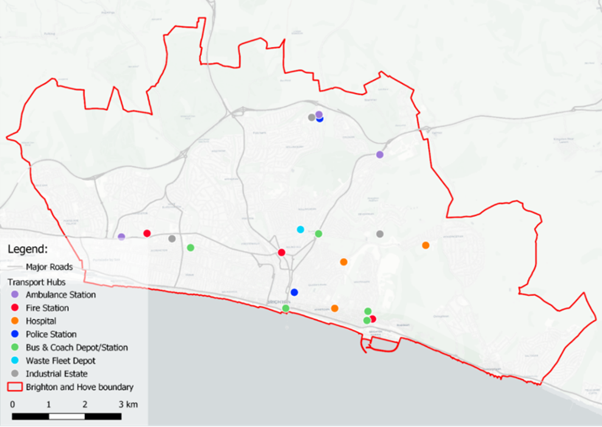
The council is also keen to explore options to expand its private EVI by 1,250 kVA to support electrification of its corporate fleet. The map on page 25 highlights similar opportunities across the city, mapping 20 fleet depots linked to public services (hospital sites, fire stations, bus depots, etc.) that will likely require major EVI upgrades in their transition to net zero. With a fleet of 222 buses serving 73 routes, Brighton & Hove Buses face a significant challenge in achieving net zero.
For projects requiring new substations, there are opportunities for the SEP to investigate improving local grid flexibility through battery storage, Vehicle to Grid (V2G) and other smart grid technologies, indirectly supporting the delivery of other SEP projects.